 Anacortes Siding
 Decking Built for West Anacortes, Not Just "Decking"
West Anacortes sits close enough to the water that homes here take a different kind of weather beating than decks built ten or twenty miles inland. Salt-laden air moves through the neighborhood off the surrounding marine waters, driving rain comes in sideways more often than most homeowners expect, and the long, damp Skagit County shoulder seasons keep moss and algae growing on any surface that doesn't get sun or airflow. A deck that would hold up fine in a drier part of the state can start showing problems here in just a few seasons — soft spots, corroded fasteners, slick green film on the boards, gaps that trap water instead of shedding it.
Composite decking, installed correctly, handles this environment better than wood without needing constant upkeep. But "composite decking" covers a wide range of products and installation approaches, and the difference between a deck that lasts and one that fails early almost always comes down to what's underneath the boards — the framing, the fasteners, and the drainage — not the boards themselves.
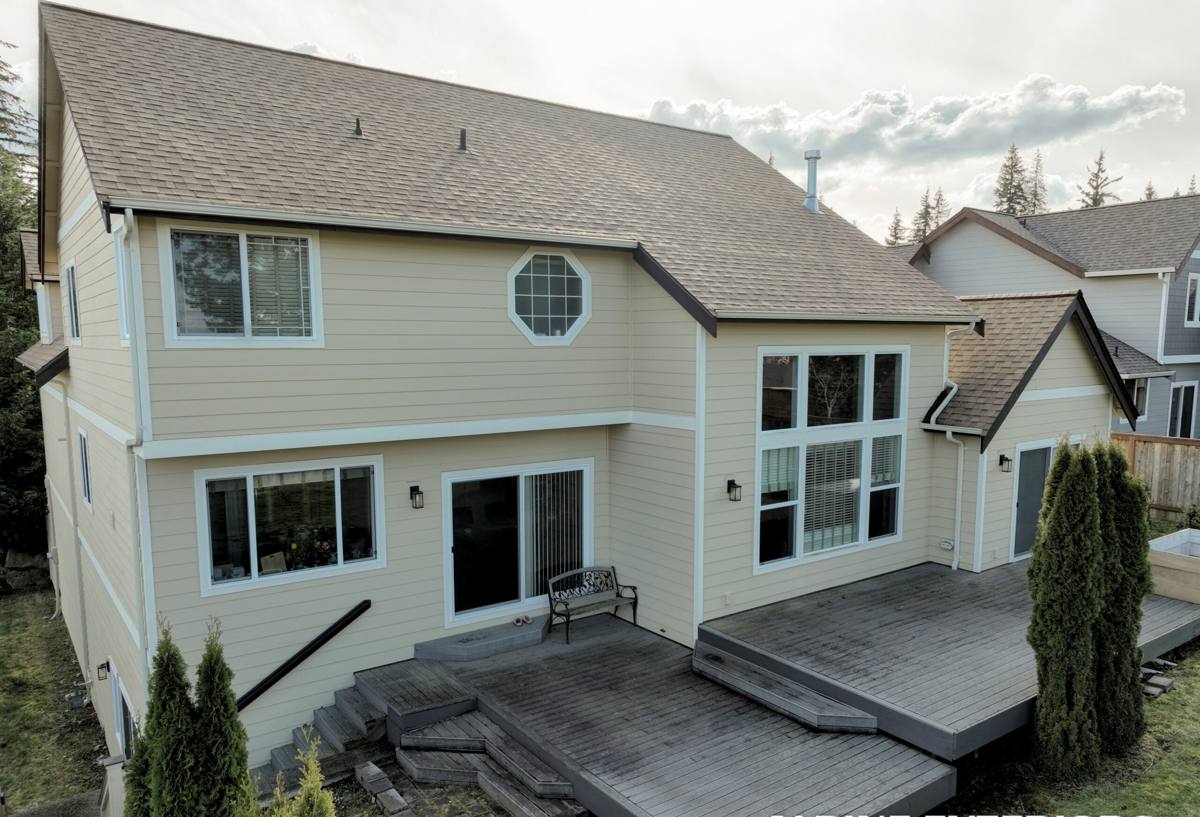
Composite vs. Wood Decking in a Marine Climate
Both materials can look good on day one. The difference shows up after two or three wet seasons, especially this close to the water.
| Factor | Composite Decking | Wood Decking |
|---|---|---|
| Moisture absorption | Low — capped boards shed water, don't swell | Absorbs water, swells and cups over time |
| Moss/algae resistance | Better on capped surfaces; still needs airflow underneath | Rougher grain holds moisture, grows moss faster |
| Refinishing needs | None — color is through the cap or board | Needs stripping and re-staining every 2-3 years in this climate |
| Fastener corrosion risk | Same risk as wood if hardware isn't upgraded | Same risk — salt air corrodes standard fasteners in both cases |
| Upfront cost | Higher material cost | Lower material cost |
| 10-year cost of ownership | Lower — little to no recoating labor | Higher once refinishing labor is factored in |
Wood isn't a bad material — it's a maintenance commitment. Composite is a higher upfront cost that trades ongoing labor for a more stable, lower-maintenance surface. Which one makes sense depends on how much upkeep you actually want to do every couple of years, not just which one "lasts longer" on paper.
What a Correct Composite Deck Installation Actually Involves
Most composite deck problems we get called out to fix started with the framing, not the decking material. The boards get blamed, but the failure point is almost always underneath.
Framing and Joist Spacing
Composite boards flex more than solid wood decking and generally need tighter joist spacing than a traditional wood deck — the manufacturer's span tables matter here, and skipping them to save a few joists is one of the most common shortcuts we see on decks that later feel spongy or develop waves between joists.
Fasteners and Hardware
This is the single biggest climate-specific detail for West Anacortes. Standard galvanized fasteners corrode faster in salt-influenced air than they would inland, and a corroding fastener under a composite board you can't easily inspect is a slow, invisible failure. Stainless steel or coated, corrosion-rated hardware for every structural connection — joist hangers, ledger bolts, hidden fastener clips — isn't optional here, it's the standard we build to.
Ledger Board and Flashing
Where the deck attaches to the house is the most water-exposed connection on the whole structure, and it's the spot driving rain finds first. Proper flashing that directs water out and away from the ledger, rather than relying on caulk alone, is what keeps this connection from rotting the rim joist behind it over time.
Ventilation Underneath the Deck
Composite boards don't rot, but the framing underneath them still can, and moss and mildew still grow on anything shaded and damp. Decks built low to the ground or against a foundation without enough airflow underneath tend to develop the same green film and musty smell whether the boards on top are wood or composite. Adequate clearance and airflow paths are part of a correct install, not an afterthought.
Salt Air, Rain, and Moss: Three Separate Problems
These three climate factors don't act the same way on a deck, so each one needs its own answer.
- Salt air attacks metal first — fasteners, brackets, railing hardware. The fix is corrosion-rated hardware throughout, not just at visible connections.
- Driving rain attacks joints and penetrations — the ledger connection, post bases, and any spot water can pool instead of run off. The fix is flashing, slope, and drainage gaps, not sealant alone.
- Moss and algae attack shaded, low-airflow surfaces — board grooves, the underside of the deck, and north-facing areas that don't get sun. The fix is airflow, board profile choice, and periodic cleaning; no decking material is fully immune to it.
A deck built to handle only one of these three will still fail from the other two. We treat all three as part of the same job, not separate upgrades.
Our Process for a West Anacortes Composite Deck
- On-site assessment. We look at sun exposure, wind exposure, existing framing condition (if this is a replacement), and how close the deck sits to grade or the water side of the property.
- Material selection. We walk through board profile, cap type, and color options based on how much direct weather that specific side of the house takes — a west-facing deck catching driving rain gets different recommendations than a sheltered side yard.
- Tear-out (if replacing). Old decking and any compromised framing comes out, and we check the ledger connection and structural posts before anything new goes up.
- Framing and flashing. Joist spacing to spec, corrosion-rated hardware throughout, proper ledger flashing before a single deck board is installed.
- Decking installation. Hidden fastener systems where the board profile supports them, correct end-gapping for thermal movement, consistent drainage gaps between boards.
- Railing and finish details. Railing hardware gets the same corrosion-rated treatment as the deck framing — no point protecting one and not the other.
- Walkthrough. We go over basic maintenance for the specific product installed before we consider the job done.
Cost Factors for Composite Decking in This Area
Every deck is different, but the same handful of factors move the price up or down more than anything else.
| Factor | Effect on Cost |
|---|---|
| Tear-out of existing deck | Adds labor and disposal cost; framing condition underneath can add more if it's compromised |
| Deck height and access | Elevated decks and difficult site access increase labor time |
| Board profile and cap type | Higher-end capped composite costs more per square foot than base-tier composite |
| Railing system | Composite or metal railing adds more than basic wood or cable options |
| Fastener and hardware upgrade | Corrosion-rated hardware costs more than standard galvanized, and it's not optional in this climate |
| Square footage and shape | Complex shapes, angles, and multiple levels add cutting and layout time |
We don't quote off square footage alone — the framing condition and hardware spec matter as much as the board count, and skipping them to hit a lower number is exactly how decks end up failing early in this climate.
What to Look For in a Properly Installed Composite Deck
- Joist spacing matches the manufacturer's span table for the specific board used
- Stainless or corrosion-rated fasteners and hardware throughout, not just at visible spots
- Flashing at the ledger board, not just caulk or sealant
- Consistent drainage gaps between boards, not tight-butted joints
- Adequate clearance and airflow underneath the deck
- End-gapping that accounts for thermal expansion, especially on long runs
- A written scope that specifies hardware grade, not just "composite decking installed"
Why a Crew That Already Works West Anacortes Matters
A deck built to a generic spec sheet, without accounting for how much salt air and driving rain a specific side of a specific property actually takes, is a deck that gets the hardware upgrade skipped or the flashing detail rushed. A crew that works this neighborhood regularly already knows which properties sit exposed to the wind and which are more sheltered, which sides of a house take the worst of the weather, and which shortcuts show up as callbacks two winters later. That's not something you get from a spec sheet — it's from having built and repaired decks in this specific stretch of Skagit County long enough to see what actually holds up.
It also means straight answers instead of upsells. If a lower-tier composite board is genuinely the right fit for a sheltered, low-exposure deck, we'll say so. If a west-facing deck taking the brunt of the weather needs the upgraded hardware and a better cap, we'll explain why rather than just quoting the higher number.
Get a Straight Estimate
If you're planning a new composite deck or replacing one that's showing its age, we're happy to take a look and give you an honest read on what your specific site needs — no pressure, no inflated scope. Use the form below to request a free estimate for your West Anacortes property.