 Anacortes Siding
 Fidalgo Island sits right where the Salish Sea meets the mainland, and that location shapes everything about how a house ages here. Homes on the island and throughout Anacortes deal with a combination of conditions that most inland Skagit County properties don't see in the same intensity: salt-laden air off Rosario Strait and the surrounding waterways, wind-driven rain that finds every gap in a wall assembly, and a wet season long enough that moss and algae get a real foothold on anything that stays damp. Siding, trim, and roofing systems that work fine forty miles inland can struggle here. This page covers what we see on Fidalgo Island homes specifically, and how our exterior work is built around those conditions.
What the Island Climate Actually Does to a House
Salt air is corrosive in ways that aren't always obvious right away. It accelerates the breakdown of certain paint films, degrades some fasteners and metal flashing faster than inland exposure would, and tends to find weaknesses in caulking and sealants sooner. Combine that with the marine layer moisture that rolls off the water most mornings, and you get a slow, steady dampness cycle that a lot of siding materials simply aren't engineered to handle over the long term.
Then there's the rain itself. Anacortes doesn't get the heaviest annual rainfall in the Pacific Northwest, but a large share of what falls here arrives sideways, pushed by wind off the water. Driving rain hits siding at an angle instead of running straight down, which means it works its way into laps, seams, and butt joints that would stay dry in a calmer climate. Any siding installation on Fidalgo Island has to assume wind-driven moisture is normal, not an edge case.
Finally, there's the moss and algae issue. Long stretches of overcast, damp weather from fall through spring give organic growth plenty of time to establish itself on north-facing walls, shaded siding, and anywhere airflow is limited by trees or tight lot lines. Once moss gets a grip on a wood-based product, it holds moisture against the surface and accelerates rot underneath it.
Why This Matters More on the Island Than Elsewhere in the County
Properties closer to the water, with more direct wind exposure or less tree buffering, tend to show weathering fastest. Homes tucked into more sheltered pockets of Anacortes fare a little better, but salt air still travels further than most homeowners expect. We treat every Fidalgo Island property as a full-exposure site until we've actually looked at it.
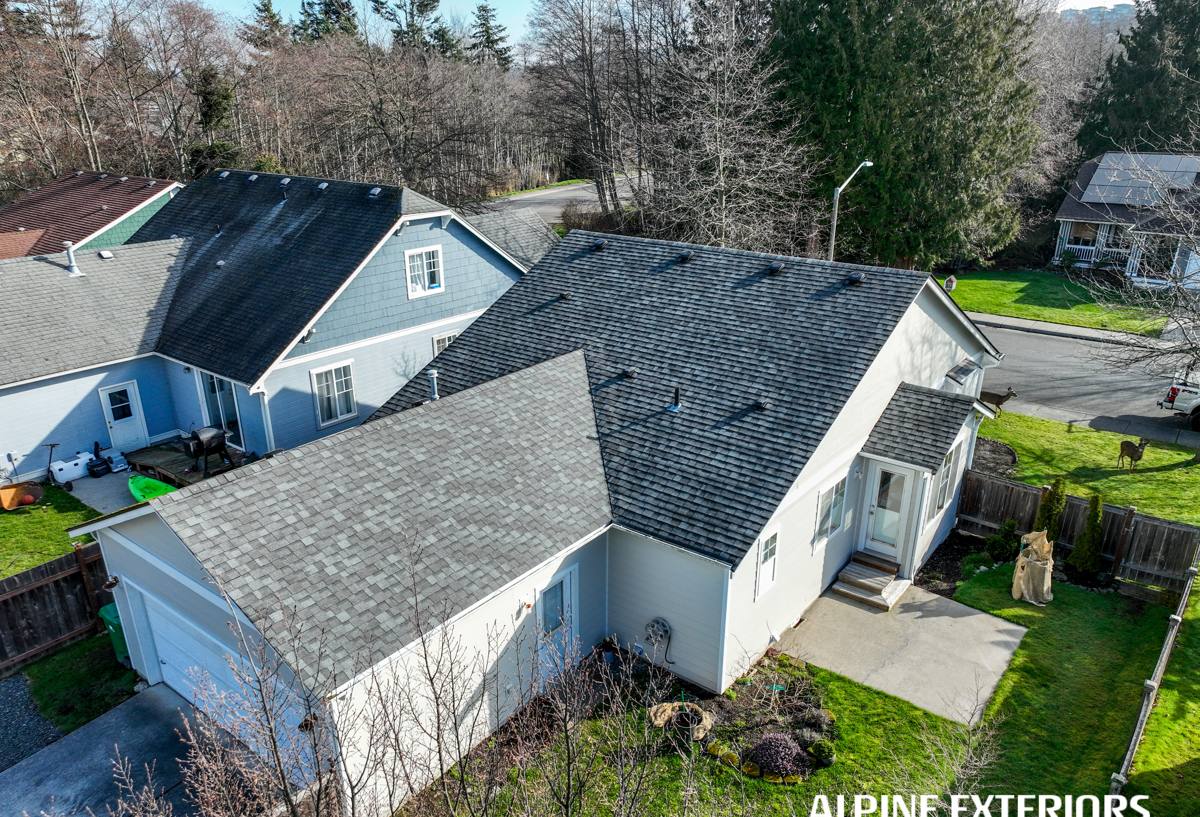
Why We Install Only James Hardie Fiber Cement
We made a standing decision as a company to install James Hardie fiber cement siding exclusively. We don't install vinyl, LP SmartSide, Cemplank, Allura, primed spruce, or cedar. That's not a marketing position — it's a practical one, built around what actually holds up on homes in this exact climate.
Fiber cement is non-combustible, which matters increasingly to insurers and homeowners in Washington. It's dimensionally stable, meaning it doesn't expand and contract with humidity swings the way wood-based products do, which keeps joints and caulk lines intact longer. And James Hardie's ColorPlus factory-applied finish is baked on and cured under controlled conditions, giving it a more consistent, UV- and moisture-resistant finish than field-applied paint typically achieves — which matters a lot when salt air is already working against the finish from day one.
We're not going to pretend every alternative product is without merit. Vinyl is inexpensive and low-maintenance in mild climates. Engineered wood products have real strengths in appearance and workability. Cedar has a genuine aesthetic appeal that some homeowners specifically want. But each of those comes with a trade-off that shows up faster on an exposed, wet, salt-air site like Fidalgo Island than it would somewhere drier and calmer — whether that's seam and moisture vulnerability, edge-swelling risk, or a maintenance schedule that's hard to keep up with on a rental or second home. James Hardie's HZ5 product line in particular is engineered for the kind of freeze-thaw and moisture cycling the Pacific Northwest delivers, and that's the deciding factor for us.
How We Approach a Siding Job on Fidalgo Island
Every install starts with an honest look at the house — not just the siding, but what's underneath it. On a lot of older Anacortes homes we open up, we find water intrusion issues that have nothing to do with the visible siding and everything to do with flashing, house wrap, or trim details that were never sealed correctly the first time. Replacing siding without fixing that underlying problem just buries it again.
- Inspect and repair or replace damaged sheathing before any new siding goes on
- Install or correct weather-resistive barrier (house wrap) with proper lapping for wind-driven rain
- Detail flashing at windows, doors, and roof-to-wall intersections — the most common failure points we find on the island
- Use corrosion-resistant fasteners appropriate for coastal exposure
- Install James Hardie panels or lap siding to manufacturer spec, including proper clearances at grade and hardscape
- Caulk and seal per Hardie's published installation guidelines, not generic best-guess practice
That last point matters more than most homeowners realize. James Hardie's warranty coverage depends on installation matching their documented specifications — gaps, clearances, fastener patterns, and caulking all have to be done a specific way. A poorly installed Hardie job won't perform the way a correctly installed one will, and it can also jeopardize warranty coverage. We install to spec because that's the only way the product actually delivers on what it's engineered to do.
Roofing, Windows, and Decks in the Same Climate
Siding doesn't work in isolation — it's one piece of the building envelope, and on Fidalgo Island the roof, windows, and any exterior decking face the same salt air and driving rain. We handle all four because they're connected problems. A roof with failing flashing will send water down behind siding no matter how well that siding was installed. Windows with degraded seals let moisture into wall cavities from the inside out. And decks exposed to the same wet, mossy conditions need materials and fastening details that account for standing moisture and organic growth, just like siding does.
When we're on a property for a siding estimate, we'll flag anything we see on the roof, window flashing, or decking that's contributing to moisture problems — even if it's outside the scope of what was asked for. It's a more useful conversation for the homeowner than treating each exterior surface as a separate, unrelated project.
Comparing Siding Materials for a Coastal Anacortes Property
| Material | Salt Air / Moisture Behavior | Maintenance | Our Position |
|---|---|---|---|
| James Hardie Fiber Cement | Non-combustible, dimensionally stable, factory-cured ColorPlus finish resists salt and UV degradation | Low — occasional wash, caulk checks | What we install |
| Vinyl | Doesn't rot, but can become brittle and fade faster under coastal UV and can warp under solar heat gain | Low, but limited repair options if damaged | Not installed |
| Cedar | Attractive but requires diligent sealing; moss and moisture take hold quickly if maintenance lapses | High — regular refinishing and moisture monitoring | Not installed |
| LP SmartSide / engineered wood | Engineered to resist moisture better than raw wood, but edge and seam sensitivity remains a factor in wind-driven rain | Moderate | Not installed |
| Primed Spruce | Vulnerable to moisture absorption at cut edges and joints without diligent upkeep | High | Not installed |
Dealing with Moss, Algae, and General Weathering
Even with the right siding material, exterior surfaces on Fidalgo Island benefit from some seasonal attention. Moss and algae growth is largely a function of shade, airflow, and moisture retention — not a defect in the siding itself. A periodic gentle wash (not high-pressure blasting, which can force water behind panels or damage caulk lines) keeps most growth from establishing. Trimming back vegetation that shades north-facing walls also helps a surface dry out between rain events instead of staying damp for days.
James Hardie's factory finish resists staining and growth better than raw wood or field-painted surfaces, but no siding material is completely immune to a persistently damp, shaded environment. Good site conditions — trimmed landscaping, functioning gutters, correct grading away from the foundation — do as much for long-term appearance as the siding material itself.
Why a Local Crew Matters Here
Anacortes and the rest of Fidalgo Island have their own microclimate quirks that don't always match generic Pacific Northwest assumptions — wind patterns off the water, salt exposure that varies block by block, and drainage conditions shaped by the island's terrain. A crew that works this area regularly knows which details tend to fail first on island properties and builds the install around that, rather than applying a one-size-fits-all approach pulled from a different region's playbook.
Being local also means we're a short drive away if a question comes up after the job is done, and we're familiar with permitting and inspection expectations in Anacortes and Skagit County.
What to Expect from an Estimate
A siding estimate on a Fidalgo Island home usually includes a walk-around inspection of the current siding, a look at trim, flashing, and any visible moisture staining, and a conversation about what's driving the replacement — whether that's visible damage, age, or just wanting a lower-maintenance exterior. We'll give a straightforward assessment of what we find, including anything that needs attention beyond the siding itself.
- Full exterior walkthrough, not just a glance from the driveway
- Honest note on any underlying moisture or flashing issues we spot
- Clear explanation of why we recommend James Hardie for the specific exposure your home has
- A written estimate with no pressure to decide on the spot
If you're weighing a siding, roofing, window, or deck project on Fidalgo Island, we're happy to take a look and give you a straight answer about what your home actually needs. Reach out for a free, no-pressure estimate using the form below.