 Anacortes Siding
 Homeowners in Anacortes ask us about vinyl siding more than almost any other product. It's affordable, it's everywhere, and a lot of it is sold with the promise that it's "maintenance-free." We understand the appeal. But after years of working on homes along the Skagit County shoreline, we made a decision as a company: we don't install vinyl siding. Not because it's a scam or a bad product in every setting, but because of how it actually performs in our specific climate, and because we'd rather stand behind one material we trust completely than sell something we know will disappoint a homeowner in year twelve. Here's the honest reasoning, not a sales pitch against a competitor's product.
What Vinyl Siding Actually Gets Right
It's worth being fair here. Vinyl siding is inexpensive, it's fast to install, and modern versions come in a decent range of colors and profiles. It doesn't rot the way untreated wood does, and it never needs painting. For a homeowner on a tight budget in a mild, dry climate, vinyl can be a reasonable choice for a good number of years. If we lived somewhere with low humidity, minimal wind-driven rain, and no marine air, our answer might be different.
We also want to be clear: when vinyl siding fails early, it's rarely because the material itself is fundamentally flawed. It's usually because of how and where it was installed, and how the local climate interacts with a product engineered for a national average, not for a specific coastline.
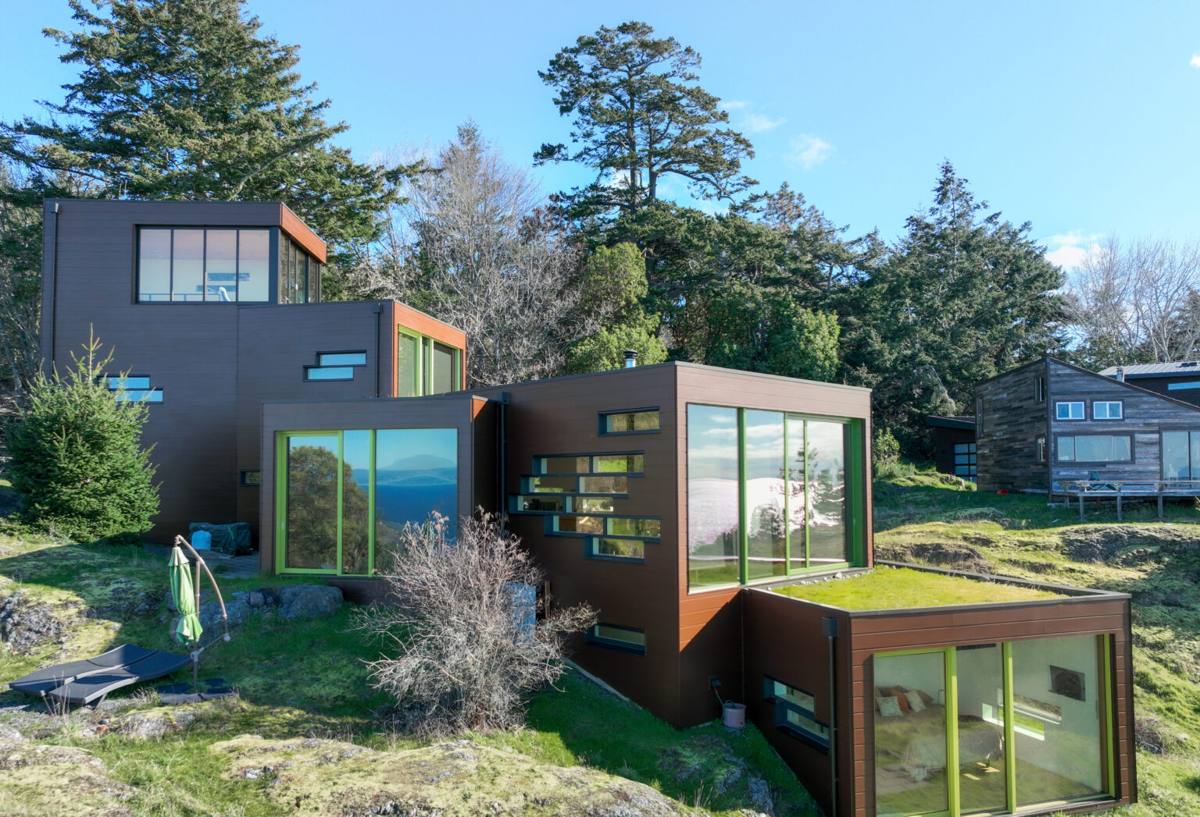
Anacortes Isn't the Climate Vinyl Was Designed For
Anacortes sits at the water's edge of the Salish Sea, surrounded by Rosario Strait, Guemes Channel, and the open exposure that comes with a peninsula town. That means three things hit the exterior of every home here harder than they do further inland: salt-laden air, sustained wind-driven rain, and a moss and algae season that can run nine months out of twelve.
Vinyl siding is a rigid PVC product that's engineered to expand and contract significantly with temperature swings. In a lot of the country, that's a manageable, predictable movement. In Skagit County, where damp, cool mornings give way to sun and back again within the same day, that expansion and contraction cycle happens constantly, and it happens against a backdrop of near-constant moisture. Salt air accelerates the breakdown of the plasticizers that keep vinyl flexible, which is part of why coastal vinyl siding tends to become brittle years ahead of the same product installed 50 miles inland.
Moss and Algae Aren't Cosmetic Here
Our moss season isn't a minor annoyance — it's a defining feature of the climate. Vinyl's textured, low-gloss finish and the horizontal laps where panels overlap give algae and moss plenty of places to take hold, especially on north-facing walls and anywhere shaded by fir and cedar canopy, which describes a large share of Anacortes lots. Once established, moss holds moisture directly against the panel surface far longer than a smooth, factory-sealed surface would, and pressure-washing vinyl aggressively enough to remove it also stresses the fastening system.
The Installation Sensitivity Problem
Vinyl siding isn't fastened tight to the wall the way most other claddings are — it's designed to hang loosely on its nailing hem so it can expand and contract without buckling. That sounds simple, but it means correct installation depends entirely on the installer nailing every single panel to the exact right tension, leaving the exact right gap at every butt joint and corner, and never over-driving a fastener. Get that wrong even occasionally across a job, and you get a wall that buckles in the heat, rattles in wind, or pulls loose at the corners during a real Anacortes windstorm coming off the strait.
This is the part that concerns us most as a crew that stands behind our work: a vinyl installation looks fine on day one regardless of whether it was done correctly. The problems show up two, five, or ten winters later, after the crew that installed it is long gone. We didn't want to build a business around a product where correct installation is invisible at handoff and the consequences of a rushed job only show up on someone else's timeline.
What's Happening Behind the Panel Matters More Than the Panel
Vinyl siding is not a waterproof skin — it's designed to shed the bulk of water while allowing some to get behind it, relying on the weather-resistant barrier (WRB) and drainage plane underneath to do the real work of keeping the wall assembly dry. That's a sound system on paper. In practice, on a home taking direct, wind-driven rain off the water, that WRB and the flashing details around every window, door, and penetration have to be executed with zero shortcuts, because vinyl gives you very little warning when something behind it is wrong.
We've opened up enough Anacortes walls to see what a few years of trapped moisture behind failed flashing looks like, and by the time it's visible from outside, the sheathing underneath has often already been compromised. A rigid, factory-finished cladding with a more forgiving moisture profile gives both the installer and the homeowner more margin for error in a climate that doesn't offer much room for mistakes.
Fading, Chalking, and the Color Question
Vinyl's color runs through the material rather than sitting on top of it, which sounds like an advantage — no paint to peel. But UV exposure combined with salt air causes vinyl to fade and chalk over time, and darker colors fade faster and absorb more heat, which increases the expansion problem described above. Once a vinyl panel is faded or damaged, matching it years later is close to impossible, because manufacturers change color formulations and discontinue profiles regularly. A single storm-damaged panel on a fifteen-year-old vinyl wall often means the whole elevation gets a visibly different-colored patch, or a full re-side.
The Warranty Reads Better Than It Pays Out
Most vinyl siding warranties are prorated, meaning the coverage value shrinks every year you own the home — by year fifteen or twenty, a claim might cover a small fraction of replacement cost, not the full amount. Many are also non-transferable, or transfer only once with a shortened term, which matters in a market like Anacortes where homes change hands regularly. And nearly every vinyl warranty explicitly excludes installation-related failures, which, as covered above, are the most common real-world cause of early problems. Reading the fine print on a vinyl warranty is often more instructive than reading the marketing brochure.
Cost Over Time: A Fair Comparison
We won't pretend vinyl doesn't win on day-one price. It does. The honest comparison has to include what happens over the ownership timeline, not just the installed cost.
| Factor | Vinyl Siding | James Hardie Fiber Cement |
|---|---|---|
| Upfront installed cost | Lowest of common claddings | Moderate to higher |
| Expected service life in coastal PNW conditions | Variable; often shortened by UV, salt air, and installation sensitivity | Long service life when installed to spec |
| Moss and algae resistance | Textured surface holds growth | Factory ColorPlus finish sheds growth more readily |
| Impact and wind performance | Can crack in cold, dislodge in high wind if under-fastened | Rigid, dense material holds up to wind-driven debris |
| Fire rating | Combustible plastic | Non-combustible |
| Repainting or color change | Not recommended; can void warranty | Can be repainted; factory finish also available in a wide range |
| Warranty structure | Typically prorated, installation exclusions | Strong non-prorated coverage, transferable |
Why We Standardized on James Hardie Instead
We install only James Hardie fiber cement siding, and we did that deliberately rather than defaulting to it. Hardie's HZ5 product line is engineered specifically for climates like ours — freeze-thaw cycling, sustained moisture, and coastal exposure. It's non-combustible, which matters increasingly in Washington. The ColorPlus factory finish is baked on under controlled conditions rather than field-applied, which gives it far better fade and moss resistance than a field-painted or extruded-color product, and it comes with a real, non-prorated warranty backed by a manufacturer with decades in the fiber cement business.
Just as important: fiber cement is a far less installation-sensitive product than vinyl. It's fastened tight to the wall rather than hung loosely, so a correctly installed Hardie wall looks the same on day one and year twenty. That predictability is exactly what we want to be able to promise a homeowner in Anacortes, where the weather doesn't give a poorly built wall assembly any slack.
Questions Worth Asking Before You Choose a Siding Material
- How does this product perform specifically in marine, high-moisture climates — not just the national average?
- Is the warranty prorated, and does it exclude installation-related failure?
- How sensitive is correct installation to individual installer technique, and how would a mistake show up later?
- What does this material look like after fifteen years of moss exposure with no maintenance?
- If a section is damaged, can it realistically be color-matched and replaced years down the road?
- Is the product combustible, and does that matter for your insurance or local fire risk?
If you're weighing siding options for a home in Anacortes or anywhere in Skagit County, we're happy to walk your property, point out what your current siding is actually doing, and explain — honestly, without pressure — why we'd install Hardie instead of the alternatives. A free estimate doesn't commit you to anything except a clearer picture of your options.