 Anacortes Siding
 Guemes Island Is a Different Kind of Exposure
Guemes Island sits just across the Guemes Channel from Anacortes, reachable only by the county ferry, and that separation shapes everything about how a home ages out there. Homes on the island catch the full sweep of Skagit County's marine weather with less buffering than you'd get further inland — more direct salt air off the Salish Sea, more wind-driven rain on exposed walls, and long stretches of shade and dampness under the fir and madrona cover that much of the island is known for. An exterior that would coast along for years in a sheltered subdivision can start showing real wear on Guemes in half the time if it isn't built for the exposure.
We've worked on homes across Anacortes and the surrounding islands long enough to know that "island house" isn't a style — it's a maintenance category. The siding, roofing, trim, and decking on a Guemes Island property are working harder than the same materials would on a typical mainland lot, and that changes what we recommend and how we install it.
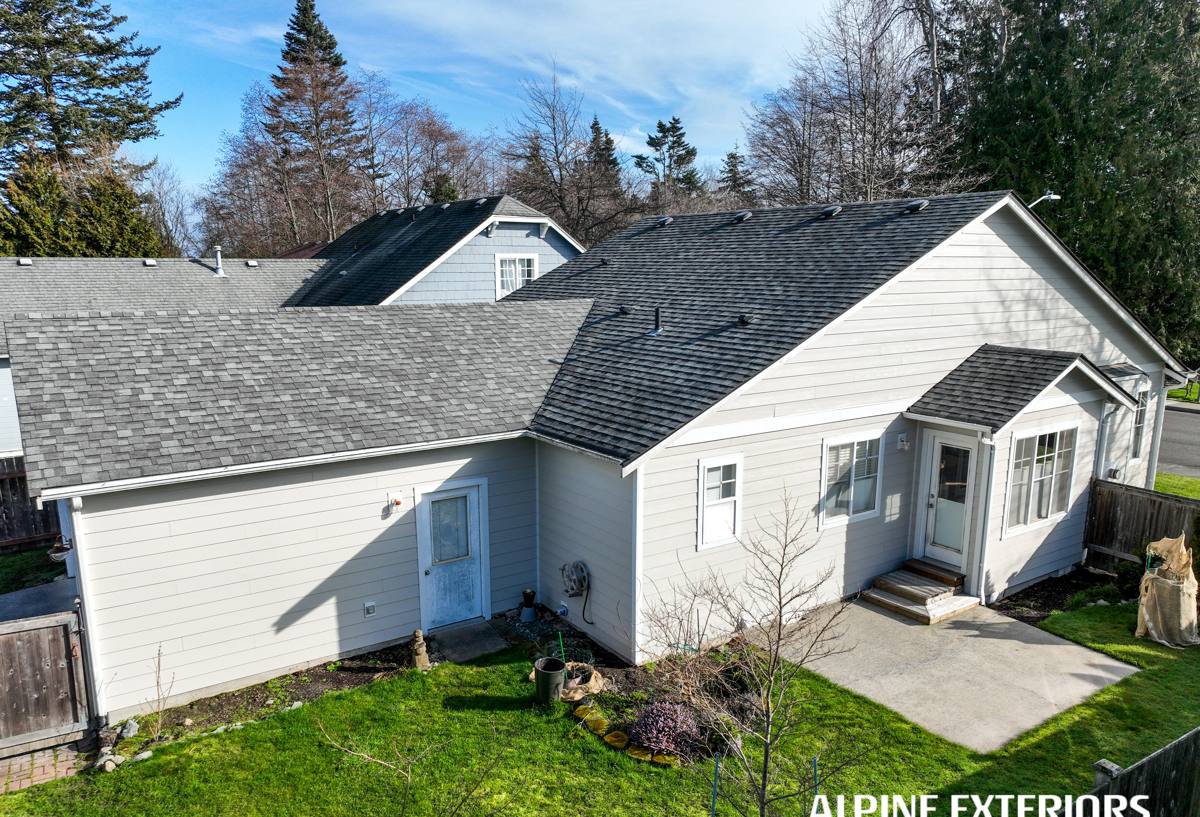
What the Climate Actually Does to a House Out There
Salt air and corrosion
Airborne salt from the Salish Sea settles on everything — siding, flashing, fasteners, hinges, light fixtures. It doesn't take a waterfront lot to feel it; salt-laden air moves across the whole island. Over years, uncoated or lightly coated metal fasteners and trim pieces can corrode, and that corrosion often shows up as rust streaking down the face of siding long before the siding itself has failed. Once we see that pattern on a home, it's usually a sign the original installation used the wrong fastener spec for the environment.
Wind-driven rain
Storms coming off the water tend to drive rain sideways into west- and south-facing walls rather than letting it fall straight down and shed off. That matters because a lot of siding failures aren't about the siding material getting wet — they're about water finding its way behind the siding through poorly lapped flashing, gaps at trim, or old caulk joints, and then having nowhere to dry out. On an exposed island lot, the margin for sloppy flashing detail is much smaller than it is in a sheltered yard.
Shade, moss, and slow drying
A lot of Guemes Island lots are wooded, which is part of the appeal, but tree cover also means shaded north walls that stay damp for days after a storm. That's ideal growing conditions for moss and algae, and it's rough on any siding material that isn't factory-finished to resist mold and mildew growth. Homeowners on shaded lots often end up pressure-washing or scrubbing siding every year or two just to keep the moss season from staining the finish permanently.
Why Material Choice Matters More Out Here
On a sheltered inland lot, a homeowner can get away with a wider range of siding products and still get decent life out of them. On an island lot with salt exposure, driving rain, and shade, the gap between a good material and a mediocre one shows up faster and more visibly. Here's how the common options tend to hold up under that specific combination of stresses.
| Material | Salt air | Wind-driven rain | Moss/algae resistance |
|---|---|---|---|
| Vinyl siding | Doesn't corrode, but can chalk and fade faster in salt air and UV | Seams and laps are more prone to water intrusion over time | No factory mildew resistance; stains embed in the surface |
| Cedar siding | Handles salt fine but needs regular refinishing to stay protected | Absorbs moisture at end grain and laps if not maintained | Prone to moss and mildew without frequent treatment |
| LP SmartSide (engineered wood) | Coating helps, but any breach exposes wood substrate | Edge swelling risk if water gets past the finish | Better than raw wood, but still an engineered-wood substrate |
| James Hardie fiber cement | Non-combustible, dimensionally stable, holds up to salt exposure | Engineered HZ5 formulation for the Pacific Northwest's wet climate | ColorPlus factory finish resists fading, mold, and mildew |
This is the whole reason we standardized on James Hardie and stopped installing vinyl, LP SmartSide, and bare cedar: on a lot like the ones common on Guemes Island, those products ask a homeowner to do a lot of upkeep just to keep pace with the climate, and even then the failures we see tend to start at the same weak points — seams, end grain, and fastener corrosion.
James Hardie Fiber Cement: Engineered for This Exposure
James Hardie makes region-specific product lines, and the HZ5 formulation is built for the wetter, harsher climates like ours here in western Washington — it's engineered to resist moisture damage in a way their general-climate products aren't. Fiber cement itself is made from cement, sand, and cellulose fiber, so it doesn't rot, it doesn't attract insects, and it's non-combustible, which matters on a wooded island lot where wildfire risk is a real consideration even in a rainy region.
The factory-applied ColorPlus finish is baked on under controlled conditions, not brushed or sprayed on-site, so it resists fading, chipping, and the mildew staining that hits site-finished materials first. That finish is also backed by a real limited warranty, and Hardie's product warranty is transferable if you sell the home — worth something on an island where houses tend to change hands to people specifically looking for a well-built, low-maintenance property.
Getting Materials to the Island
Working on Guemes Island means working around the ferry schedule, and that's a logistics problem as much as a construction one. We plan material deliveries and crew mobilization to minimize the number of ferry trips a project needs — staging siding, trim, fasteners, and flashing materials together so we're not making repeat runs for a forgotten box of nails. A contractor who hasn't worked the island before will often underestimate this, and that shows up as delays or crews standing around waiting on a supply run that missed the last sailing.
Full Exterior Services for Guemes Island Homes
Siding is rarely an isolated project — on an exposed island home, siding, roofing, windows, and decking all take the same weather and often need attention around the same time. We handle all four so a project can be planned as one coordinated exterior job instead of separate contractors working around each other on separate ferry trips.
- Siding replacement and repair — full re-siding or spot repair with James Hardie fiber cement
- Roofing — replacement and repair suited to the moss and moisture exposure common under tree cover
- Windows — replacement units and the flashing detail work that keeps wind-driven rain out around them
- Decks — built and finished to hold up to salt air and constant damp shade
What Correct Installation Actually Involves
Fiber cement siding performs the way it's supposed to only when it's installed to Hardie's published specifications, and on a high-exposure lot like Guemes Island, the installation detail matters even more than the material choice. A few things we treat as non-negotiable on every island project:
- Stainless steel or hot-dip galvanized fasteners rated for coastal/marine exposure, not standard interior-grade fasteners
- A properly lapped weather-resistive barrier and rainscreen gap behind the siding so any incidental moisture can drain and dry
- Correct flashing at every window, door, and horizontal trim intersection — the points where wind-driven rain finds its way in
- Manufacturer-specified nailing patterns and clearances, especially at butt joints and corners
- Ground clearance and proper caulking at the bottom course, since splash-back off decks and walkways adds another moisture source
Skip any one of these on a sheltered inland home and you might not notice for a decade. Skip them on an exposed Guemes Island wall and the consequences show up in a few wet winters.
Cost Factors for an Island Project
Every exterior project is priced around the specifics of the home, but a few factors come up consistently on Guemes Island jobs that homeowners on the mainland don't usually have to think about.
| Factor | Why it affects cost |
|---|---|
| Ferry access and scheduling | Material and crew mobilization has to be planned around sailings, which affects timeline and logistics |
| Wind and rain exposure of the lot | Waterfront or unshaded, exposed walls warrant a full rainscreen assembly and marine-grade fasteners |
| Tear-off vs. new construction | Removing old vinyl, cedar, or damaged siding adds labor and disposal beyond a fresh install |
| Home size and complexity | Cut corners, dormers, and trim detail all add labor time regardless of material |
| Combined-scope projects | Bundling siding with roofing, windows, or decks in one mobilization can reduce per-trip overhead |
Why a Local Crew Matters for Island Work
An out-of-area contractor can quote a Guemes Island job, but living with the ferry schedule, understanding Skagit County permitting, and knowing how the island's microclimates vary from lot to lot is something you only get from doing this work locally and regularly. When you're vetting a contractor for an island property, it's worth asking directly how they plan logistics, how they handle weather delays given the ferry's own schedule, and whether they've actually completed projects on the island before rather than just in Anacortes proper.
Ask for their contractor license number, confirm they carry liability insurance, and ask specifically about their fastener and flashing details for coastal exposure — a contractor who can answer that without hesitation has done this kind of work before.
If you're planning a siding, roofing, window, or deck project on Guemes Island, we're happy to walk the property, look at what your exterior is actually dealing with, and put together a free, no-pressure estimate — with a materials and logistics plan that accounts for the ferry from the start.