 Anacortes Siding
 Mount Vernon's Climate and What It Does to Siding
Mount Vernon sits in the Skagit River valley, a few miles inland from the saltwater of the Salish Sea but still squarely inside the same marine-influenced weather system that soaks the rest of Skagit County. The valley's flat, low-lying terrain and proximity to the river mean humidity lingers longer here than it does on higher ground, and fog is a regular visitor in the fall and winter months. Add in driving rain that comes sideways off Pacific storm systems, and siding on a Mount Vernon home is under near-constant moisture pressure for much of the year.
That moisture doesn't just sit on the surface. It works its way into seams, laps, and any gap where a siding product wasn't sealed or installed correctly. Combine that with the shaded, damp microclimates created by mature trees and tight lot lines common in older Mount Vernon neighborhoods, and you get ideal conditions for a long moss and algae season — often eight months or more of the year where organic growth has enough moisture and low light to take hold on north-facing walls and anything shaded by roof overhangs or landscaping.
None of this is unusual for the region. It's simply the baseline a siding product has to perform against here, year after year, without babying.
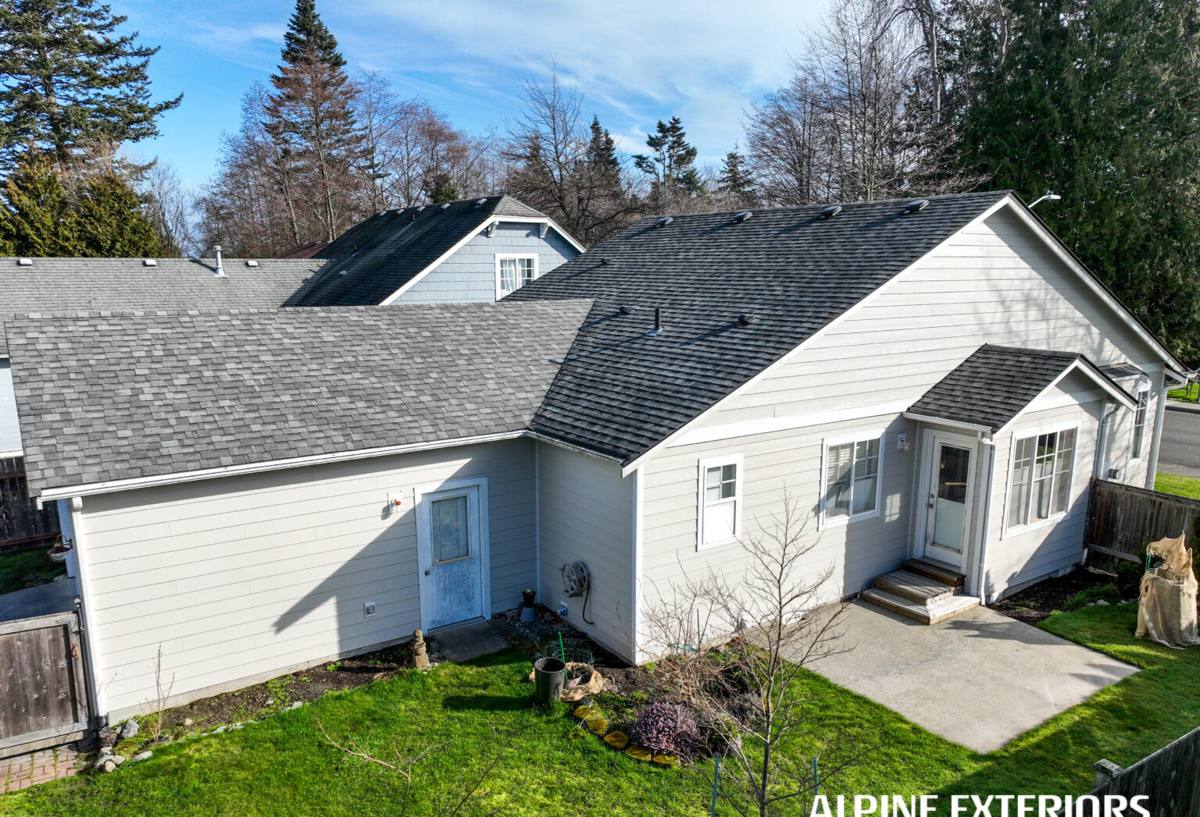
Why James Hardie Fiber Cement Is Our Standard
We install James Hardie fiber cement siding exclusively. We don't install vinyl, LP SmartSide, Cemplank, Allura, primed spruce, or cedar. That's not a marketing position — it's a decision we made after years of servicing exterior products in exactly this kind of climate and seeing which ones held up and which ones created recurring problems for homeowners.
Fiber cement is non-combustible, dimensionally stable, and doesn't absorb and release moisture the way wood-based products do. James Hardie's ColorPlus factory-applied finish is baked on under controlled conditions rather than field-painted, which means better adhesion and more consistent long-term color performance than a coat of paint applied on-site in variable weather. Hardie also engineers its products by climate zone — the HZ5 line used in the Pacific Northwest is formulated for regions with sustained moisture and freeze-thaw cycling, which is exactly what Skagit County delivers.
We're not going to tell you every other product on the market is junk. Vinyl is inexpensive and low-maintenance in mild climates. Engineered wood siding like LP SmartSide has real strengths in dry regions. Cedar has genuine visual appeal. But installed on a Mount Vernon home that sits under near-constant humidity and heavy rain for eight or nine months a year, those products carry trade-offs — moisture sensitivity, seam vulnerability, finish degradation, or maintenance burden — that we're not willing to put our name behind. Fiber cement, installed correctly, is the product we trust to perform in this specific environment.
What We Install: Siding, Roofing, Windows, and Decks
Siding is our core focus, but a home's exterior only works as a system when everything is doing its job together. We also handle roofing, window replacement, and decks — the components that, alongside siding, form the first line of defense against Skagit Valley weather.
- Siding: James Hardie lap, panel, and shingle siding, plus trim and soffit systems designed to work together.
- Roofing: Roof replacement and repair, since a failing roof is one of the most common hidden causes of siding damage below it.
- Windows: Replacement windows installed with proper flashing integration into the siding system — a detail that matters more than the window brand itself.
- Decks: Deck construction and replacement built to handle the same wet-dry cycling that affects the rest of the exterior.
Because we handle all of these trades, we can look at a Mount Vernon home's exterior as one connected system rather than a series of disconnected repairs. A lot of siding failures we see start as roof or window flashing problems, not siding problems.
Common Problem Signs We See on Mount Vernon Homes
When we walk a property in Mount Vernon, certain patterns show up again and again, largely driven by the valley's climate and the age of housing stock in the area.
Moss and Algae Streaking
Green or black streaking on north- and east-facing walls, especially under eaves or near mature landscaping, is one of the most common calls we get. It's a cosmetic issue at first, but left unaddressed it traps moisture against the siding surface and accelerates whatever underlying material is beneath it.
Swelling, Delamination, or Soft Spots
On wood-based and engineered wood siding, prolonged moisture exposure often shows up as swelling at panel edges, bubbling paint, or soft, spongy spots when pressed. These are signs the material is absorbing water it can't shed fast enough.
Caulk and Seam Failure
Caulking is not a permanent moisture barrier — it's a maintenance item with a limited lifespan. Once it cracks or pulls away at seams and trim joints, water gets a direct path behind the siding.
Fading and Chalking
Field-painted siding tends to lose color evenness faster than factory-finished products, particularly on the south and west sides of a home that take direct sun between rain systems.
Comparing Siding Materials for the Skagit Valley
| Material | Moisture Performance in This Climate | Finish Durability | Typical Maintenance |
|---|---|---|---|
| James Hardie Fiber Cement | Excellent — non-combustible, dimensionally stable, resists moisture-driven warping | Factory ColorPlus finish, long-term color retention | Periodic washing; repaint not required for many years |
| Vinyl | Good in mild conditions; can warp or crack in temperature swings and impact | Color molded in, but can fade unevenly over time | Low, but seams and panels can loosen over years |
| LP SmartSide / Engineered Wood | Moderate — wood-based core is more moisture-sensitive if seams or cuts aren't fully sealed | Factory or field finish depending on product | Regular inspection of seams and cut edges |
| Cedar | Requires consistent upkeep to resist rot and moisture absorption | Field-applied stain or paint, needs recoating | Higher — periodic staining/sealing and rot monitoring |
This isn't a claim that every alternative product fails in this climate — it's a summary of the maintenance and moisture-management burden each one places on a homeowner here, which is the basis for why we standardized on fiber cement.
What Correct Installation Looks Like
James Hardie siding is only as good as its installation, and this is where a lot of the product's reputation gets built or broken. Correct installation in a wet climate like the Skagit Valley involves several details that are easy to skip and hard to spot once the siding is up:
- Proper water-resistive barrier and flashing behind every seam, window, and door opening
- Correct fastener spacing and placement per Hardie's published installation specifications
- Adequate clearance between the bottom of the siding and grade, decks, roof lines, and patios
- Caulking only where Hardie's instructions call for it — not as a substitute for proper flashing
- Painted or factory-finished cut edges, since exposed raw edges are a moisture entry point
Hardie's warranty coverage assumes the product was installed to these specifications. Shortcuts at installation are one of the most common reasons a homeowner ends up with a problem they assumed was a product failure.
Choosing a Local Contractor
For a Mount Vernon homeowner comparing bids, a few questions separate a contractor who understands this climate from one who's just installing whatever's cheapest to source that month.
- Are they a certified or factory-trained James Hardie installer, and can they explain the HZ5 zone rating for this region?
- Do they carry current Washington State contractor licensing and liability insurance?
- Will they walk you through the flashing and water-management details before the first board goes up, not just the finished look?
- Do they offer a written scope of work and a clear explanation of warranty coverage — both material and labor?
- Can they speak to how the local climate — humidity, moss, driving rain — affects the specific installation choices on your home?
Maintenance: What Hardie Actually Requires
One of the reasons we stand behind fiber cement is that its maintenance needs are honest and manageable, not zero. Homeowners in Mount Vernon should still plan on:
Periodic washing to keep moss and algae from establishing on shaded walls — a soft wash, not high-pressure blasting that can force water behind seams. Occasional inspection of caulking at trim and window joints, since caulk is a wear item regardless of the siding material behind it. And keeping gutters, downspouts, and grading working properly, since most siding problems we investigate trace back to water being directed at the wall rather than away from it.
Compared to the recoating cycles wood-based products need, or the seam and impact vulnerabilities of vinyl, this is a modest maintenance load — but it's real, and we'd rather tell a homeowner that upfront than oversell a "maintenance-free" product that doesn't exist.
Let's Take a Look at Your Home
If you're noticing moss buildup, fading, soft spots, or seam damage on your Mount Vernon home's exterior — or you're simply planning ahead for a replacement — we're happy to walk the property with you and give you a straight assessment. There's no pressure and no obligation. Use the form below to request a free estimate.