 Anacortes Siding
 Flounder Bay's Exterior Challenge
Flounder Bay sits close enough to the water that the air itself works against your siding. Salt-laden marine air moves through Anacortes and Skagit County most of the year, and it doesn't just sit on the surface of a house — it works into seams, fasteners, and any spot where the exterior isn't fully sealed. Add in wind-driven rain that comes sideways off the water during winter storms, and you have an exterior envelope that's under more stress than a typical inland home just a few miles east.
Then there's the moss. Western Washington's long, wet, mild-temperature season is close to ideal for moss and algae growth, and homes near the water with more shade and moisture tend to get it worse. Moss holds water against a wall assembly for extended periods, which is exactly the condition that causes problems for siding materials that aren't built to handle sustained dampness.
None of this means a house near Flounder Bay is doomed to constant repairs. It means the siding material and the installation details matter more here than they would in a drier climate, and it's why we've been deliberate about what we put on homes in this part of Anacortes.
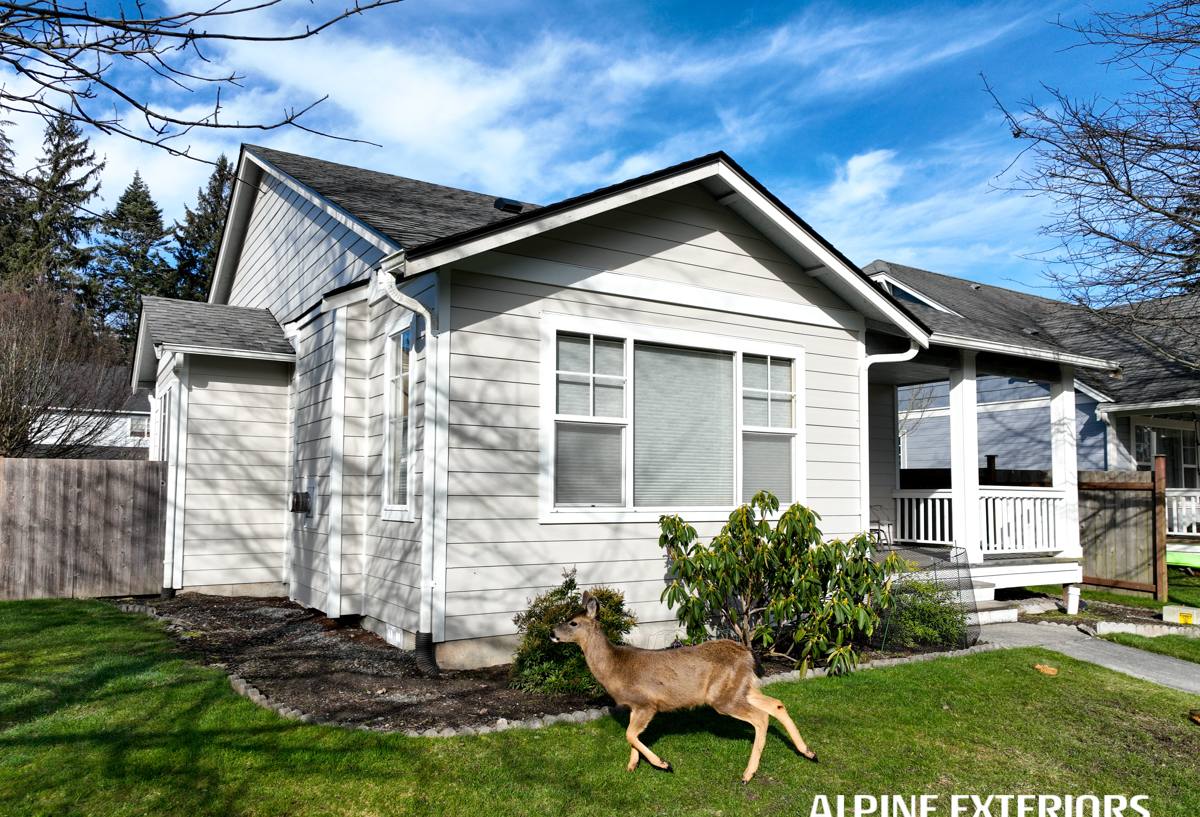
Why We Only Install James Hardie Fiber Cement
We get asked fairly often why we don't offer vinyl, LP SmartSide, or other engineered wood products, especially since some of those cost less upfront. The honest answer is that we've made a professional decision to standardize on one product line — James Hardie fiber cement — because we believe it performs better over the long run in exactly the conditions Flounder Bay sees: salt air, driving rain, and heavy moss pressure.
What Fiber Cement Does Differently
James Hardie siding is made from cement, sand, and cellulose fiber. It doesn't have the organic wood content that gives moss and rot something to feed on, and it's non-combustible, which matters in a state where wildfire smoke and ember exposure have become a bigger part of building conversations even on the wet side of the Cascades. It holds paint and factory finish far more consistently than wood-based products because it doesn't expand and contract with moisture the same way.
What We're Trading Off
To be fair to the alternatives: vinyl is lighter and often cheaper to install, and engineered wood siding can look very close to real wood grain at a lower price point than fiber cement. We're not saying those products can't work in the right application. We've simply concluded that for the coastal exposure common around Anacortes and Skagit County, the moisture resilience and factory-cured finish of Hardie's product line are worth the added upfront cost, and installing it correctly is the standard we hold ourselves to on every job.
How James Hardie Handles Salt Air and Rain
James Hardie's HZ product designations (HZ5 and HZ10) reflect zone-specific engineering for different climate exposures. Homes in the Anacortes area typically fall in a zone where moisture resistance and freeze-thaw stability are the priority, rather than the extreme heat concerns that drive Hardie's product decisions in other parts of the country. The board itself is dimensionally stable, so it doesn't swell, cup, or warp the way wood-based sidings can when they take on repeated moisture cycles.
The factory-applied ColorPlus finish is a meaningful part of the salt-air equation too. Because the finish is baked on in a controlled environment rather than field-applied, it resists fading and chalking better than a site-painted surface, and it means the color coat isn't compromised by whatever the weather is doing on install day. For a bay-adjacent property, that finish integrity is the difference between repainting every several years and going a long stretch without touching the exterior.
Moss and Algae Resistance in Practice
No exterior product is moss-proof — moss will grow on almost any surface given enough shade and moisture, including roofs, decks, and fences. What matters is whether the material underneath degrades once moss takes hold. Fiber cement doesn't rot or delaminate the way wood substrates can when moss traps moisture against the surface for months at a time. That said, we still recommend homeowners keep an eye on shaded, low-airflow sections of the house (north-facing walls, areas under tree cover) and have moss cleaned off periodically — it's a maintenance item, not a structural threat, when the siding underneath is fiber cement installed correctly.
Installation Details That Matter Near the Water
A siding product is only as good as the installation behind it, and that's especially true in a high-moisture coastal zone. A few things we pay close attention to on every Flounder Bay-area job:
- Proper rain screen or drainage plane behind the siding so incidental moisture has somewhere to go instead of sitting against the wall sheathing
- Correct fastener spacing and type — Hardie specifies corrosion-resistant fasteners, which matters more here than in a dry inland climate
- Manufacturer-specified clearances at grade, decks, and roof lines so water doesn't wick up into the bottom course of siding
- Properly flashed and sealed windows, doors, and penetrations, since most siding failures actually start at these transition points rather than in the field of the wall
- Correct joint treatment and caulking at butt joints, sized and sealed to Hardie's published specifications
Skipping any one of these details can undermine an otherwise good product. We've seen enough exteriors around Skagit County to know that the failures homeowners blame on "bad siding" usually trace back to installation shortcuts rather than the material itself.
Beyond Siding: Roofing, Windows, and Decks in a Marine Climate
Siding doesn't work in isolation — it's one piece of an exterior envelope that also includes your roof, windows, and any exposed decking, and all of them face the same salt air and rain exposure common to Flounder Bay.
Roofing
Roofs near the water deal with the same driving rain and moss pressure as siding, often worse, since a roof has more direct sun and shade transitions across its surface. Proper underlayment, flashing at valleys and penetrations, and ventilation all matter for longevity here.
Windows
Window flashing and integration with the siding plane is one of the most common failure points on any coastal home. When we replace siding, we look closely at window flashing details, since a poorly integrated window can undermine even the best siding installation around it.
Decks
Exposed decks near the bay take direct weather exposure with no siding or roof overhang to protect them, so material choice and fastening details matter even more there. We build decks with the same attention to moisture management we apply to siding work.
Comparing Siding Options for a Bay-Adjacent Home
| Factor | Vinyl | Engineered Wood (e.g. LP SmartSide) | James Hardie Fiber Cement |
|---|---|---|---|
| Moisture/rot resistance | Doesn't rot, but can warp and gap over time | Vulnerable if moisture gets behind the coating | Cement-based, doesn't rot or absorb moisture into the substrate |
| Finish durability | Color molded in, but can fade and chalk | Factory-treated, needs maintained coating | Factory-baked ColorPlus finish, strong fade resistance |
| Fire resistance | Can melt/deform near heat sources | Combustible, wood-based core | Non-combustible |
| Upfront cost | Lowest | Mid-range | Higher, reflects material and labor |
| Long-term maintenance | Low, but repairs can be visible (mismatched panels) | Requires coating upkeep to prevent moisture entry | Low, periodic cleaning and caulk checks |
What Working With a Local Crew Actually Means
Anacortes and the surrounding Skagit County waterfront have their own microclimate quirks compared to siding jobs 30 miles inland. A crew that works this area regularly knows to plan around tide-influenced humidity, knows which neighborhoods get hit hardest by wind off the water, and knows how local moss growth patterns tend to behave through the wet season. That local knowledge shapes small decisions — where to add extra flashing attention, which wall orientations need closer inspection during a quote — that a crew unfamiliar with the area might not think to check.
Being local also means we're around after the install. If a question comes up two years down the road about a caulk line or a spot where moss is building up, we're not a phone number connected to a crew that worked here once and moved on.
Planning a Siding Project: A Homeowner's Checklist
- Walk your exterior and note any areas with visible moss buildup, especially shaded walls
- Check for soft spots, bubbling paint, or staining near the bottom of walls and around windows
- Look at your current siding's condition at deck ledgers and roof-to-wall intersections — these are common trouble spots
- Ask any contractor you're considering which siding lines they install and why they chose them
- Get a clear explanation of what's included in the installation (rain screen, flashing details, fastener type) — not just the siding material itself
- Ask about warranty coverage on both material and labor, and get it in writing
Cost Factors to Expect
Every home is different, but a few factors consistently move the price on a Flounder Bay-area siding project: the size and complexity of the home (number of corners, gables, and trim details), whether existing siding needs to be removed first, the condition of the sheathing underneath once old siding comes off, and the specific Hardie product and ColorPlus color selected. We won't quote a number without seeing the house, but we're happy to walk through these factors during an estimate so there are no surprises.
If you're seeing moss buildup, faded or failing siding, or just want an honest read on how your home is holding up against the salt air and rain around Flounder Bay, we're glad to come take a look. There's no pressure and no cost for a straightforward estimate — just a clear picture of where things stand and what your options are.