 Anacortes Siding
 Why Siding Fails Faster in Anacortes Than It Does Inland
Anacortes sits in a tough spot for exterior materials. You've got salt-laden air coming off Rosario Strait and Fidalgo Bay, driving rain that hits west and south-facing walls straight-on during winter storms, and a mossy, shaded understory in a lot of neighborhoods that keeps north walls damp for weeks at a time. None of that is dramatic on its own. But siding doesn't usually fail because of one big event — it fails because of years of small, repeated exposure that homeowners don't catch until the damage is already behind the wall.
The good news is that siding almost always gives warning signs before it fails outright. Wood-based products telegraph trouble through swelling, soft spots, and peeling paint. Even materials marketed as low-maintenance show wear patterns if you know what you're looking at. This page walks through what to check, where to check it, and how to tell the difference between a cosmetic issue and a sign that moisture has already gotten past the surface.
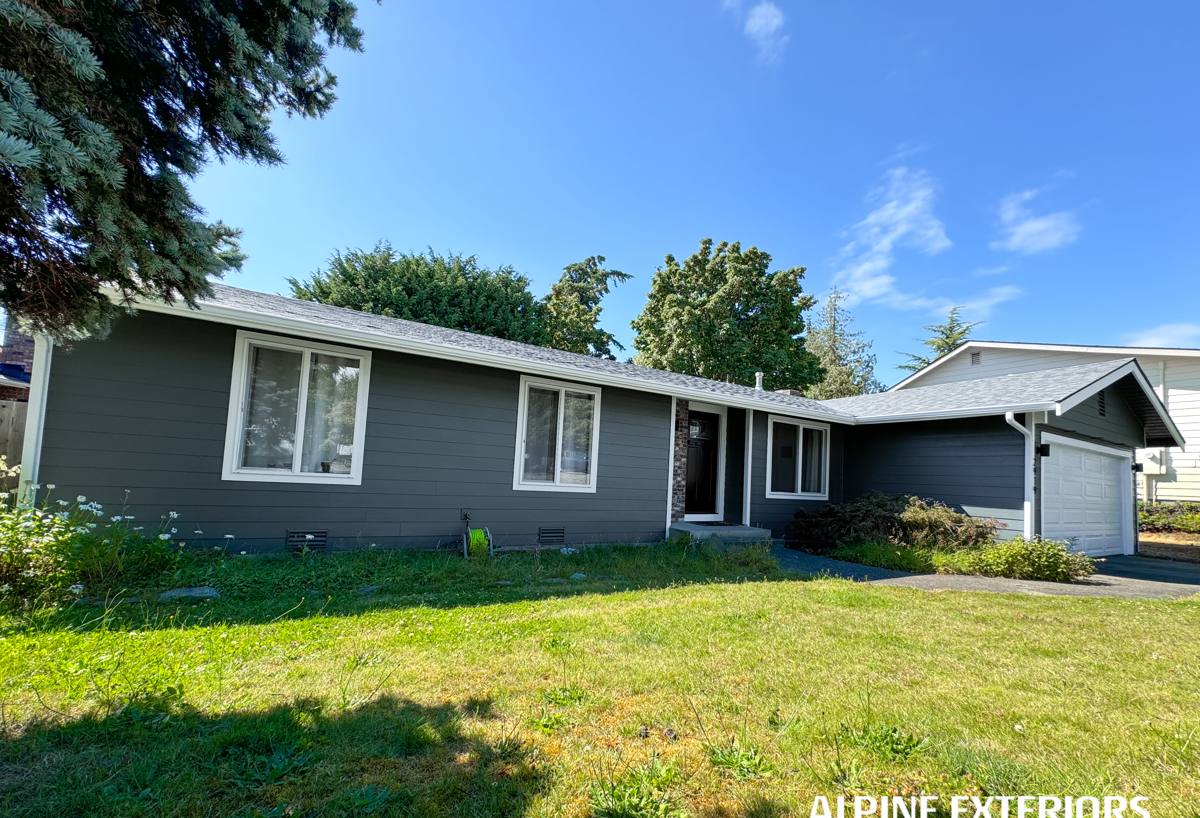
The Skagit County Climate Factor
It's worth understanding the three specific stressors at play here, because they don't affect every wall of a house equally:
- Salt air — accelerates corrosion on fasteners, flashing, and any exposed metal trim, and it can also degrade certain paint and coating systems faster than they're rated for.
- Driving rain — Anacortes gets wind-driven rain off the water, which pushes moisture into laps, joints, and seams that a light vertical rain would never reach.
- Moss and shade — north and east-facing walls near mature trees or under eaves without much sun stay damp longer after every rain, creating ideal conditions for moss, algae, and — eventually — rot in wood-based products.
A single house can have all three problems on different walls. The ocean-facing side takes the driving rain and salt exposure, while a shaded side wall two feet from a fence line stays green with moss most of the year. That's why a proper inspection has to be wall-by-wall, not a single glance from the driveway.
The Early Warning Signs Checklist
Walk the perimeter of your house on a dry day and look for these. None of them mean you need full replacement tomorrow, but each one is worth documenting and watching — or having a contractor look at directly.
- Paint that's peeling, bubbling, or alligatoring (a cracked, reptile-skin texture) rather than just fading
- Soft or spongy spots when you press on siding, especially near the bottom few feet of a wall
- Visible swelling or delamination at panel edges, seams, or butt joints
- Dark streaking below nail heads or staples — a sign moisture is tracking through the fastener
- Moss or algae growth that returns quickly after cleaning, especially in the same spots each year
- Gaps opening up at corner trim, window trim, or where siding meets the foundation
- A musty smell in an interior room along an exterior wall, particularly after heavy rain
- Visible warping — boards that no longer sit flat against the wall or have a wave to them
- Caulk that's cracked, shrunk, or pulled away from joints it used to seal
Where to Look First
Not every square foot of a wall ages the same way. Focus your first pass on:
- The bottom 2 feet of siding on any wall, where splashback and standing water do the most damage
- Corners and butt joints, where two pieces of material meet and caulk is the only thing keeping water out
- Under windows, where flashing failures show up as staining or soft siding directly below the sill
- Anywhere a deck, porch roof, or addition creates a horizontal surface against a vertical wall
- North and shaded walls, for moss and prolonged dampness
Reading Paint Failure Correctly
Paint failure gets treated as a painting problem, but it's often a siding problem wearing a paint problem's clothes. There's a real difference between paint that's simply reached the end of its service life and paint that's failing because the substrate underneath is already compromised.
Uniform fading and chalking across a whole wall, with the surface still hard and flat, usually means the paint job is just old — a maintenance repaint will fix it. Peeling that's isolated to specific boards, especially combined with soft wood or swelling underneath, usually means moisture is already in the material and no amount of repainting will hold. Painting over a moisture problem doesn't solve it — it hides it, and the rot keeps working underneath the new coat.
This is one of the reasons factory-applied finishes have an advantage over field-applied paint in a climate like ours: a factory finish is cured and bonded under controlled conditions, rather than applied on-site in variable Pacific Northwest humidity, so it tends to hold up more evenly over the same number of years.
Moss as a Diagnostic Tool, Not Just a Nuisance
Most homeowners think of moss as a cosmetic problem to pressure-wash away once a year. It's worth treating it as more than that. Moss growing directly on siding — not just on the roof or in the yard — tells you that wall stays wet longer than it should. That's useful information even if the moss itself isn't damaging the material.
On wood, engineered wood, and some composite products, sustained dampness under moss growth can eventually contribute to rot at the surface. On fiber cement, moss is mostly cosmetic and cleans off without damaging the material, though it still points to a wall that would benefit from better drainage, trimmed vegetation, or improved gutter performance to reduce how long it stays saturated.
If you have one wall that grows moss faster than the rest of the house, that's the wall to inspect most closely for the other warning signs above — it's your house telling you where the water sits longest.
Repair, Recoat, or Replace: How to Decide
Not every warning sign means a full re-side. The table below is a general guide to how these issues typically get triaged, though a hands-on inspection is the only way to know for sure what's happening behind the surface.
| What You're Seeing | Likely Scope | Why |
|---|---|---|
| Uniform fading, chalky but hard paint | Recoat / repaint | Cosmetic wear only, substrate is sound |
| A few soft boards near grade, rest of wall solid | Spot repair | Localized moisture entry, likely fixable without full replacement |
| Swelling at multiple butt joints across one wall | Wall-by-wall replacement | Suggests a systemic flashing or caulk failure on that elevation |
| Soft siding + musty smell indoors + visible staining | Full inspection, likely broader replacement | Points to moisture that's reached the sheathing, not just the siding face |
| Moss regrowth with siding otherwise firm | Cleaning + drainage fix | Cosmetic/environmental, not structural on most materials |
| Widespread warping, delamination, or brittle panels house-wide | Full replacement | Material has reached the end of its service life |
What Happens If You Wait
Siding problems in a climate like Anacortes rarely stay small. Water that finds its way past a failed caulk joint or a soft board doesn't stop at the siding — it moves into the house wrap, the sheathing, and eventually the framing if it's given enough time. What starts as a $400 spot repair can turn into sheathing replacement and interior drywall repair if it sits through two or three more wet seasons unaddressed.
This is especially true on walls that take direct driving rain or stay shaded and damp most of the year. A small problem on an exposed, wet wall progresses faster than the same problem would on a protected, sunny wall. That's part of why we look at inspection findings in context of which elevation they're on, not just what the damage looks like in isolation.
When Replacement Is the Right Call
If an inspection turns up widespread issues rather than isolated spots, full replacement is usually the more cost-effective path over the long run — repeated spot repairs on a wall that keeps failing end up costing more in materials, labor, and repainting cycles than doing it once, correctly.
When homeowners in this area do decide to replace, we install James Hardie fiber cement siding exclusively. It's a call we've made deliberately: fiber cement doesn't rot, doesn't feed moss the way wood-based products can, and Hardie's ColorPlus factory finish holds its color and bond far more consistently than field-applied paint in our wet, salt-air climate. Hardie's HZ5 product line is also engineered specifically for climates with heavy moisture exposure, which is exactly the profile Anacortes and the rest of Skagit County present. We're not saying every siding material on the market is unusable here — we're saying that after years of doing repair and replacement work on homes throughout this area, Hardie is the product we're willing to put our name behind.
Get a Second Opinion Before You Decide
If you're seeing one or two of the warning signs above, it's worth getting a professional read before deciding between a repair, a repaint, or a full replacement. We'll walk the exterior with you, tell you honestly what we're seeing on each wall, and give you a straight answer about what needs attention now versus what can wait. If you'd like us to take a look at your home, we offer a free, no-pressure estimate — just fill out the form below and we'll get in touch.