 Anacortes Siding
 Old Town Anacortes: A Neighborhood Shaped by Water and Weather
Old Town Anacortes is one of the city's oldest residential pockets, sitting close to the water on the west side of town where Skagit County's marine climate is at its most direct. Many of the homes here predate modern building codes and vapor barriers, which means the siding, trim, and roofing you see today have often been patched, repainted, or partially replaced multiple times over the decades. That history matters when we're evaluating a home for new siding — older wall assemblies behave differently than a house built in the last twenty years, and a contractor who doesn't account for that will end up recommending the wrong fix.
Being this close to the water means the neighborhood takes the brunt of what Rosario Strait and the surrounding channels throw at it: salt-laden air, wind that drives rain sideways into wall surfaces, and long stretches of shade and dampness that never fully dry out between storms. None of that is unusual for Anacortes as a whole, but Old Town's proximity to open water and its mix of mature trees and older lot layouts tend to make the effects show up faster and more visibly than in newer subdivisions further inland.
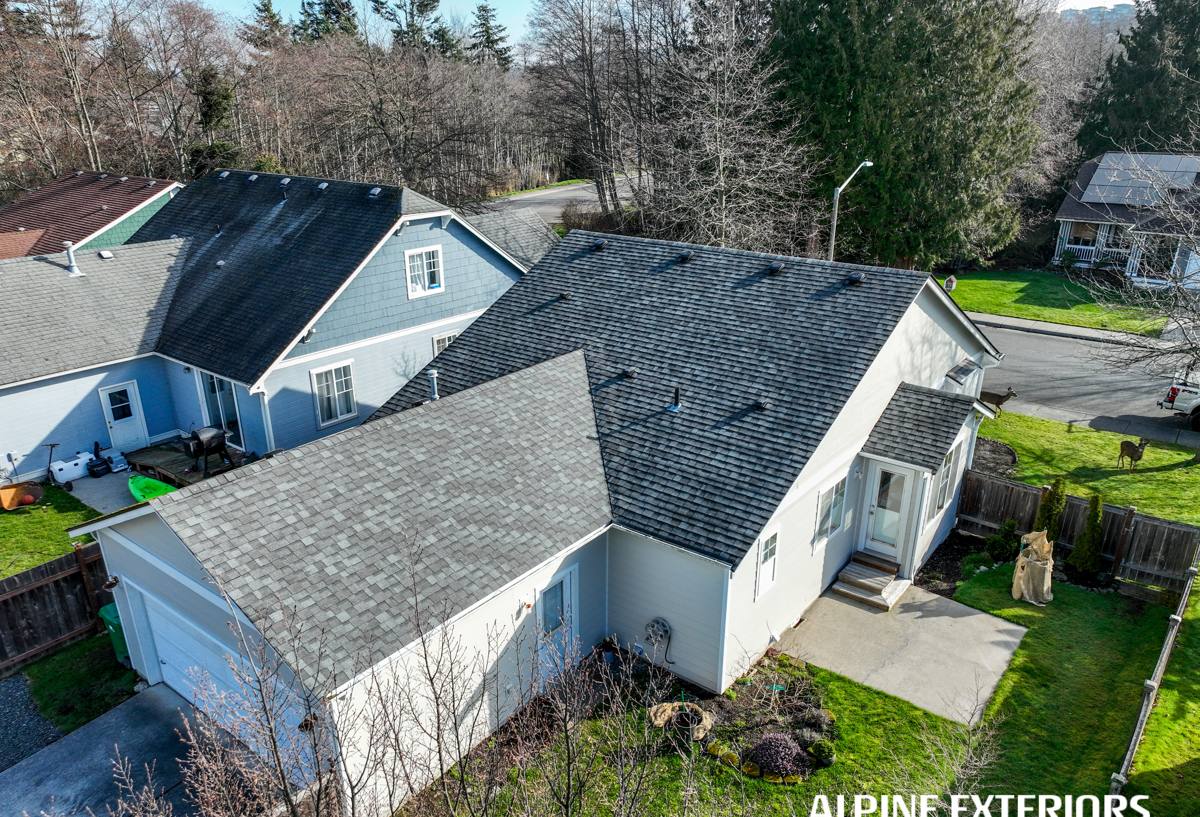
What Salt Air, Driving Rain, and a Long Moss Season Do to Siding
Salt Air and Corrosion
Airborne salt doesn't just affect boats and hardware — it settles on siding surfaces, fasteners, and trim, accelerating the breakdown of paint films and speeding corrosion on lower-quality fasteners and flashing. Over years, that shows up as chalking paint, rust streaks below nail heads, and premature failure of caulked joints, especially on the sides of a house that face the water or prevailing wind.
Wind-Driven Rain
Anacortes gets less annual rainfall than many parts of western Washington, but what falls near the water often comes in sideways during winter storms. Wind-driven rain finds every gap in lap siding, poorly sealed trim joints, and old caulk lines. Once moisture gets behind a wall covering, it doesn't dry quickly in this climate — and repeated wetting and drying cycles are what eventually rot wood-based siding from the inside out, long before the surface looks obviously damaged.
Moss, Shade, and a Long Damp Season
Old Town's mature street trees and closely spaced lots mean plenty of shaded, slow-drying wall sections. Combined with Skagit County's long wet season, that's ideal territory for moss and algae growth on north- and east-facing walls. Moss holds moisture against the siding surface for extended periods, which is a slow but steady contributor to wood decay and paint failure, and it's a maintenance headache that never really goes away on the wrong siding material.
Why James Hardie Fiber Cement Fits This Kind of Exposure
We install James Hardie fiber cement siding exclusively, and neighborhoods like Old Town are exactly why. Fiber cement is a non-combustible, cement-based material that doesn't feed moisture into a wood substrate the way traditional wood or wood-composite sidings can, and it holds up to repeated wetting without the swelling, cupping, or rot risk that plagues softer materials in a marine environment. Hardie's ColorPlus factory-applied finish is baked on under controlled conditions, which gives it better adhesion and fade resistance than field-applied paint — a real advantage in a location where salt air and UV exposure are both working against ordinary paint jobs.
Hardie also engineers specific product lines for different climate zones. In the Pacific Northwest, that means HZ5 formulations built to resist moisture-related issues common to wet, temperate coastal regions. That's not a marketing detail — it's the difference between a product designed for this exact combination of rain, humidity, and temperature swings, and one that's simply been adapted from a design meant for a drier part of the country.
Why We Don't Install Everything on the Market
Homeowners in Old Town sometimes ask why we won't quote vinyl, LP SmartSide, primed wood, or cedar alongside Hardie. Each of those products has legitimate uses and each has a following, but none of them holds up as consistently as fiber cement under sustained coastal exposure:
- Vinyl siding can warp or become brittle with temperature swings and UV exposure over time, and its seams and J-channels give wind-driven rain more opportunities to work behind the surface.
- LP SmartSide and other wood-strand products are engineered wood — meaning they're still vulnerable to moisture intrusion at cut edges and fastener points if caulking and paint maintenance lapse, which is a real risk in a climate that doesn't give surfaces much time to dry.
- Primed spruce and other solid wood sidings require the most disciplined ongoing maintenance of any option — regular repainting and caulk inspection — and Old Town's salt air and shade shorten the window before that maintenance becomes due.
- Cedar is a beautiful, traditional choice, but natural wood siding is the most exposure-sensitive material on this list, and the upkeep cost over a 20-30 year span is significant.
We'd rather stand behind one product we trust completely than offer a menu of options we know will disappoint some homeowners five or ten years down the road.
Comparing Siding Materials for a Coastal Anacortes Home
| Material | Moisture Resistance | Maintenance Burden | Typical Lifespan |
|---|---|---|---|
| James Hardie Fiber Cement | Excellent — cement-based, does not rot or swell | Low — occasional wash, no repainting for years | 30-50+ years |
| Vinyl | Fair — seams and gaps allow water intrusion | Low, but prone to cracking/fading over time | 20-30 years |
| LP SmartSide | Good if maintained; vulnerable at cut edges | Moderate — paint and caulk upkeep required | 20-30 years |
| Cedar | Fair — absorbs moisture without diligent sealing | High — regular repainting/staining | 15-30 years with upkeep |
Beyond Siding: Roofing, Windows, and Decks for Old Town Homes
Siding rarely fails in isolation. On the older homes common in this part of Anacortes, we're often looking at the whole exterior envelope at once. A roof nearing the end of its service life lets moisture into the wall assembly from above; aging windows with failed seals or degraded flashing let it in at the sides; and decks exposed to the same salt air and rain patterns face many of the same wear issues as siding. Because we handle siding, roofing, windows, and decks, we can flag problems in one system while we're evaluating another, instead of sending a homeowner to three different contractors and hoping they coordinate.
This matters especially around window openings and roof-to-wall transitions, where flashing details determine whether new siding actually keeps water out or just looks good until the next storm season.
Our Process for an Old Town Property
Every estimate starts with a walk-around of the exterior, paying close attention to the sides of the house facing the water and prevailing wind, shaded areas prone to moss, and any visible signs of past water intrusion — soft trim, peeling paint, or staining below fastener lines. On older homes, we also check what's underneath the existing siding where accessible, since sheathing condition affects the scope of the job.
From there we walk through material selection, color (Hardie's ColorPlus lines offer a wide range that holds up to UV and salt exposure), and a realistic timeline that accounts for weather windows — installation quality suffers if fiber cement is installed in the wrong conditions, so we plan around Skagit County's wetter months rather than fighting them.
Questions Worth Asking Any Contractor Before You Hire
- Are they installing to the manufacturer's written installation instructions, including fastener spacing and clearances above grade and roofing?
- Do they carry current Washington state contractor licensing and insurance, and can they provide proof without hesitation?
- Will flashing and moisture barrier details be addressed at windows, doors, and roof lines — not just the siding panels themselves?
- Is the warranty transferable, and does it cover both the product and the labor?
- Can they explain, in plain terms, why they recommend one material over another for your specific exposure?
Why a Local Crew Matters in Old Town
A contractor who works throughout Skagit County knows that a house three blocks from the water needs different attention than one further inland, even within the same city limits. That local knowledge shapes decisions about caulking schedules, moss treatment, and which wall assemblies are most likely to need extra care — details that are hard to get right from a generic regional playbook. It also means a crew that's around after the job is done, not a company that installed siding once and moved on to the next county.
If you're weighing a siding, roofing, window, or deck project on a home in Old Town Anacortes, we're happy to take a look and give you a straightforward, no-pressure estimate — including an honest opinion if your existing siding still has useful life left in it.