 Anacortes Siding
 Exterior Work in West Anacortes: What the Location Actually Demands
West Anacortes sits close enough to the water that salt air isn't an occasional visitor — it's a constant, low-grade presence on every exterior surface. Combine that with Skagit County's marine-driven weather pattern — wind-driven rain off the Sound, long stretches of overcast humidity, and a moss season that can run from fall through spring — and you get a set of conditions that are genuinely harder on a home's exterior than what inland Washington neighborhoods deal with. Roofs, siding, windows, and decks in this part of Anacortes all age differently than they would 20 miles east, and the materials and installation details that hold up here aren't always the same ones that get specified in a generic build.
We work exteriors — siding, roofing, windows, and decks — as a connected system, because on a home exposed to this kind of weather, that's how they actually behave. Water that gets past a window flashing detail doesn't stay at the window; it travels behind siding. A roof edge that sheds water poorly dumps it straight onto the top course of siding below. Treating each component in isolation is how small problems in one system turn into rot, staining, or premature failure in another.
Why Salt Air and Driving Rain Change the Math
Airborne salt accelerates corrosion on fasteners, flashing, and any exposed metal trim. It also leaves a fine residue on siding and windows that holds moisture longer than clean rain would on its own. Driving rain — rain pushed sideways by wind rather than falling straight down — finds every gap in a building envelope that vertical rain would never reach: lap joints, trim intersections, window returns, and deck ledger connections. West Anacortes gets both at once often enough that "good in most of the state" isn't the bar. The exterior has to handle wind-driven, salt-laden moisture as routine weather, not a worst-case event.
Moss, Shade, and the Slow Damage Nobody Notices Right Away
Moss doesn't just grow on roofs — it establishes on north-facing siding, in shaded side yards, and on decking that doesn't get enough sun exposure to dry out between rain events. It holds moisture against the surface it's growing on for extended periods, which is exactly the condition that causes trouble for water-sensitive materials. A long moss season means a long window every year where any weak point in the exterior envelope is sitting damp rather than drying out.
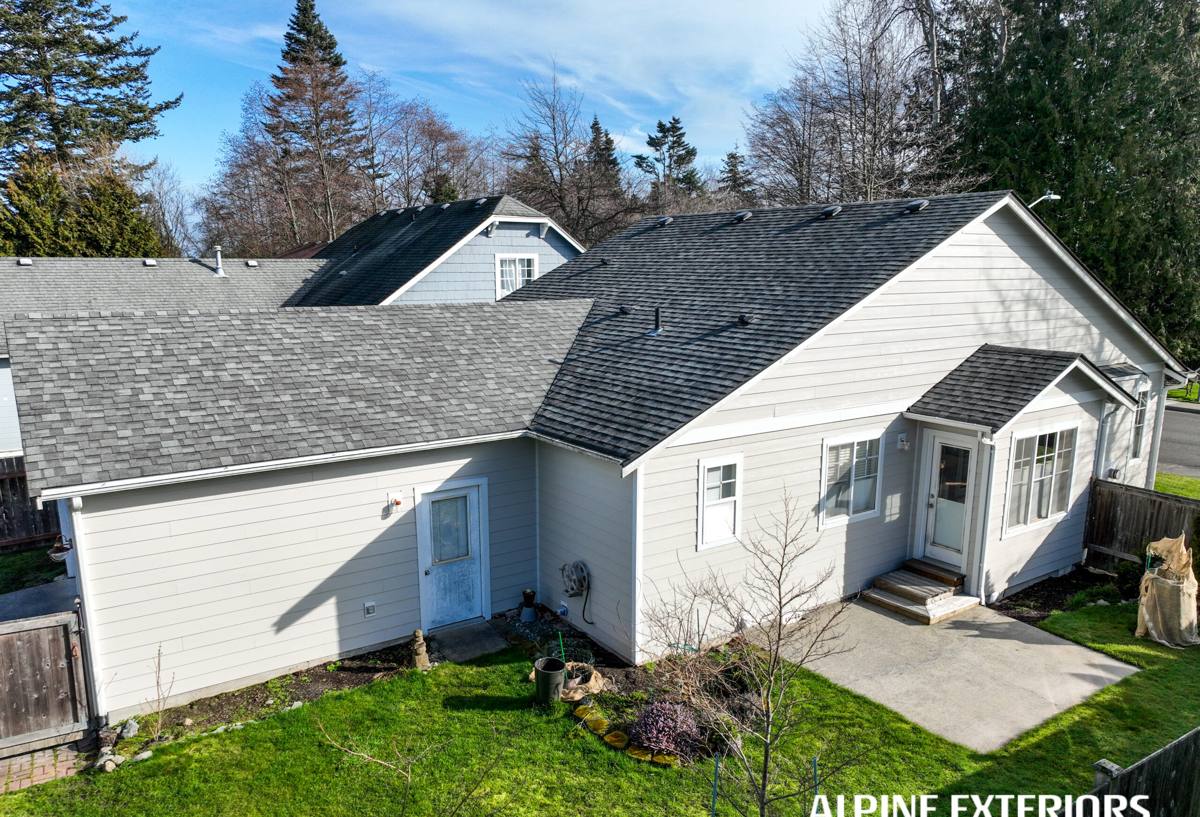
Siding: Why We Only Install James Hardie Fiber Cement
We install James Hardie fiber cement siding exclusively. We don't install vinyl, LP SmartSide, Cemplank, Allura, primed spruce, or cedar — not because those products have no merit, but because after years of exterior work in this specific climate, fiber cement from Hardie is the material we're willing to stand behind long-term on a home exposed to salt air and sustained moisture.
Vinyl is inexpensive and low-maintenance in the sense that it doesn't need painting, but it's a thin material that expands and contracts significantly with temperature swings, can become brittle over time, and doesn't offer the impact resistance or dimensional stability that fiber cement does. Wood products — cedar or primed spruce — can look excellent when new, but they require an ongoing maintenance commitment (recoating, caulking, moisture monitoring) that most homeowners underestimate, and in a climate with this much sustained dampness, that maintenance gap shows up as rot faster than in drier regions. Engineered wood products like LP SmartSide have improved moisture resistance over older wood siding, but they're still a wood-based substrate, which means edge sealing and installation detailing have to be close to perfect to avoid moisture intrusion at cut ends and joints — a much smaller margin for error than fiber cement gives you.
James Hardie fiber cement is non-combustible, dimensionally stable across temperature and humidity swings, and doesn't support the kind of moisture-driven decay that wood products can. Its ColorPlus factory finish is baked on under controlled conditions rather than field-applied, which gives more consistent, longer-lasting color than site painting — a real advantage in a climate where UV exposure is lower but moisture cycling is high. Hardie's HZ5 and HZ10 product lines are engineered specifically for climate zones with heavy moisture exposure, which describes West Anacortes accurately. The warranty is also transferable, which matters to homeowners who may sell before the siding's functional life is over.
What Correct Installation Actually Involves
Fiber cement performs the way it's rated to perform only when installed to manufacturer spec — proper clearance from grade and roof lines, correct fastener pattern and depth, factory-cut or properly sealed field cuts, and flashing integration at every window, door, and penetration. Skipping these details is the most common reason any siding product underperforms, and it's where hiring a crew that installs Hardie routinely — rather than occasionally — makes a real difference.
Roofing: The First Line of Defense Against Moss and Wind-Driven Rain
A roof in West Anacortes needs two things above baseline weatherproofing: shedding capacity for wind-driven rain at edges, valleys, and penetrations, and resistance to sustained moss growth in shaded or north-facing sections. Proper underlayment, ice-and-water shield at vulnerable transitions, and correctly lapped flashing matter more here than in drier parts of the state, because the roof stays wet longer after every weather event.
Moss removal and prevention is also a maintenance conversation worth having early rather than after moss has already worked into shingle edges. Left unchecked, moss holds moisture against roofing material through the wet season, which shortens roof life regardless of the underlying product quality.
Windows: Where Driving Rain Finds Weak Points First
Window flashing and sealant details are one of the most common points of water intrusion on coastal Washington homes, and driving rain makes flashing quality non-negotiable rather than optional. Replacement windows installed with correct pan flashing, head flashing, and integration into the surrounding siding weather barrier keep water moving out and away from the wall assembly instead of behind it. This is also where treating siding and windows as one connected job pays off — window replacement done without attention to the siding tie-in is a common source of hidden moisture problems that surface months or years later.
Decks: Built for Shade, Moisture, and Salt Exposure
Decking in shaded or partially shaded yards deals with the same slow-drying conditions that drive moss growth elsewhere on the property. Ledger board flashing, proper fastener selection resistant to salt-air corrosion, and adequate spacing for airflow underneath the deck all matter more in this environment than they would on a dry, sun-exposed lot. Composite decking options reduce some of the maintenance burden compared to wood, though the structural framing and flashing details still need to be done correctly regardless of the decking material chosen.
Cost Factors for Exterior Projects in This Area
| Factor | Why It Affects Cost Here |
|---|---|
| Home exposure to wind/salt | Waterfront-adjacent and higher-exposure lots often need more robust flashing and fastener detailing |
| Existing moisture damage | Hidden rot behind old siding or around windows adds repair scope once opened up |
| Roof complexity | Valleys, dormers, and multiple planes increase flashing work and moss-prone shaded areas |
| Access and site conditions | Tree cover, slope, and shaded/damp yard conditions affect scheduling and prep work |
| Scope bundling | Combining siding, window, and trim work in one project often reduces total disruption and cost versus separate projects |
Signs a West Anacortes Home May Need Exterior Attention
- Persistent moss or algae staining on north-facing or shaded siding sections
- Soft spots, bubbling, or peeling paint near window trim or lower siding courses
- Visible gaps or cracking at siding joints and trim intersections
- Rust staining running down from fasteners, flashing, or metal trim
- Shingle granule loss or moss buildup concentrated in shaded roof valleys
- Soft or spongy decking, especially near ledger boards or shaded areas
- Drafts, fogging, or visible moisture between window panes
Why a Local Crew Matters for This Kind of Work
Exterior work done by a crew that regularly works in Anacortes and around Skagit County understands which details actually matter here — flashing at wind-exposed corners, fastener choices that hold up to salt air, and where moss is likely to establish based on how a particular lot sits relative to sun and shade. That local pattern recognition is hard to replicate from a generic install approach, and it's the difference between an exterior that's technically installed and one that's installed for the conditions it will actually face.
If you're weighing a siding, roofing, window, or deck project for a home in West Anacortes, we're happy to take a look and talk through what your specific home and lot are dealing with. A free, no-pressure estimate is available through the form below.