 Anacortes Siding
 Why Decks in Old Town Anacortes Wear Out Faster Than You'd Expect
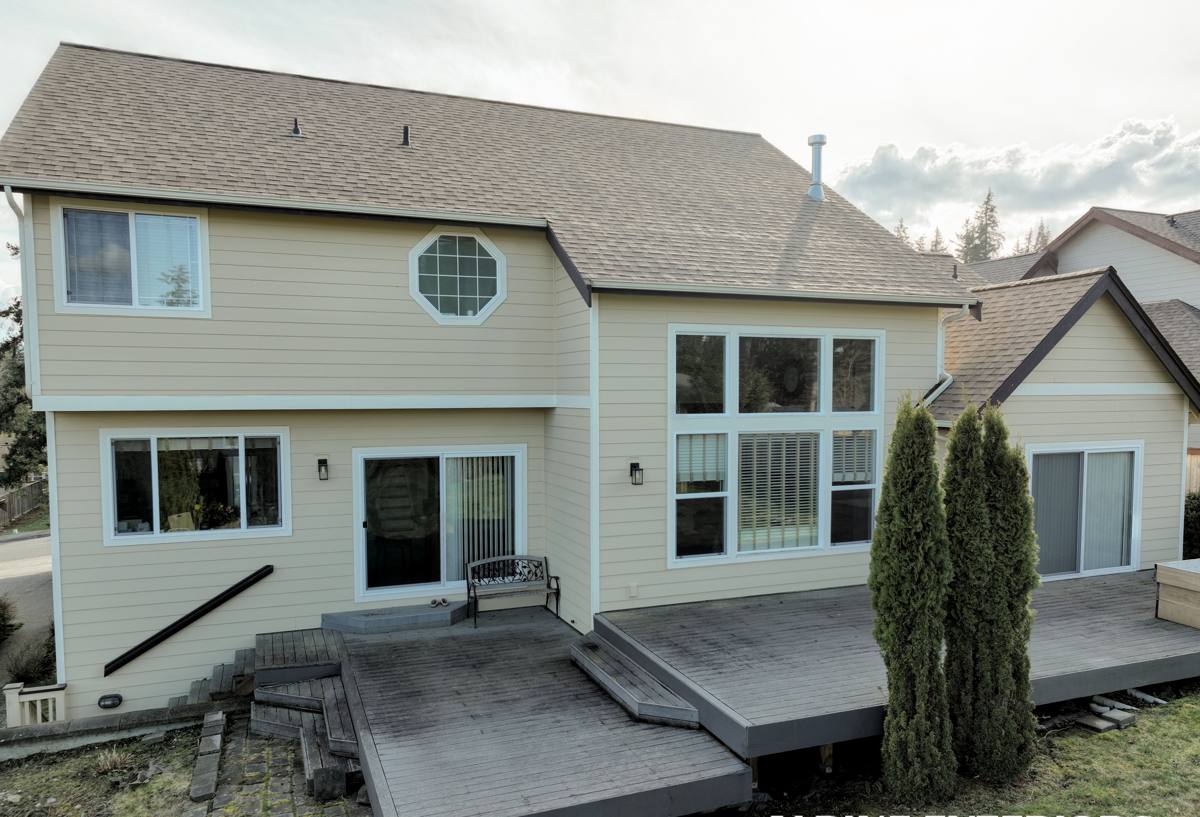
A deck in Old Town Anacortes lives a harder life than the same deck would in a drier, inland climate. Sitting on Fidalgo Island, homes here get salt-laden air off the surrounding water, long stretches of driving rain through fall and winter, and a moss season that can run eight or nine months out of the year on shaded lots. None of that shows up as a dramatic failure right away — it shows up slowly, as rust streaks, soft spots, and a deck that "still looks fine" from the yard while the framing underneath is quietly rotting.
Older neighborhoods like Old Town Anacortes add a second variable: age. Many decks here were built decades ago, some as owner add-ons that predate current code, and even well-built originals are now well past the point where a repair actually fixes anything. When we talk about deck replacement in this part of Anacortes, we're talking about correcting both the climate exposure and the age of the original build at the same time.
The Three Climate Factors That Actually Matter
Salt Air
Airborne salt off the water accelerates corrosion on anything metal — deck screws, joist hangers, railing hardware, even the heads of nails holding down fascia boards. Standard zinc-coated fasteners that would last two decades inland can start bleeding rust within a few seasons this close to salt water. That rust doesn't just stain the boards; it's a sign the fastener itself is losing holding strength.
Driving Rain
Pacific Northwest rain in this area rarely falls straight down — wind off the water drives it sideways, under railings and against the house. The point where a deck ledger board attaches to the home is the single most common place we find hidden rot, because water gets pushed behind the ledger and sits there, invisible, for years before anyone notices a soft spot or a sagging corner.
Moss Season
Mature tree cover is common on the older lots around Old Town Anacortes, and shaded, north-facing decks stay damp far longer after a storm than decks in open sun. That extended dampness is exactly what moss and algae need. Beyond being a slip hazard on stairs and landings, moss holds moisture directly against the wood fibers, which speeds up decay from the top down — not just from the framing up.
Signs Your Deck Needs Replacement, Not Another Repair
A lot of deck problems get patched instead of properly fixed, which just delays the real cost. Walk your deck and check for these before deciding a repair is enough:
- Soft or spongy decking boards, especially within a few feet of the house
- Rust streaks bleeding from screw heads or joist hangers
- Any visible gap or separation between the ledger board and the house
- Railing posts that wobble or flex when pushed
- Moss or algae that returns within days of cleaning
- Rot or crumbling at the base of support posts, where they meet the footings
- Stairs that bounce, flex, or feel less solid than the deck itself
- No record of a permit or inspection for a deck that was clearly added after the house was built
Any one of these on its own might be repairable. Two or more together, especially involving the ledger or the posts, usually means the structure has moved past the point where patching makes financial sense.
What a Correct Deck Replacement Actually Involves
A proper replacement is a full tear-off to the framing, not a resurfacing job. That's the only way to find out what's actually happening at the ledger, joists, and posts — the parts you can't see from the top of the deck. From there, a correct job for this climate includes:
- New or reinforced ledger board, attached with self-adhering flashing membrane and metal drip flashing to keep driving rain from wicking behind the siding
- Joist tape over every joist top, so water sheds off before decking ever goes down
- Structural connections that meet current residential code — rated joist hangers, hold-down tension ties at the ledger, proper post-to-beam and beam-to-footing hardware
- Footings sized and set to reach undisturbed, frost-free bearing soil, not just reused from the original build
- Guardrails and stair railings at correct height with code-compliant baluster spacing
Skipping any one of these to save money on a replacement just reintroduces the same failure points that took down the old deck — usually faster the second time, since the framing is now exposed to the same salt air and rain that damaged it before.
Choosing Decking Material for This Climate
There's no single "best" decking material — it's a trade-off between upfront cost, how it holds up to salt air and moss, and how much upkeep you're willing to do. Here's how the common options compare for a deck in this environment:
| Material | Upfront Cost | Salt Air / Moisture | Moss & Algae | Typical Maintenance |
|---|---|---|---|---|
| Pressure-treated lumber | Lowest | Good if sealed regularly | Needs regular cleaning | Annual sealing/staining |
| Cedar | Moderate | Naturally rot-resistant, but surface still weathers | Needs regular cleaning | Sealing every 1–2 years |
| Capped composite | Higher | Excellent — won't rot or absorb water | Resistant, still needs occasional washing | Occasional cleaning only |
| PVC / cellular vinyl | Highest | Excellent — fully impervious to moisture | Most resistant of the group | Occasional cleaning only |
Whatever decking you choose, the framing underneath is almost always still wood, which means the ledger flashing, joist tape, and fastener quality matter just as much as the surface material. A composite deck built on a poorly flashed ledger will fail at the same point a wood deck would.
Hardware and Fasteners: The Detail Most Contractors Skip
This is where salt air does the most damage, and where cutting corners is hardest to notice until it's too late. Our standard for decks in this area is stainless steel or high-grade coated fasteners rated for direct contact with treated lumber, hot-dip galvanized or stainless structural hardware for joist hangers and post bases, and hidden fastener clip systems where the decking product supports them. Standard mill-run screws and basic galvanized hardware are built for a general market, not a coastal one, and it shows within a few years in the form of rust bleed and loosened connections.
Permits and Building for This Site
Deck replacement in Anacortes typically requires a permit through the city, particularly for anything structurally attached to the house or elevated off grade — even a like-for-like replacement, since the ledger and footing connections are structural. Older homes in Old Town Anacortes sometimes have decks or additions that were never permitted in the first place, so a replacement is often the first real opportunity to bring the structure up to current code rather than just matching what was there before.
Footings are another area where older decks in this part of Skagit County commonly fall short. Frost-free bearing depth and proper footing size aren't optional details — undersized or shallow footings are a leading cause of posts settling unevenly over time, which is what causes a deck to feel "off" even when the decking surface still looks fine.
Our Process
- On-site inspection, including probing the ledger, joists, posts, and footings for hidden rot or movement
- A written scope of work with an honest material recommendation for your specific site and sun/shade exposure
- Permit pulled through the City of Anacortes before any demolition begins
- Full tear-off and disposal of the old structure
- Framing, ledger flashing, and footing work brought up to current code
- Decking, railing, and stair installation with coastal-grade fasteners
- Final inspection and walkthrough before we consider the job done
Why Hire a Crew That Already Works Old Town Anacortes
Deck replacement isn't a generic job you can do the same way everywhere. A crew that already works this neighborhood knows which lots sit on sloped or fill soil, has a working relationship with the city permit office, and has seen firsthand how fast moss comes back on a shaded lot here compared to a deck in full sun a few miles inland. We stock coastal-grade fasteners and hardware as standard, not as a special order after finding rusted-out connections mid-project. That familiarity with the specific conditions in Old Town Anacortes — the salt air, the rain patterns, the moss, and the age of the homes — is what separates a deck that lasts fifteen years from one that lasts thirty.
If your deck is showing any of the warning signs above, or you'd just like an honest opinion on repair versus replacement, we're happy to take a look. Fill out the form below for a free, no-pressure estimate.