 Anacortes Siding
 Why Old Town Anacortes Is Hard on Siding
Old Town Anacortes sits close to the water, and that closeness is exactly what makes the neighborhood beautiful and what makes its siding age faster than siding twenty miles inland. Homes here deal with three things at once, year after year: salt-laden air off Fidalgo Bay and the surrounding straits, driving rain that comes in sideways during winter storms, and a long, damp moss season that keeps north- and west-facing walls wet for weeks at a stretch. Any one of those is manageable. All three together, on the same wall, is what actually wears a home down.
Salt Air
Salt in the air settles on siding, trim, and fasteners. On products that rely on paint film alone for protection, that salt film accelerates coating breakdown and corrodes exposed metal fasteners over time. It doesn't take a house sitting directly on the beach to matter — Skagit County's marine air travels well inland, and Old Town's proximity to open water puts it squarely in that exposure zone.
Driving Rain
Anacortes gets weather off the Strait of Juan de Fuca and Rosario Strait, and a good winter storm doesn't just fall straight down — it drives horizontally into whatever wall faces the wind. That means water finds every gap in flawed flashing, every unsealed joint, and every place where siding wasn't lapped correctly. On an older home, it also finds every place where decades-old trim and window details have started to open up.
Moss Season
Western Washington's wet, mild fall-through-spring stretch is moss season for a reason. Shaded walls, north exposures, and anything under overhanging trees stay damp far longer than they would in a drier climate. Moss and algae hold moisture against the siding surface, which is a bigger problem for materials that swell, rot, or delaminate when wet than it is for a properly engineered fiber cement product.
What Old Town's Older Homes Need From Their Siding
A lot of the housing stock in Old Town Anacortes predates modern building science. That's part of the neighborhood's character, but it also means a re-siding job here is rarely a simple panel swap. Sheathing behind decades-old siding is often original, sometimes with wood that's soft or checked in spots. Framing can be slightly out of square. There may be older trim details — window casings, corner boards, water tables — worth preserving or matching rather than covering over with something generic.
Any home with siding that predates the late 1970s should also be treated as a potential lead-paint situation until proven otherwise. That changes how tear-off is handled — containment, cleanup, and disposal all follow lead-safe work practices rather than a standard demo approach. It's not something to skip to save a day of labor.
Why We Only Install James Hardie Fiber Cement
We install James Hardie siding exclusively — not vinyl, not LP SmartSide, not cedar or primed spruce. In a climate like this one, that's a deliberate call, not a marketing line. Fiber cement doesn't rot, doesn't feed insects, and doesn't warp or delaminate the way wood-based and some engineered wood products can when they take on repeated moisture. It's also non-combustible, which matters given the wildfire-smoke seasons the whole region has seen in recent summers, even if direct wildfire exposure isn't the primary risk in Anacortes itself.
James Hardie makes climate-specific product formulations under its HZ5 engineering for the Pacific Northwest's freeze-thaw and moisture patterns, and every board comes with a factory-applied ColorPlus finish — a baked-on finish that holds up to UV and moisture far better than a job-site paint coat, with a longer color warranty to match. For a wall that's going to see salt air and driving rain for the next thirty years, that factory finish is doing real work.
HardiePlank Lap Siding vs. HardieShingle
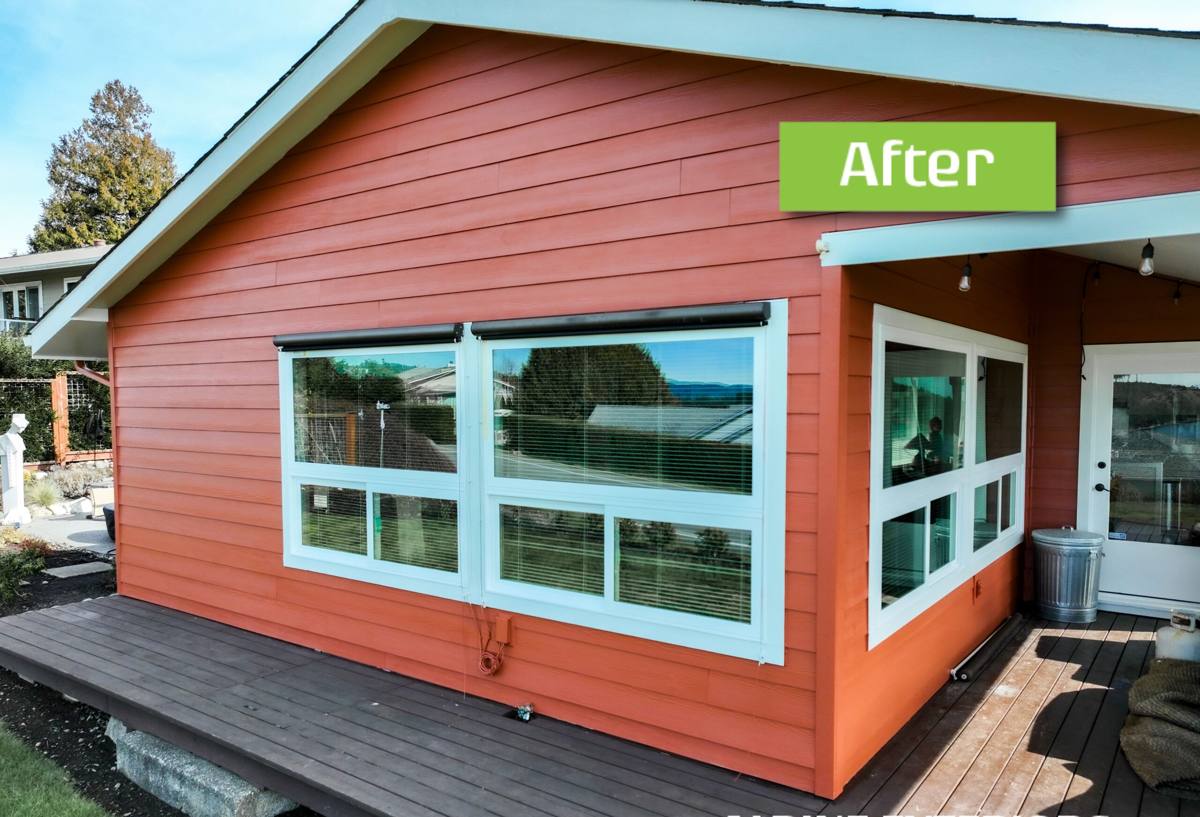
Old Town's homes run from early-1900s cottages to Craftsman-influenced bungalows, and the right Hardie profile depends on what the house is already saying. HardiePlank lap siding in a traditional reveal reads as classic clapboard and suits most of the older housing stock in the neighborhood. HardieShingle staggered or straight-edge panels are the better call on gable ends, dormers, or homes that originally carried a shingle-style skin — it keeps the historic proportions intact instead of flattening the look with a single lap profile everywhere.
What a Correct Installation Actually Involves
Fiber cement performs the way it's rated to perform only when it's installed to spec. In a wet, salt-exposed climate, the details that get skipped on a rushed job are exactly the details that cause callbacks two winters later.
- Water-resistive barrier installed correctly, lapped shingle-style so water sheds outward, with no reverse laps
- Flashing at every window, door, and roof-to-wall intersection — not caulk used as a substitute for flashing
- Correct fastener type, spacing, and embedment depth per the Hardie install guide, not whatever's left in the nail gun
- Proper clearance from grade, decks, and roof lines so board bottoms don't sit in standing water or snow
- A 1/4-inch gap at all trim and butt joints, sealed with a quality sealant rated for exterior movement — not siding butted tight
- Starter strip set level and square before the first course goes up, since every course above compounds any early error
- Kick-out flashing at roof-to-wall transitions so runoff is directed away from the wall assembly, not behind it
None of this is exotic. It's the manufacturer's published installation guide, followed completely rather than partially. Skipping steps doesn't usually show up on install day — it shows up as a soft spot or a stain two or three wet seasons later.
Our Process for an Old Town Anacortes Project
- Walk-through and assessment. We look at existing siding condition, trim details worth preserving, sheathing access points, and anything that suggests moisture has already gotten behind the current siding.
- Tear-off. Old siding comes off in a way that protects landscaping and, where the home's age calls for it, follows lead-safe practices for containment and cleanup.
- Sheathing inspection and repair. Any soft, rotted, or delaminated sheathing gets replaced before anything new goes back on — new siding over bad sheathing just hides the problem.
- Weather barrier and flashing. This is the layer that actually keeps water out long-term; it gets done right and inspected before siding goes up, not rushed to make up schedule.
- James Hardie installation. Panels or planks installed to manufacturer spec, with attention to reveal consistency and clean trim lines that match the home's existing character.
- Final detailing and cleanup. Caulking, touch-up, and a full site cleanup — nails, offcuts, and packaging don't get left in the yard or the neighbor's.
What It Costs — and What Actually Drives the Number
Every Old Town home is different, so a real number only comes from an on-site look. What we can tell you up front is what tends to move the price up or down.
| Cost Factor | Why It Matters |
|---|---|
| Home age and sheathing condition | Rot or soft sheathing found during tear-off adds repair scope before new siding can go on |
| Lead-paint era construction | Pre-1978 homes require lead-safe tear-off and disposal practices, which adds labor and disposal cost |
| Siding profile selected | Lap siding installs faster than shingle-style siding, which is more labor-intensive per square foot |
| Trim and architectural detail | Corner boards, window casings, and multiple roof lines all add cutting and fitting time |
| Site access | Narrow lots, mature landscaping, or tight setbacks common in an older platted neighborhood can slow material staging and scaffolding |
| Existing damage behind the siding | Moisture intrusion found once old siding is off is the most common source of a revised estimate |
Maintenance in a Marine, Mossy Climate
One of the honest selling points of James Hardie in this climate is how little it asks for afterward, compared to the materials it's replacing.
| Task | James Hardie | Untreated wood siding |
|---|---|---|
| Repainting | ColorPlus finish typically holds well beyond a decade; field-painted trim eventually needs a fresh coat | Needs repainting on a much shorter cycle, especially on rain- and sun-exposed walls |
| Moss and algae growth | Doesn't feed mold or rot from surface moss; a periodic soft wash keeps it looking clean | Trapped moisture under moss can accelerate rot in wood fiber |
| Rot risk | Not a wood product — doesn't rot | Ongoing risk, especially at butt joints and ground-level boards |
| Insect damage | Not a food source for insects | Vulnerable to carpenter ants and similar pests |
Why Local Experience With Old Town Anacortes Matters
A crew that's worked in this specific neighborhood already knows which walls take the worst of the winter wind, which older homes are likely to have lead paint or original single-wall construction under the siding, and how to stage a job on a lot that's tighter than a newer subdivision would allow. That's not something a crew coming from outside the area picks up on the first day. It shows up in small decisions — where to put extra flashing, which wall to prioritize for moisture inspection, how to sequence tear-off around mature trees and narrow driveways — that add up to a job that holds up through the next twenty winters instead of the next two.
It also matters for something less visible: knowing what "normal" looks like on an Old Town home before starting, so anything unusual found during tear-off — old damage, prior repairs, non-standard framing — gets flagged and handled instead of covered over.
Getting Started
If your Old Town Anacortes home is due for new siding, we're happy to take a look and give you a straight assessment — what shape things are in behind the current siding, what a correct James Hardie installation would involve for your specific home, and a real cost range based on what we actually see, not a guess over the phone. Reach out for a free, no-pressure estimate.