 Anacortes Siding
 Windows in Bow Take a Different Kind of Beating
Bow sits close enough to the water and to the open farmland of Skagit County that its homes catch weather from two directions at once — salt-laden air drifting in off Samish Bay and Padilla Bay, and wind-driven rain that doesn't fall straight down so much as get thrown sideways against the west and south faces of a house. Add in a wet season that stretches long and a shade-and-moisture combination that keeps moss and algae active for much of the year, and you've got a climate that is genuinely harder on window assemblies than a lot of homeowners realize until they're dealing with a soft sill or a window that won't seal anymore.
This isn't a scare story — older windows in this area can and do last a long time when they were installed correctly and flashed properly. But when a window replacement is done wrong, or done with the wrong assumptions about how water moves around a Bow home, the failures show up faster here than they would in a drier inland climate. That's the reason a window replacement in Bow deserves a slightly different approach than a generic "swap the glass" job.
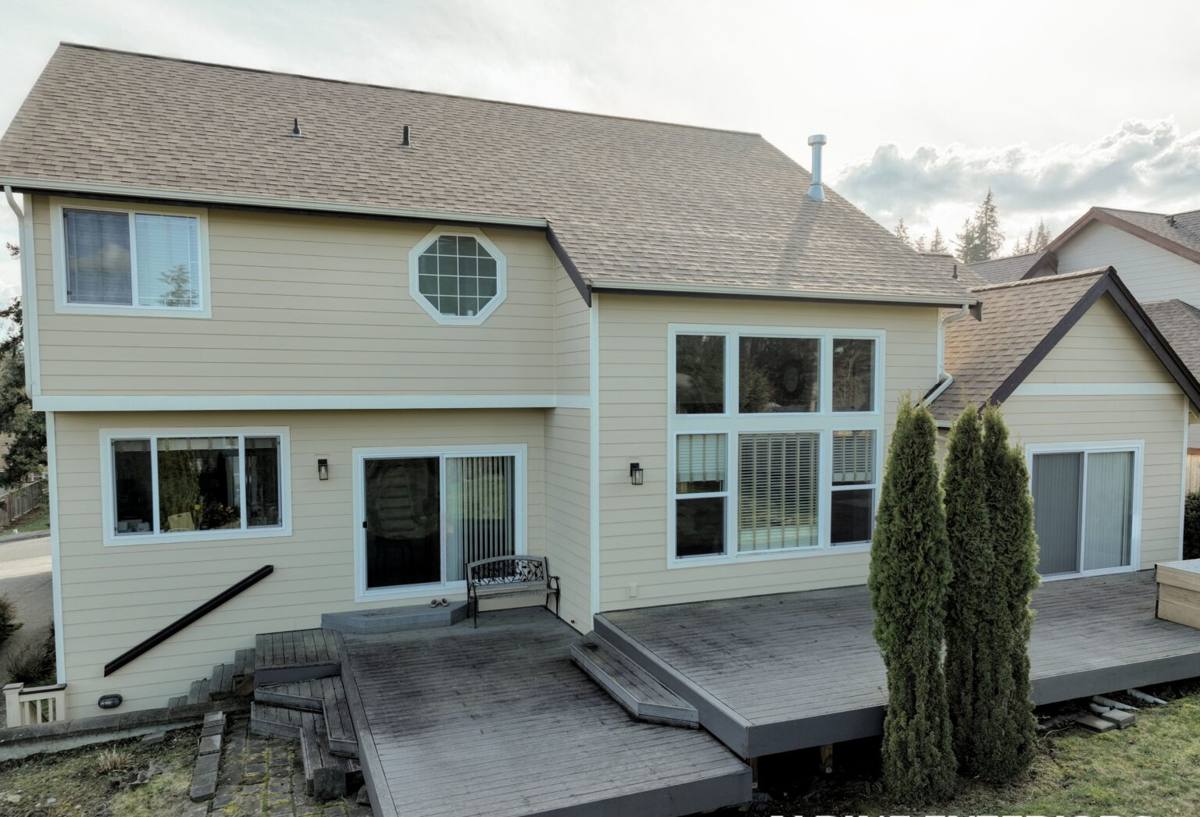
What Salt Air, Driving Rain, and Moss Season Actually Do to a Window
Salt Air and Hardware
Salt in the air accelerates corrosion on anything metal — window locks, hinges, screen frames, and especially the fasteners and flashing behind the trim that you never see until something fails. Cheaper hardware or non-marine-grade fasteners can start showing pitting and stiffness years before they should. On a coastal-adjacent property like Bow, hardware quality and fastener choice matter more than they would 20 miles inland.
Driving Rain and Water Intrusion
Wind-driven rain doesn't just hit glass — it gets pushed up under sills, into corner joints, and behind trim boards if the flashing and sealant details aren't right. A window can look fine from inside for years while water is slowly working its way into the wall cavity around it. By the time you see staining on drywall or trim, the damage underneath is usually already established.
Moss, Algae, and Prolonged Dampness
Shaded exposures and a long damp season keep moisture sitting against window trim and sills longer than in sunnier climates. That constant dampness is exactly what moss and algae need to take hold, and it's also what accelerates wood rot in sills, jambs, and the trim boards around a window opening. Vinyl and fiberglass frames don't rot, but the wood framing and trim around any window — regardless of frame material — still needs correct flashing and drainage to stay dry.
Signs a Bow Home's Windows Need Replacing
- Sashes that stick, won't latch fully, or have visibly warped or swollen
- Condensation or fogging between panes of double-glazed glass — the seal has failed
- Soft, spongy, or discolored wood at the sill or bottom corners of the frame
- Visible gaps, cracked caulk, or daylight showing around the frame from inside
- Persistent drafts near the window even with it fully closed and locked
- Paint that keeps failing on the sill or trim no matter how often it's redone
- Noticeably higher heating bills in a room with older, single-pane, or aluminum-frame windows
What a Correct Window Replacement Actually Involves
Window replacement is often sold as a simple swap, but the window itself is only part of the job. The details that determine whether a window lasts 25 years or fails in 5 are almost all in the opening — not the window.
The Opening Matters More Than the Window
Before a new window goes in, the old unit has to come out cleanly so the rough opening can actually be inspected. This is the point where a lot of hidden problems in older Bow homes get found — soft framing, missing or degraded flashing, insulation that's been wet and compressed, or sill pans that were never installed in the first place. Skipping this step and just dropping a new window into a bad opening is how you get a beautiful window that fails again in a few years.
Flashing and Drainage Details
Given how much driving rain this area sees, the flashing sequence around a window is not optional detail work — it's the difference between a dry wall cavity and a slow, expensive rot problem. A correct install uses a sloped sill pan so any water that does get past the glass drains back outside instead of pooling, along with properly lapped flashing tape at the sides and head so water sheds down and out, never in.
Sealant and Air Sealing
Exterior sealant keeps bulk water out; interior air sealing (backer rod and low-expansion foam, not just caulk) stops drafts and moisture-laden interior air from condensing inside the wall cavity. Both matter, and they're not interchangeable — using caulk to do the job of proper air sealing is a common shortcut that causes problems later.
Frame Material Comparison for a Coastal-Adjacent Climate
| Frame Material | How It Handles Bow's Climate | Maintenance |
|---|---|---|
| Vinyl | Won't rot or corrode; performs well in salt air and damp conditions | Low — occasional cleaning, no painting |
| Fiberglass | Very stable in temperature swings and moisture; strong long-term option near the coast | Low — occasional cleaning, no painting |
| Wood (clad exterior) | Good insulator; exterior cladding protects the wood from direct weather exposure | Moderate — interior finish upkeep, watch for cladding seal failures |
| Wood (unclad) | Most exposed to rot risk from driving rain and prolonged dampness without diligent upkeep | High — regular painting/sealing required |
| Aluminum | Prone to condensation and slower to insulate; can corrode faster in salt air without proper coatings | Moderate to high |
There's no single "right" material for every home — a wood-clad window on a covered porch elevation is a very different situation than a bare wall taking direct west wind and rain. What matters is matching the material and the install detail to the specific exposure on your house, and being honest about the upkeep each option asks of you.
How Our Process Works
- On-site assessment: we look at each window's exposure, current condition, and the state of the framing and flashing where visible, not just the glass.
- Honest recommendation: we tell you which windows genuinely need replacement now, which can wait, and why — no upselling a full-house job when a few units are the actual problem.
- Written estimate: clear pricing by window, material, and any extra work the opening needs (rot repair, re-flashing, etc.) called out separately so there are no surprises.
- Careful removal: old units come out without damaging siding or trim more than necessary, and we inspect the opening before anything new goes in.
- Correct installation: sill pan, flashing sequence, air sealing, and fastening done to hold up against wind-driven rain, not just to look finished on install day.
- Cleanup and walkthrough: we walk each window with you so you know it operates and locks correctly before we consider the job done.
Cost Factors for Window Replacement in Bow
| Factor | Why It Affects Price |
|---|---|
| Frame material | Vinyl is typically the most budget-friendly; fiberglass and clad wood cost more upfront but suit heavier exposure |
| Number of windows | Per-unit pricing usually drops somewhat on larger multi-window projects |
| Opening condition | Rot repair or reframing found once the old window is out adds cost but is essential to do right |
| Window size and type | Standard double-hung or slider units cost less than large picture windows or custom shapes |
| Glass package | Upgraded low-E coatings or gas fills add cost but improve comfort and efficiency |
| Access and exposure | Second-story or hard-to-access windows, and units on the weather-facing side of the house, can take more time to do correctly |
We don't publish blanket prices because the honest answer depends on your specific windows, but we'll give you a clear, itemized number before any work starts.
Why a Crew That Already Works Bow Matters
Bow isn't a big place, but it has its own weather patterns and building stock — a mix of older farmhouses, waterfront-adjacent properties, and newer construction, each with different exposure to the wind and rain coming off the bay. A crew that already works this specific area has seen how these houses actually hold up over time, which openings tend to have hidden rot, and which elevations need extra attention to flashing. That's knowledge you don't get from a crew that's mostly worked drier, more sheltered parts of Skagit County or comes in from outside the area for a single job.
There's also a practical side: local crews know the permitting expectations, can respond quickly if a problem shows up after install, and have a reputation in the community worth protecting. When you're trusting someone to cut openings into your exterior walls, that local accountability is worth something.
Maintaining New Windows Through Skagit County's Wet Season
A correctly installed window still benefits from basic upkeep, especially given how long the damp season runs here. A few habits go a long way:
- Rinse sills and tracks periodically to keep moss and algae from getting a foothold
- Check exterior caulking annually, especially after a hard winter, and touch up if it's cracked or pulling away
- Keep gutters and downspouts clear so roof runoff isn't sheeting down across window heads
- Trim back vegetation that keeps a window's exterior shaded and damp longer than necessary
- Open and close each window a few times a season so hardware doesn't seize up from disuse
None of this is complicated, but skipping it is how a well-installed window ends up looking neglected years before it should.
Get a Straightforward Estimate
If your Bow home has windows that are drafty, fogged, sticking, or showing soft spots at the sill, it's worth getting a professional look before the next wet season sets in. We'll give you an honest assessment of what actually needs replacing, walk you through material options suited to your home's exposure, and provide a clear, no-pressure estimate — use the form below to get started.