 Anacortes Siding
 Similk Beach Sits Right Where Weather Does the Most Damage
Similk Beach is one of the more exposed pockets of the Anacortes area — homes here sit close to Similk Bay, often tucked under fir and cedar cover, with saltwater on one side and shaded, damp ground on the other. That combination is tough on siding in a way that inland Skagit County properties don't experience nearly as much. Salt-laden air corrodes fasteners and trim faster, driving rain off the water finds every gap in a wall assembly, and the shade that makes these lots so pleasant in summer also keeps siding wet and mossy for months at a time. When we get a repair call from Similk Beach, we're rarely dealing with a single obvious problem. It's usually a combination of moisture, salt exposure, and organic growth that's been working on the siding for years before it became visible.
This page is about siding repair specifically — not full re-siding — for homes in this shoreline community. A repair, done correctly, can add real years to siding that's otherwise sound. Done poorly, it hides a problem instead of fixing it, and you end up paying for the same repair twice.
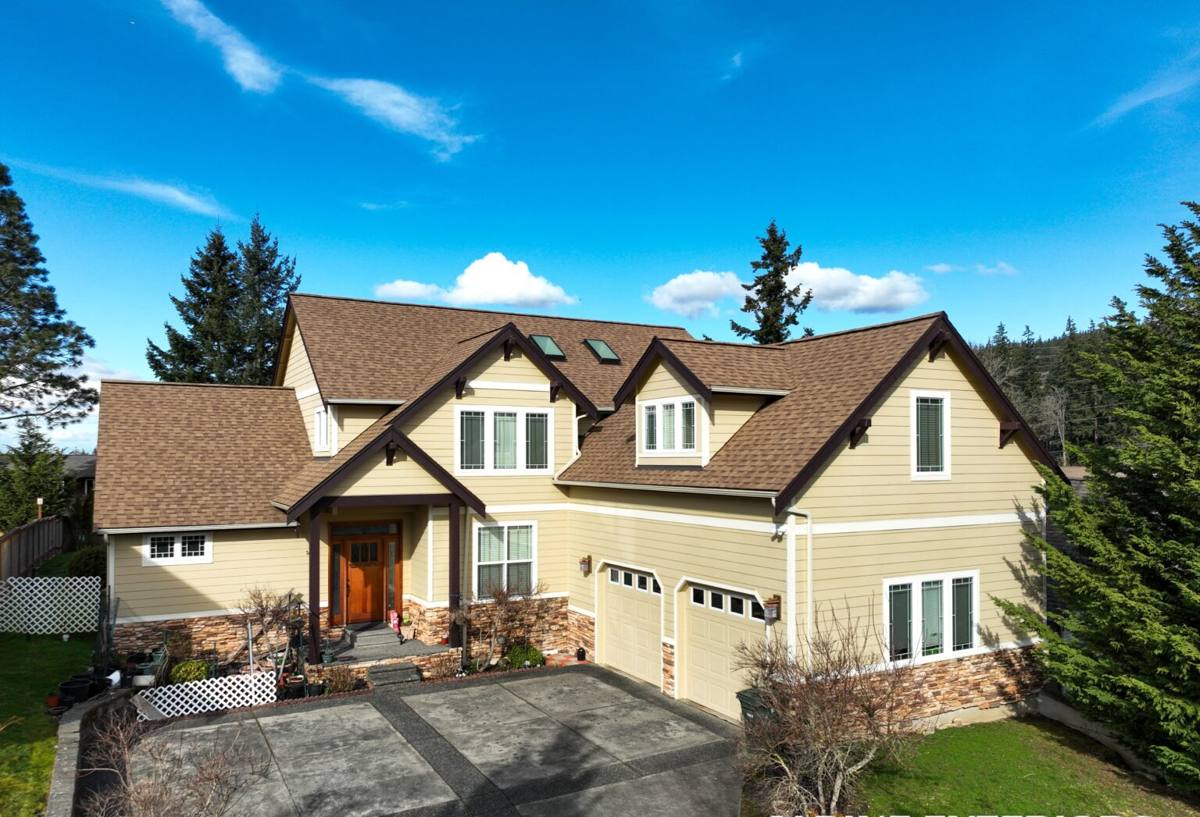
What Salt Air, Rain, and Moss Actually Do to Siding
Salt Air
Airborne salt from Similk Bay settles on exterior surfaces and accelerates corrosion of nails, staples, and metal trim pieces. Once a fastener starts to corrode, it loses its grip, and the siding piece around it starts to move. Movement opens gaps, and gaps let water in behind the cladding — which is where the real damage starts.
Driving Rain
Storms coming off the water don't fall straight down — they're pushed sideways into walls, window trim, and butt joints. Siding that would shed a normal vertical rain just fine can still take on water when it's driven horizontally, especially at seams, corners, and anywhere caulk has started to fail.
Moss and Prolonged Dampness
Shaded, low-airflow sections of a home — north walls, areas under overhangs, spots tucked behind landscaping — stay damp longer here than almost anywhere else in Anacortes. Moss and algae take hold in that dampness, and while they look like a cosmetic problem, they hold moisture directly against the siding surface around the clock. Over a long moss season, that constant dampness is what actually breaks siding down, whether it's wood, engineered wood, or an aging finish coat.
Signs Your Siding Needs Repair, Not Just a Cleaning
Not every mossy or discolored wall needs repair work — sometimes it just needs a proper wash. But there's a point where the damage has moved past cosmetic. Signs worth having looked at:
- Soft or spongy spots when you press on a siding panel
- Visible gaps opening at seams, corners, or where trim meets siding
- Paint or finish that's bubbling, peeling, or flaking rather than just fading
- Streaking or dark staining below nail heads or seams
- Siding that's visibly bowed, cupped, or pulling away from the wall
- Moss or algae that regrows within weeks of being cleaned off
- Soft trim boards or a musty smell near an exterior wall from inside the house
Any one of these on its own might be minor. Several of them together, especially on a wall facing the water or shaded by trees, usually means moisture has already gotten behind the siding and the repair needs to address more than the surface.
What a Correct Siding Repair Actually Involves
A repair that's done right is not just pulling off a bad board and nailing up a new one. On a Similk Beach home, we treat every repair as a chance to check the parts of the wall you can't see from the driveway:
- Remove the damaged section carefully so the surrounding siding and trim aren't stressed or cracked in the process.
- Inspect the water-resistive barrier and sheathing underneath. This is the step that separates a real repair from a cosmetic patch — if the barrier is torn or the sheathing is soft, replacing siding over it just resets the clock on the same failure.
- Address the cause, not just the symptom — a failed flashing detail, a caulk joint that opened up, a fastener pattern that let water track behind the panel.
- Match the replacement material to the existing siding as closely as possible in profile, reveal, and finish, so the repair doesn't stand out as a patch.
- Reseal and refasten correctly, using fasteners and sealants rated for coastal, high-moisture exposure rather than whatever's fastest off the shelf.
Skip any of those steps and you've patched the visible symptom while leaving the actual entry point for water untouched — which, on a shoreline lot like this, tends to resurface within a season or two.
Repair vs. Replacement: How We Make the Call
Homeowners often assume any siding problem means full replacement, and just as often assume a small visible issue means a quick patch will do. Neither assumption is reliable on its own. We look at the extent of the damage, how much of the wall assembly is affected, and how much useful life is left in the rest of the siding before recommending one or the other.
| Signal | Repair Usually Makes Sense | Replacement Is Usually Smarter |
|---|---|---|
| Extent of damage | Isolated to one or two sections or walls | Recurring across multiple walls or elevations |
| Sheathing condition | Solid, dry sheathing behind the affected area | Soft, delaminated, or moisture-damaged sheathing found in multiple spots |
| Age of existing siding | Siding is mid-life and otherwise performing well | Siding is near or past its expected service life |
| Cause of failure | A single, fixable detail (flashing, caulk, one bad board) | A systemic issue — product-wide moisture behavior, failing finish, widespread fastener corrosion |
| Cosmetic match | Replacement material can be matched closely | Original product is discontinued or won't match without a full wall re-side |
We'll always tell you honestly which side of that table your home falls on. A straightforward repair is a fraction of the cost of replacement, and we're not going to sell you a bigger job than the house needs. On the other hand, if we find moisture damage spreading behind the siding on a shoreline home, patching over it isn't doing you any favors.
Why We Repair With James Hardie Fiber Cement
We install and repair with James Hardie fiber cement siding exclusively — we don't stock or install vinyl, LP SmartSide, or other engineered wood products, and that standard applies to repair work too. On a home like the ones along Similk Bay, the reasoning is straightforward: fiber cement doesn't absorb water the way wood-based products can, it doesn't provide the same food source for moss and algae, and it's non-combustible, which matters given how many of these lots sit close to dry brush and tree cover in summer. Hardie's ColorPlus factory finish also means a well-matched repair piece keeps its color instead of visibly fading against the surrounding siding within a year or two, which is a real problem with field-painted repairs in this much sun-to-shade variation.
If your existing siding is already Hardie, a repair is usually a clean match — we can source the same profile and, where possible, the same ColorPlus finish, so the patched section blends in rather than standing out. If your current siding is a different product and it's failing in a way that keeps generating repair calls, that's usually the point where we talk about whether it makes more sense to address the problem wall-by-wall with Hardie rather than keep repairing a product that isn't holding up to this exposure.
Our Process for Similk Beach Repairs
- On-site inspection. We look at the visible damage and check adjacent areas — corners, trim, penetrations — that tend to fail together on shoreline homes.
- Diagnosis, not just a quote. We tell you what's actually causing the failure, not just what it'll cost to cover it up.
- Honest repair-or-replace recommendation. Using the factors above, we tell you which one your home actually needs.
- Material matching. For Hardie repairs, we match profile, reveal, and finish as closely as the product line allows.
- Correct installation. Proper flashing, fastening, and sealing details for a coastal, high-moisture environment — not shortcuts that'll be back on our schedule in two years.
- Walkthrough. We show you what was found, what was fixed, and what to keep an eye on going forward.
Why Local Experience Matters Here
Similk Beach isn't like a subdivision a few miles inland. Wind exposure, tree cover, and proximity to the water vary block by block, and a crew that's only worked in drier, more sheltered parts of Skagit County can miss what's actually driving the failure on a lot like this. A crew that already works this shoreline knows to check the water-facing walls first, knows how fast moss comes back in the shaded sections, and knows which fastener and flashing details actually hold up to salt air instead of just meeting code on paper. That local pattern-recognition is a big part of why a repair holds for years instead of needing a follow-up call the next wet season.
It also matters for permitting and code questions specific to Skagit County and the Anacortes area — knowing what does and doesn't require a permit for exterior repair work saves you time and avoids surprises partway through the job.
After the Repair: Keeping Similk Beach Siding Ahead of the Weather
A good repair buys you time, but the same conditions that caused the original damage don't go away. A little regular attention keeps a repaired wall — and the rest of your siding — from ending up back in the same spot.
- Rinse siding and knock back moss growth at least once a year, more often on shaded, water-facing walls
- Check caulk joints at trim, corners, and penetrations annually and reseal before gaps open up
- Keep gutters clear so overflow isn't running down the siding face
- Trim back vegetation and tree limbs that keep a wall section shaded and damp
- Walk the exterior after major storms and note any new soft spots, staining, or open joints
- Address small issues right away — a small caulk failure is a five-minute fix; a rotted sheathing panel behind it is not
If you're seeing moss that won't stay gone, soft spots, or open seams on a Similk Beach home, we're glad to take a look and give you a straight answer on what it actually needs. Reach out for a free, no-pressure estimate — we'll tell you honestly whether it's a repair or something bigger, with no upsell either way.