 Anacortes Siding
 Ship Harbor's Waterfront Exposure Is a Different Kind of Job
Ship Harbor sits close enough to the water that homes here take a different kind of weathering than siding jobs a few miles inland in Skagit County. Salt-laden air off the strait works into seams, fasteners, and caulk lines year-round. Wind-driven rain doesn't just fall straight down — it gets pushed sideways into laps, corner boards, and window trim during winter storms. And the long stretch of gray, damp months means moss and algae have months at a time to take hold on north-facing walls and anything shaded by trees or a neighboring roofline. None of this is unique to one house on one street — it's the baseline condition for anything built near this shoreline, and it's exactly what the siding on a Ship Harbor home has to be engineered and installed to handle.
A siding product and installation method that works fine in a dry inland climate can fail years early out here if it wasn't chosen and installed with salt air and driving rain in mind. That's the lens we use on every Ship Harbor estimate: not "what's the cheapest siding that looks good," but "what will still be doing its job in twenty years given what this specific location throws at it."
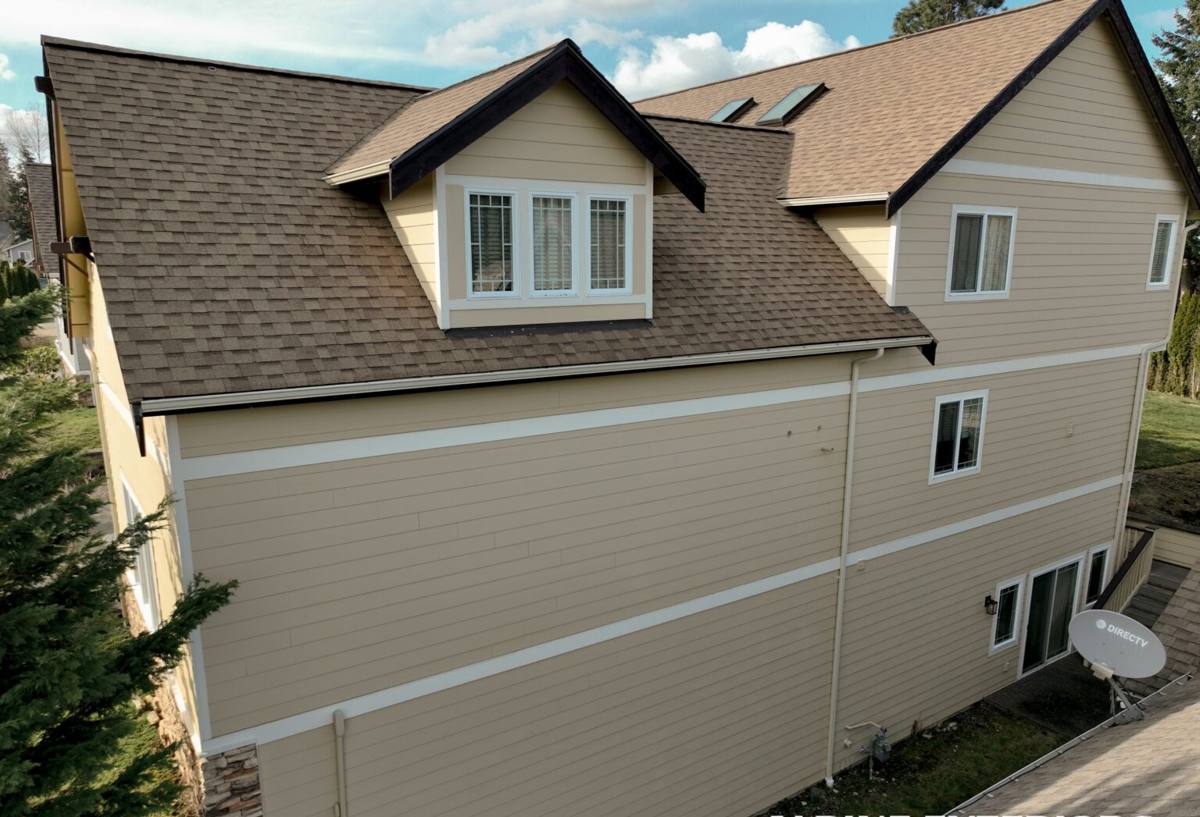
What Salt Air, Rain, and Moss Actually Do to Siding
Salt Air and Corrosion
Airborne salt accelerates corrosion on anything metal — fasteners, flashing, trim screws, even staples left behind from a previous siding job. Once a fastener starts rusting behind the siding, it weakens its grip, water tracks down the corroded shank, and you get a slow, hidden path for moisture to reach the wall sheathing. This is a much bigger deal on waterfront-adjacent lots than it is a few miles inland.
Wind-Driven Rain
Standard lap siding assumes rain mostly falls vertically. On exposed Ship Harbor lots, wind pushes rain up and under laps, around inside corners, and into any gap where flashing or caulking is even slightly short of spec. The failure point is almost never the siding material itself — it's the flashing details, the lap exposure, and the sealant joints that were rushed or skipped.
Moss and Algae
Skagit County's damp season runs long, and shaded or north-facing walls can stay wet for days after a storm passes. Moss and algae don't just look bad — sustained moisture held against a wall by organic growth keeps the substrate wetter for longer, which matters more for some siding materials than others. Fiber cement handles this far better than wood or wood-based composite products, but even fiber cement needs the right finish and installation to shed water instead of holding it.
What a Correct Fiber Cement Job Requires Here
Fiber cement siding is not a "nail it up and caulk the gaps" product, especially in an exposure like this. The material is only as good as the water-management system behind it.
Moisture Management Behind the Siding
Every wall gets a water-resistive barrier, and on exposed elevations we pay extra attention to lap overlaps, seam taping, and window and door flashing sequencing — installed shingle-style so water is always directed outward and down, never trapped behind a joint. A rainscreen gap (a thin drainage space between the barrier and the siding) is worth discussing on the most exposed walls of a Ship Harbor home, since it gives incidental moisture a place to drain and dry instead of sitting against the back of the siding.
Fasteners and Corrosion Resistance
Given the salt air, fastener choice isn't optional detail — it's a durability decision. Hot-dipped galvanized or stainless fasteners, installed at the correct spacing and depth (not overdriven, which cracks the material's edge and opens a water path), are non-negotiable on this kind of job.
Caulking and Sealant Joints
Every trim joint, butt seam, and penetration needs the right sealant, applied correctly the first time. On a waterfront-exposed home, a shortcut here shows up as a stain or soft spot two or three winters later, not immediately — which is exactly why it's tempting to skip and exactly why we don't.
Clearances and Grade
Fiber cement siding needs proper clearance from the ground, roof lines, decks, and hardscape so it isn't sitting in standing water or splash-back. This is a basic install standard everywhere, but it matters more where the ground stays saturated longer during the wet season.
Why We Install James Hardie Fiber Cement Only
We don't install vinyl, LP SmartSide, Cemplank, Allura, or bare cedar and primed spruce siding, and Ship Harbor's climate is a good example of why. Vinyl can warp and its seams are a weak point against wind-driven rain. Wood-based products, including engineered wood siding, are more vulnerable to sustained moisture exposure than fiber cement — and sustained moisture is Ship Harbor's specialty for a good chunk of the year. Other fiber cement brands exist, but we standardized on James Hardie because of the combination of factory-applied ColorPlus finish (which resists the fading and touch-up headaches that come with field-painted siding exposed to sun and salt spray), a climate-engineered product line, and a transferable warranty backed by a manufacturer with a long track record in exactly this kind of installation.
HardiePlank HZ5 for This Climate
James Hardie engineers its HZ (HardieZone) product lines for different climate zones. The HZ5 line is built for the wetter, more moisture-exposed climates found in the Pacific Northwest — including the freeze-thaw swings and prolonged damp conditions Skagit County sees. That's the line we spec for Ship Harbor homes, not the general-purpose version sold in drier regions of the country.
Non-Combustible, Doesn't Rot, Doesn't Feed Moss the Way Wood Does
Fiber cement is cement-based, so it doesn't rot the way wood siding can when it stays wet, and it won't feed the kind of organic growth that finds a foothold on damp wood surfaces. It still needs to be kept clean of built-up moss and debris like any siding, but the material itself isn't degrading the way a wood-based product would under the same conditions.
Cost Factors for a Ship Harbor Fiber Cement Job
Fiber cement installed to spec generally runs in a broad range of roughly $8–$14 per square foot installed nationally, though the final number on any given house depends heavily on the specifics below. We'll always walk your home and give you a real number rather than a rough average — but here's what actually moves the price on a waterfront-exposed Skagit County home.
| Cost Factor | Why It Matters in Ship Harbor |
|---|---|
| Tear-off and disposal of existing siding | Older wood or vinyl siding on exposed walls often hides moisture damage that needs to be addressed before new siding goes on |
| Sheathing and framing repair | Salt air and long-term moisture exposure can mean more rot repair than an inland home of the same age |
| Home height and wall exposure | Two-story and waterfront-facing walls need more careful flashing and staging, which adds labor time |
| Trim and corner detailing | Corner boards and window trim are where wind-driven rain intrudes first, so these details take more care and material |
| Rainscreen / drainage gap | Recommended on the most exposed elevations here; adds material and labor but extends service life |
| Siding profile and ColorPlus color | Lap width, texture, and factory finish choice affect material cost but not labor |
Our Process From Estimate to Finished Siding
- On-site walk-through: we look at every elevation, noting sun/shade exposure, wind exposure, current moisture damage, and existing trim condition.
- Moisture inspection: where old siding is coming off, we check sheathing and framing before quoting final scope — this is where a fixed low-ball bid usually falls apart on an older waterfront-area home.
- Written scope and product spec: HardiePlank line, HZ5 rating, profile, and ColorPlus color, plus fastener and flashing spec, in writing before work starts.
- Tear-off and substrate repair: any soft sheathing or damaged framing gets replaced, not covered over.
- Water-resistive barrier and flashing: installed shingle-style around every window, door, and penetration.
- Siding installation: correct fastener type, spacing, and clearance, with extra attention on wind-exposed and shaded elevations.
- Caulking and final trim: sealant joints finished to manufacturer spec, not just "close enough."
- Final walk-through: we go over the finished job with you before calling it done.
What to Watch For Between Now and a Full Reside
If you're not ready for a full reside yet, there are warning signs worth checking for on a Ship Harbor home specifically, given the exposure:
- Soft or spongy siding, especially near ground level or under windows
- Paint that's bubbling or peeling on wood or composite siding — often a sign of trapped moisture
- Rust streaks below fasteners or metal trim pieces
- Persistent moss or dark algae staining on north-facing or shaded walls that comes back quickly after cleaning
- Caulk joints that have cracked, shrunk, or pulled away from trim
- Visible gaps at corner boards or where siding meets window and door trim
- Any musty smell or interior wall staining on an exterior wall, which can indicate moisture already inside the assembly
None of these mean you need siding replaced tomorrow, but they're worth a professional look before they turn into sheathing or framing repair.
Why Local Experience in This Exposure Matters
A crew that mostly works drier, inland neighborhoods can install fiber cement perfectly well by the book and still miss the details that matter specifically near open water — where the rainscreen gap earns its keep, which elevations need extra flashing attention, and how much clearance to leave given how long the ground stays wet here. Working Ship Harbor and the surrounding Anacortes and Skagit County area regularly means we're not guessing at how a house this close to the water behaves through a wet winter — we've seen what holds up and what doesn't on homes with this exact exposure, and we spec the job accordingly rather than defaulting to a generic install.
Permitting and inspection also move faster when a contractor already has a working relationship with local building officials and knows what they'll want documented on an exterior job in this area — one less thing for you to manage.
Maintenance After Installation
James Hardie's ColorPlus finish is factory-baked and more fade- and chip-resistant than field-applied paint, which matters in a spot that gets both sun exposure and salt spray. Even so, a Ship Harbor home benefits from:
- An annual rinse-down to keep salt residue and organic buildup from accumulating, especially on shaded walls
- A visual check of caulk joints every year or two, since sealant is the one component that ages faster than the siding itself
- Prompt attention to any gutter or downspout issues, since misdirected roof water concentrated onto one section of wall will outpace what any siding is designed to shed
Done right, a correctly installed and maintained Hardie system should be one of the lowest-maintenance parts of the house, even in this exposure — not the thing you're worrying about every winter.
If you're weighing a reside or just want an honest read on what your current siding has left in it, we're glad to walk the house and give you a straight answer. There's a free, no-pressure estimate form below — no obligation, just a real look at what your home in Ship Harbor actually needs.