 Anacortes Siding
 Why La Conner Roofs Wear Differently
La Conner sits low against the Swinomish Channel, close enough to Skagit Bay and the Salish Sea that salt-laden air is a constant, not an occasional weather event. Combine that with Skagit County's long wet season, frequent driving rain off the water, and shade from mature trees on many older lots, and you get a roofing environment that's harder on materials than most inland Washington towns. A roof that would last 25-30 years in a dry climate can show real wear in 15-18 years here if it wasn't built for these conditions in the first place.
We see the same failure patterns over and over on La Conner homes: fasteners corroding faster than the shingles around them, moss working its way under tab edges on north-facing slopes, and valleys that were never properly flashed for the volume of water this area actually sees. None of that is exotic — it's just what happens when a roof gets installed to a generic spec instead of a coastal Skagit County one.
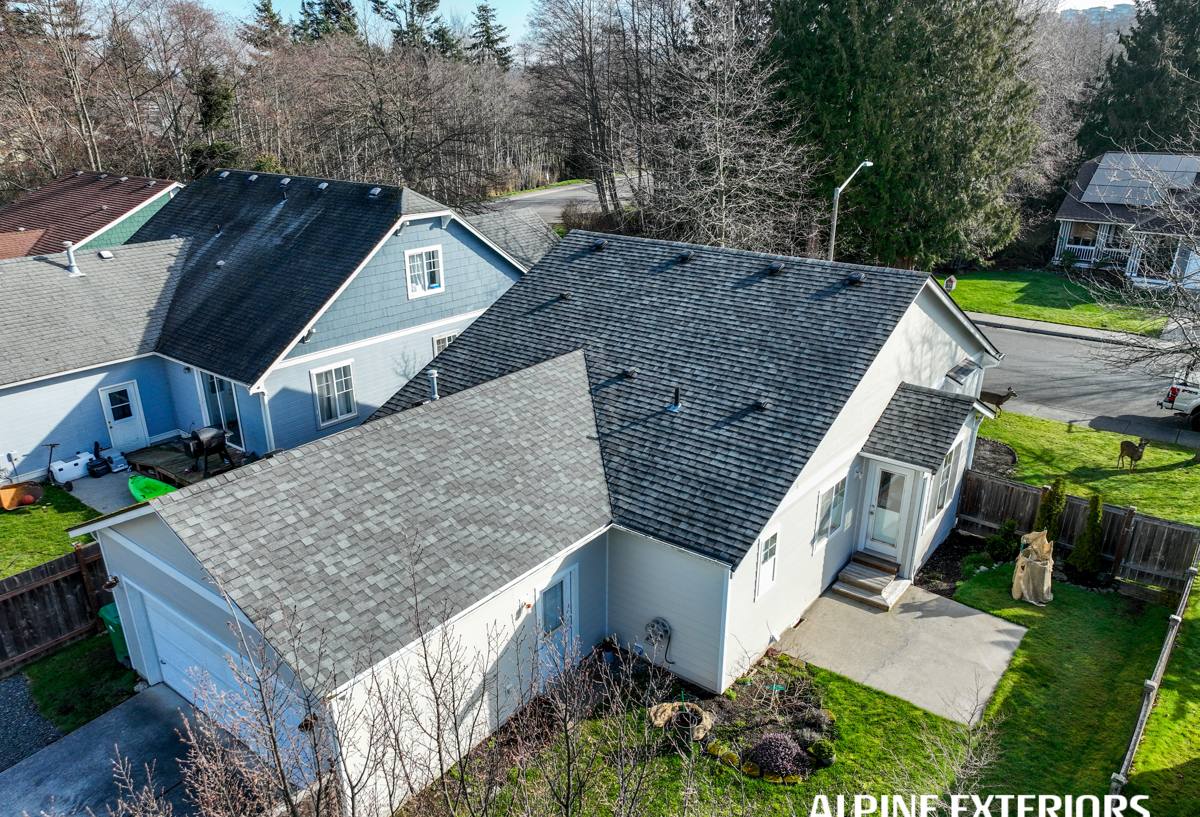
The Three Forces Working Against Your Roof
Salt Air
Airborne salt accelerates corrosion on anything metal — nails, flashing, drip edge, valley metal, and the fasteners holding your shingles or panels down. Standard electro-galvanized fasteners can start rusting within a handful of years this close to the water. The fix isn't complicated, but it does need to be specified correctly: stainless steel or hot-dip galvanized fasteners, and flashing metals chosen for salt exposure rather than whatever was cheapest at the supply house.
Driving Rain
Wind off the channel and the bay doesn't just drop rain straight down — it drives it sideways and up under laps, edges, and poorly sealed penetrations. A roof that's technically watertight in calm conditions can still leak in a La Conner windstorm if the underlayment, flashing details, and starter courses weren't built with wind-driven rain in mind.
Moss and Persistent Moisture
Long wet seasons and shaded lots mean moss and algae get a head start every year and rarely fully dry out between storms. Moss holds moisture directly against the roofing surface, lifts shingle edges as it grows, and works its way into fastener penetrations. Left alone, it shortens the life of almost any roofing material — asphalt shingles most of all.
What a Correct Roof Replacement Actually Involves
A roof replacement is more than stripping old material and nailing down new. In this climate, the details underneath the visible surface determine whether the roof performs for its full expected life or starts leaking in year eight.
- Full tear-off to the decking — never a layover — so we can inspect the sheathing and structure underneath
- Repair or replacement of any soft, delaminated, or water-stained decking before anything new goes down
- Ice-and-water shield or a comparable self-adhering membrane at eaves, valleys, and any low-slope transitions
- Synthetic underlayment rated for extended exposure, since wet-season schedules sometimes mean the underlayment is the only weather barrier for a stretch of days
- Corrosion-resistant fasteners and flashing metals throughout — not just at the visible edges
- Proper valley construction, sized for real water volume rather than a minimum-code approach
- Balanced intake and exhaust ventilation, since trapped moisture in the attic works against the roof from underneath
- Final inspection of penetrations — vents, stacks, skylights — where the majority of leaks actually originate
Choosing Materials for a Coastal Skagit County Home
There's no single "best" roofing material for La Conner — the right choice depends on your home's slope, exposure to tree cover, and how much upkeep you want to commit to. What matters is picking a material and understanding its trade-offs honestly, rather than assuming any product is maintenance-free near the water.
| Material | Typical Lifespan Here | What to Know Locally |
|---|---|---|
| Architectural asphalt shingles | 18-25 years | Most affordable option; algae-resistant granules help but don't eliminate moss risk on shaded, north-facing slopes |
| Standing seam metal | 40+ years | Sheds moss and moisture well; needs marine-grade or coastal-rated fasteners and coatings to hold up to salt air |
| Synthetic/composite shingles | 30-40 years | Resists moisture absorption better than wood or standard asphalt; higher upfront cost |
| Wood shake or shingle | 15-25 years with upkeep | Attractive on older/historic-style homes but demands regular treatment and moss removal to hit that range |
On homes with heavy tree cover or a north-facing roof plane, we'll often steer homeowners toward materials and slope details that shed moisture faster, simply because that side of the roof never gets the drying benefit of direct sun.
Signs Your La Conner Roof Needs Replacing, Not Patching
Not every roof problem calls for a full replacement, and we won't tell you it does. But there's a point where repeated repairs stop making financial sense compared to one correct replacement.
- Granule loss heavy enough that shingles look patchy or bare in spots
- Shingles that are curling, cupping, or cracking, especially on south- and west-facing slopes
- Moss that returns within months of cleaning, even after treatment
- Soft spots in the decking when walked, or visible sagging along the roofline
- Water stains on interior ceilings that keep reappearing after "spot" repairs
- A roof that's approaching or past its material's expected lifespan and has multiple prior repairs
Repair vs. Replace: A Quick Cost Framework
As a rough guide, if repair costs are approaching 30-40% of what a full replacement would run, or if the roof already has more than one prior repair on record, replacement is usually the better long-term value — you're not paying to patch a system that's already failing in multiple places.
Our Process for a La Conner Roof Replacement
- On-site inspection. We look at the roof from the ground and, where safe, up close — checking slope, ventilation, decking condition, and existing flashing details.
- Honest assessment and written estimate. We tell you what we find, including whether repair is a reasonable option, and put pricing and scope in writing.
- Material selection. We walk through the trade-offs for your specific roof — sun exposure, tree cover, budget — rather than pushing one product for every home.
- Scheduling around Skagit County weather. We plan tear-off in windows that minimize the time your decking is exposed, and we stage materials so a sudden system off the water doesn't catch an open roof.
- Full tear-off and inspection. Every square foot of decking gets checked before new material goes down — no surprises left hidden.
- Installation to a coastal spec. Corrosion-resistant fasteners, proper underlayment, correctly built valleys and flashing — the details that actually determine roof lifespan here.
- Final walkthrough. We review the finished work with you and answer questions before we consider the job done.
Why Local Experience Matters for This Job
A roofing crew that mostly works dry, inland jobs will often spec a roof to generic manufacturer minimums — because that's what holds up where they normally work. Those minimums aren't wrong, exactly, but they're not built for a home exposed to Skagit Bay salt air and channel wind. A crew that regularly works La Conner and the surrounding Anacortes area already knows which fastener grades hold up, which valley details actually keep pace with driving rain, and which roof planes need extra attention for moss.
That local pattern recognition shows up in small decisions throughout the job — the underlayment brand chosen for extended exposure windows, the flashing metal picked for salt resistance, the extra care on a shaded north slope — decisions that are easy to skip if you don't already know they matter here.
Maintaining Your New Roof in This Climate
A correctly installed roof still benefits from basic upkeep in this environment. None of this is complicated, but skipping it shortens the life of even a well-built roof.
- Clear debris from valleys and gutters at least twice a year, more often under heavy tree cover
- Have moss treated at the first sign of regrowth rather than waiting for it to spread
- Keep overhanging branches trimmed back to reduce shade and debris buildup
- Schedule a visual inspection every few years, or after any major windstorm off the water
- Address small leaks or flashing issues promptly — they rarely stay small in this climate
Get a Straight Answer About Your Roof
If your La Conner-area roof is showing granule loss, recurring moss, or you're just not sure whether it needs repair or replacement, we're happy to take a look and give you a straightforward, no-pressure estimate. Use the form below to get started.