 Anacortes Siding
 Why Oak Harbor Roofs Wear Differently Than Roofs Inland
Homes around Oak Harbor sit close to the water, and that changes what a roof has to survive. Salt-laden air moves off the Sound and settles on every exposed surface, working slowly on exposed metal fasteners, flashing, and vent stacks. Add in driving rain that comes in sideways during winter storms, and a long stretch of the year where shaded roof slopes barely dry out, and you get a roof that ages faster and fails in different spots than a roof thirty miles inland. We work exteriors across the Anacortes and Skagit County area, and the repair calls we get from the Oak Harbor side of our service area are consistently different from what we see in drier, more sheltered neighborhoods.
None of this means Oak Harbor homes need exotic materials or gimmicks. It means the basics — flashing, fasteners, underlayment, and moss control — have to be done correctly and checked more often, because the margin for a sloppy repair is smaller here than it is in most of the country.
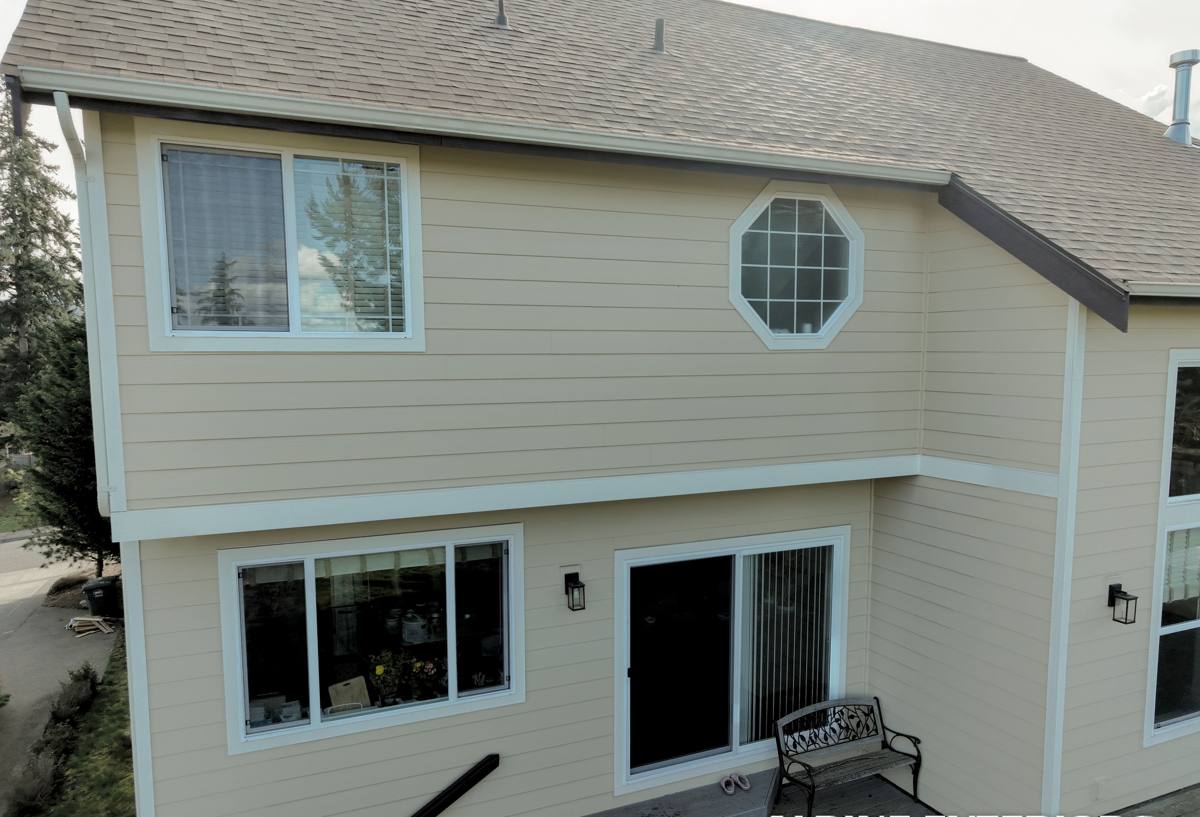
The Three Climate Factors That Drive Most Repair Calls
Salt Air and Corrosion
Salt air doesn't rot a roof the way moisture does, but it accelerates corrosion on anything metal that isn't properly rated or protected — nail heads, drip edge, flashing seams, and screws on ridge vents. Once a fastener starts to corrode, it loses its grip and its seal at the same time, which is how small leaks start at points that look fine from the ground.
Driving, Wind-Driven Rain
Rain that falls straight down is easy for a roof to shed. Rain that's pushed sideways by wind off the water finds every shortcut a shingle or flashing detail offers — open laps, under-driven fasteners, valleys with insufficient overlap. A repair that would hold up fine in calmer conditions can fail here within a season or two if it's not built for wind-driven water.
Extended Moss Season
Shaded, north-facing, and low-slope sections of roof in this region can stay damp for weeks at a time in fall, winter, and spring. That's exactly the environment moss and algae need. Moss doesn't just look bad — it holds moisture against the roofing material, lifts shingle edges as it grows, and can force water sideways under the roof covering instead of down and off.
Signs an Oak Harbor Roof Needs Repair Now
Most roof problems don't announce themselves as a dramatic leak. They show up as small, easy-to-dismiss signs first. If you're seeing any of the following, it's worth having it looked at before the next round of winter storms:
- Granule buildup in gutters or at downspout outlets, especially after a windy rain
- Moss or dark streaking concentrated on shaded or low-slope sections
- Curling, cupping, or lifted shingle edges, particularly on the side that faces prevailing wind
- Rust staining running down from flashing, vent stacks, or metal valleys
- Daylight visible through the roof deck from inside the attic
- Soft or spongy spots when walking a low-slope section
- Water stains on interior ceilings that appear only during hard rain, not light rain
- Loose or missing fasteners around ridge caps and hip lines
Any one of these on its own might be minor. Two or three together, especially in the same area of the roof, usually mean water has already found a path in and the repair needs to happen before the next atmospheric river event rather than after.
What a Correct Repair Actually Involves
A repair that holds up on this coastline isn't just patching the spot where water showed up inside the house. Water rarely travels straight down from where it enters the roof — it follows the underlayment, framing, and gravity until it finds a gap in the ceiling or wall, so the visible stain and the actual failure point are often several feet apart. A correct repair starts with tracing the path backward to the real entry point, not just covering the symptom.
From there, the work generally includes:
- Removing roofing material around the damaged area to expose the deck and underlayment, not just working on top of it
- Checking the roof deck itself for soft spots or rot before replacing anything on top of it
- Replacing damaged underlayment, not just shingles, since underlayment is the actual water barrier once shingles are compromised
- Re-flashing valleys, chimneys, vent stacks, and wall intersections with corrosion-appropriate materials and correct laps, rather than relying on sealant alone
- Matching shingle type, weight, and where reasonably possible, color and age, so the repair doesn't stand out or create a new weak seam
- Re-fastening with corrosion-resistant fasteners driven correctly — not overdriven, which cuts through the shingle, and not underdriven, which invites wind lift
Sealant and caulk have a place in roofing, but they're a finishing touch on top of correctly lapped, mechanically sound flashing — not a substitute for it. A repair that leans on sealant to do the structural work of flashing is the kind that reappears as a callback a year or two later.
Common Trouble Spots on Oak Harbor Roofs
Valleys and Flashing Intersections
Anywhere two roof planes meet, or a roof meets a wall or chimney, is a point where wind-driven rain concentrates. These intersections need more overlap and more careful sequencing than a straight run of shingles, and they're the first place a rushed repair shows its weakness.
Low-Slope and Shaded Sections
Porches, additions, and north-facing slopes that don't get direct sun dry out slowly. These sections need moss treatment and drainage checked as part of any repair, because fixing the immediate damage without addressing why that section stays wet just resets the clock on the same problem.
Vent Stacks and Roof Penetrations
Every pipe, vent, or fixture that penetrates the roof is a manufactured weak point. The rubber or metal boots around these penetrations degrade with age and UV exposure, and salt air speeds up corrosion on the metal components specifically. These are cheap to replace proactively and expensive to ignore.
Repair or Replacement: How We Help You Decide
Not every roof problem calls for a full tear-off, and not every roof is a good candidate for another patch. The honest answer depends on the roof's age, how widespread the damage is, and what's underneath the surface layer once we open it up.
| Factor | Leans Toward Repair | Leans Toward Replacement |
|---|---|---|
| Roof age | Under 15-20 years, depending on material | Near or past manufacturer's expected service life |
| Extent of damage | Isolated to one section or detail | Spread across multiple slopes or recurring in several spots |
| Deck condition | Solid, dry deck under the damaged area | Soft, rotted, or water-stained decking in multiple areas |
| Moss/algae history | Recent growth, surface-level | Long-term growth that's already lifted shingle edges |
| Cost pattern | One-time or infrequent repair need | Repeated repairs to the same areas over a few years |
Localized repairs on homes in this area commonly run from a few hundred dollars for a single flashing or shingle section up to a couple thousand for more involved valley or deck work — the actual number depends entirely on what we find once the damaged area is opened up. We'll always tell you plainly if a section has moved from "repair" into "you're better off replacing this slope" territory, rather than stacking repairs on a roof that's telling you it's done.
Our Process From Call to Finished Repair
- Initial conversation. We ask what you're seeing, where, and when it happens — a leak during hard, wind-driven rain points somewhere different than one that shows up in every storm.
- On-site inspection. We get on the roof (weather permitting) and in the attic if there's access, tracing the water path rather than assuming it starts where the stain is.
- Written assessment and options. You get a clear explanation of what's actually wrong, what a proper repair involves, and if relevant, an honest read on whether replacement makes more sense for that section.
- The repair itself. Deck inspection, underlayment replacement where needed, correct flashing and fastening, and shingle matching — done to hold up through the next storm season, not just pass a glance from the ground.
- Cleanup and walkthrough. We clear debris and fasteners from the yard and gutters and walk you through what was done and why.
Materials We Use for Coastal Roof Repairs
For fasteners and flashing near the water, we favor corrosion-resistant materials over standard-grade options, even though they cost more up front — the labor to redo a repair because the fasteners rusted out in five years costs far more than the material upgrade would have. Where roofing manufacturers specify particular underlayment or fastening patterns for coastal exposure, we follow those specs rather than defaulting to whatever's fastest to install, because doing so protects the warranty coverage on the materials as well as the workmanship.
We're straightforward about trade-offs. Some lower-cost flashing and fastener options save money initially but demand more frequent inspection and earlier replacement in a salt-air environment — that's a legitimate choice for a homeowner planning a shorter hold on the property, but we'll say so plainly rather than let it be a surprise later.
Preventing the Next Repair: Moss and Maintenance
A good repair addresses today's problem. A little maintenance keeps the next one further off. Between service visits, a few habits make a real difference on roofs in this climate:
- Keep gutters and downspouts clear so water has somewhere to go besides sideways under the shingles
- Trim back tree branches that shade roof sections and drop debris, since both extend how long a section stays wet
- Have moss treated before it becomes visible from the street — by the time it's obvious, it's often already lifting edges
- Walk the attic (or have it checked) after the first hard storm of the season, since interior signs show up before exterior ones often will
- Address small issues — a lifted shingle corner, a rusting nail head — while they're still small repairs
Why a Crew That Already Works Oak Harbor Matters
Roofing knowledge that's accurate for a dry inland climate doesn't automatically transfer to a coastal town on the Sound. Fastener selection, flashing detail, and how aggressively to treat moss are all judgment calls that get better with repeated exposure to this specific combination of salt air, wind direction, and rain pattern. A crew that works this stretch of Skagit County and the surrounding coastline regularly has already seen which repairs hold up through a full Pacific Northwest winter and which ones come back as callbacks — and builds accordingly, the first time.
As an exterior contractor working roofs, siding, and trim together, we also tend to catch roof-related issues — a failing flashing detail, a rotted fascia board, a moss problem creeping toward a wall — while we're already on-site for other work, before they turn into a bigger repair.
If you're seeing signs of trouble on your roof, or just want an honest read on its condition before the next storm season, we're glad to take a look. Reach out for a free, no-pressure estimate using the form below.