 Anacortes Siding
 Why March Point Siding Takes a Different Approach
March Point sits on a peninsula shaped by water on nearly every side — Fidalgo Bay to the east, Padilla Bay to the south, and the refinery-lined shoreline that gives the area its industrial backdrop. That geography matters more than most homeowners realize when it comes to exterior siding. Houses here don't just deal with Pacific Northwest rain; they deal with salt-laden air moving off the bay, near-constant humidity, and long stretches of overcast, wet weather that keep north- and shade-facing walls damp for days at a time. Add in Skagit County's moss season, which can run from early fall through late spring, and you've got a siding environment that punishes anything less than a well-built, well-installed cladding system.
We've worked on homes throughout this pocket of Anacortes long enough to know the failure patterns specific to it: caulk lines that give out early from salt exposure, paint that chalks and fades faster than it should on west-facing elevations, and moss creeping up from the ground line on shaded siding that never fully dries out. None of that is exotic — it's just what happens when a general-purpose siding job meets a specific coastal microclimate.
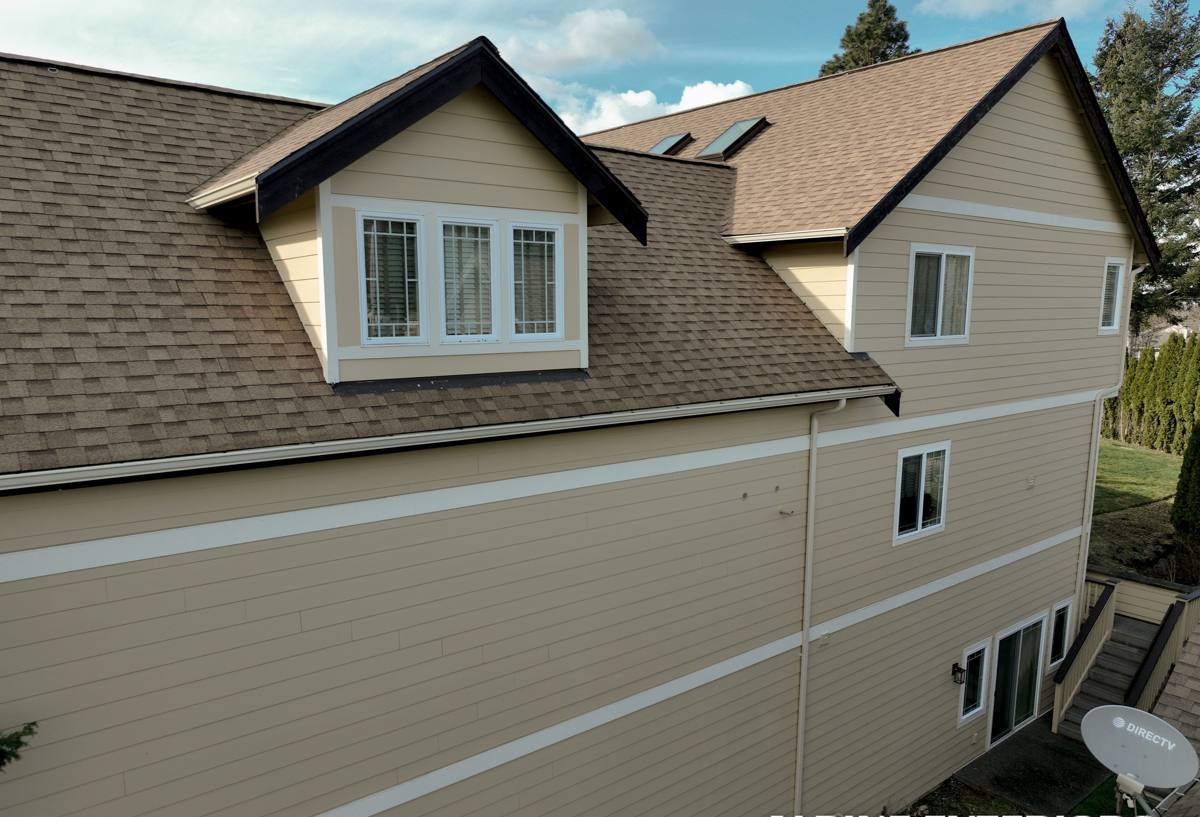
What Salt Air and Driving Rain Actually Do to Siding
It helps to be specific about the mechanisms at work, because the "why" drives the "how" of a correct installation.
Salt Air
Airborne salt is corrosive to metal fasteners, flashing, and trim accessories, and it accelerates the breakdown of lower-quality paint films. Over years, salt exposure can leave chalky residue on siding surfaces and speed up fading, especially on darker colors that absorb more heat and UV.
Driving Rain
Wind-driven rain off the bay doesn't just fall — it pushes sideways into wall assemblies, seeking any gap around windows, penetrations, and lap joints. A siding system that isn't properly flashed and lapped becomes a water delivery system rather than a water barrier.
Extended Moss Season
Shaded, damp walls in Skagit County can stay wet long enough for moss and algae to establish, especially on siding with a rougher or more absorbent surface. Left unaddressed, sustained moisture at the siding surface eventually finds its way into seams, fastener holes, and butt joints.
Why We Install Only James Hardie Fiber Cement
This is a fiber cement page, so it's worth being direct about what "fiber cement" means at our company: it means James Hardie, and nothing else. We don't install vinyl, LP SmartSide, primed wood, cedar, or other fiber cement brands like Allura or Cemplank on March Point homes, and that's a deliberate standard, not a sales pitch.
In a salt-air, high-moisture environment, the material differences stop being theoretical:
- Non-combustible core: Hardie's fiber cement won't ignite, warp, or degrade from heat the way engineered wood products can under sustained exposure.
- Moisture-resistant composition: Unlike wood-based siding, fiber cement doesn't swell, rot, or delaminate when it stays damp for extended periods — a real concern on shaded, moss-prone walls.
- Factory-applied ColorPlus finish: A baked-on finish resists fading and chalking far better than field-applied paint, which matters when salt air and UV are both working against the coating.
- Climate-engineered HZ5 formulation: Hardie's HZ5 product line is engineered for wetter, harsher climates like ours in the Pacific Northwest, versus formulations built for drier regions.
- Transferable warranty: A strong, transferable warranty backs the product when it's installed to Hardie's specification — which is the other half of this equation.
We're not going to tell you vinyl or engineered wood are junk products across the board — they have their place, and plenty of homes elsewhere do fine with them. But for a March Point wall assembly facing salt air, driving rain, and a long moss season, we've made the call that fiber cement from James Hardie is what we're willing to put our name behind.
What a Correct Installation Involves Here
Fiber cement siding is only as good as the assembly behind it. On March Point homes specifically, we pay close attention to a few things that matter more here than in drier inland areas.
Weather-Resistive Barrier and Drainage Plane
A properly lapped weather-resistive barrier behind the siding, paired with a drainage gap where the wall assembly calls for it, gives incidental moisture a path out instead of a place to sit. This is especially important on walls facing prevailing wind and rain off the bay.
Flashing at Every Penetration
Windows, doors, hose bibs, vents, and light fixtures are the places water finds its way in. Correct step flashing, head flashing, and kick-out flashing at roof-to-wall intersections aren't optional extras — they're the difference between a wall that sheds water and one that slowly absorbs it.
Fastening and Clearances
Hardie specifies fastener type, spacing, and penetration depth for a reason, and we follow it to keep the warranty intact. We also hold proper clearance between the bottom of the siding and grade, decks, patios, and roof lines — tight clearances are one of the most common reasons siding stays wet and grows moss even when the material itself is sound.
Caulking and Joint Treatment
Butt joints and trim intersections get sealed with products rated for exterior, coastal exposure. In a salt-air environment, using anything less leads to premature joint failure years before the siding itself would ever need attention.
Comparing Siding Options for a March Point Wall Assembly
| Factor | Vinyl Siding | Engineered Wood (e.g. LP SmartSide) | James Hardie Fiber Cement |
|---|---|---|---|
| Moisture tolerance | Doesn't rot, but can warp/buckle with heat and impact | Vulnerable to swelling and edge deterioration if moisture gets in | Composition resists moisture damage; engineered for wet climates (HZ5) |
| Salt air performance | Can chalk and become brittle over time | Coating can wear at seams and cut edges faster in salt air | Factory ColorPlus finish holds color and resists chalking |
| Moss/algae resistance | Moderate; smooth surface but can trap moisture at seams | Wood-based substrate is more vulnerable if surface stays damp | Dense composition resists sustained surface moisture |
| Fire resistance | Combustible | Combustible | Non-combustible core |
| Typical lifespan when correctly installed | 20–30 years | 20–30 years | 30+ years, often longer with maintenance |
These are general characteristics, not absolutes — installation quality affects every material's real-world lifespan. But the pattern holds: in a coastal, high-moisture setting like March Point, the margin for error is smaller, and fiber cement gives you more room for that margin.
Our Process on March Point Projects
- On-site assessment: We walk the exterior, check existing siding and sheathing condition, look at drainage patterns around the foundation, and identify problem areas — especially shaded sides and spots near grade.
- Moisture and substrate check: Before new siding goes up, we confirm the sheathing underneath is sound. Covering up rot or hidden moisture damage with new siding just delays a bigger problem.
- Weather barrier and flashing installation: We install or verify the weather-resistive barrier and flash every penetration and intersection before a single piece of siding goes on.
- Hardie panel or lap installation: Installed to manufacturer spec — fastener pattern, clearances, and joint treatment — so the product performs and the warranty holds.
- Trim, caulk, and paint touch-up: Coastal-rated sealants at joints, factory-finished color matched at cut edges, and final trim details buttoned up.
- Final walkthrough: We review the completed job with you and point out anything worth knowing for long-term upkeep.
Maintenance Realities for a Coastal Anacortes Property
Even the right material benefits from a bit of homeowner attention in this climate. A short annual checklist:
- Rinse siding periodically to clear salt residue, especially on walls facing open water or prevailing wind
- Keep gutters clear so overflow doesn't run down the siding face
- Trim back vegetation and tree cover that keeps shaded walls from drying out, which slows moss growth
- Check caulk lines at trim and penetrations every year or two, and touch up before small gaps become bigger leaks
- Watch for moss at the base of walls and in shaded corners, and address it early with gentle cleaning rather than pressure washing, which can force water behind the siding
Why Hire a Crew That Already Works March Point
Skagit County building patterns, wind exposure, and moisture behavior aren't identical from one Anacortes neighborhood to the next, let alone from one region of Washington to another. A crew that's worked March Point specifically already knows which elevations take the worst of the weather, how existing homes in the area were built, and what corners tend to get cut in lower-quality siding jobs that we end up having to correct later. That local familiarity shows up in small decisions — where to add extra flashing, which walls need closer attention to clearance, how to sequence work around the wetter months — that don't show up on a generic spec sheet but make a real difference in how the siding performs ten and twenty years down the road.
If you're weighing a siding replacement on a March Point home, we're happy to walk the property, look at what's there now, and talk through what a correct James Hardie installation would involve for your specific walls and exposure. Reach out for a free, no-pressure estimate using the form below.