 Anacortes Siding
 Why March Point Decks Take More Punishment Than Most
March Point sits out on the water, and that location cuts both ways. The views are part of why people build decks here in the first place, but that same open exposure means salt-laden air, near-constant humidity, and driving rain off the water hit outdoor structures harder than they would a few miles inland in Anacortes. Add in Skagit County's long, gray moss season — often eight months or more of the year where surfaces stay damp and shaded — and a deck here is working under conditions most decking products were never really tested for.
We've built and repaired decks all over this stretch of Skagit County, and the pattern is consistent: decks fail first at the fasteners, the framing, and the spots where water sits instead of draining. The decking surface itself is often the last thing to go. That's the lens we bring to every March Point composite decking project — the boards matter, but what's underneath them matters just as much.
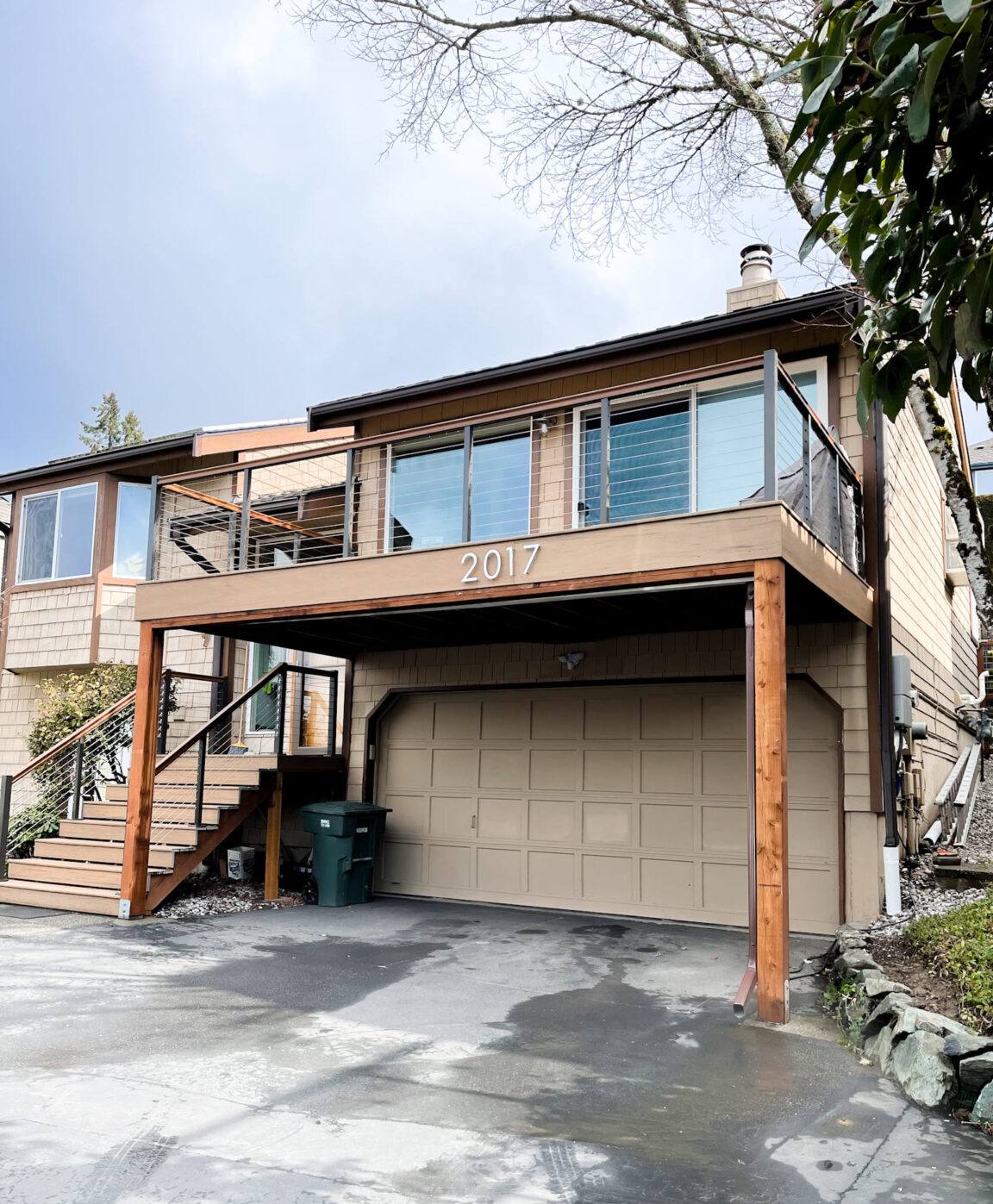
What Salt Air, Rain, and Moss Actually Do to a Deck
Salt Air and Hardware Corrosion
Airborne salt accelerates corrosion on any exposed metal — screws, joist hangers, post bases, flashing. Standard coated fasteners can start rusting within a few seasons in a waterfront exposure like March Point's. Once a fastener corrodes, it loses grip strength and can stain the decking around it, which is one of the most common "why does my new deck look old already" complaints we run into.
Driving Rain and Water Intrusion
Wind-driven rain off the water doesn't just fall straight down — it gets pushed sideways into ledger boards, under poorly flashed rim joists, and into any gap in the framing. Where a deck attaches to the house is the single most common point of hidden rot we find on older decks in this area, because that connection is easy to get "close enough" on and very hard to inspect once it's covered.
Moss, Algae, and Long-Term Surface Care
Shaded, damp conditions for most of the year mean moss and algae aren't a maybe — they're a certainty on any deck surface that doesn't get regular sun or airflow. Composite decking resists rot in a way wood can't, but it isn't immune to surface growth. The board's cap layer, the gap spacing between boards, and airflow underneath the deck all affect how much moss becomes a problem and how easy it is to clean off.
Why We Recommend Composite for This Location
Composite decking isn't the right call for every homeowner or every budget, and we'll say so plainly if that's the case for your project. But for a waterfront property in this climate, composite has real advantages over wood that are worth understanding rather than taking on faith:
- No annual sealing or staining — wood decks in this climate need refinishing every one to two years to keep water out; composite doesn't
- Consistent moisture resistance — composite boards don't swell, cup, or splinter the way wood does when it cycles between soaked and dry
- Better resistance to rot at fastener points — the areas around screws are where wood decking fails first in wet climates
- More consistent color over time — cap-stock composite resists the graying and blotching salt air causes in untreated wood
The trade-off is upfront cost and the fact that composite still requires periodic cleaning — it's low-maintenance, not no-maintenance. We'll walk through that honestly during your estimate rather than oversell it.
Comparing Decking Materials for a Waterfront Property
| Material | Moisture Performance | Maintenance | Typical Lifespan Here |
|---|---|---|---|
| Pressure-treated wood | Absorbs water, prone to cupping and splitting near salt air | Annual sealing/staining recommended | 10–15 years with upkeep |
| Cedar | Naturally rot-resistant but still needs sealing against driving rain | Regular sealing, moss treatment | 15–20 years with upkeep |
| Capped composite | Cap layer sheds moisture, resists swelling | Periodic wash-down, no sealing | 25–30 years, manufacturer warranty backed |
| PVC decking | Fully moisture-resistant, no wood content to rot | Periodic wash-down | 25–30+ years, higher upfront cost |
Actual pricing depends heavily on square footage, railing style, substructure condition, and board tier, so we're not going to throw a number here that doesn't mean anything until we've seen your site. What we can tell you is that composite generally runs higher upfront than pressure-treated wood and comparable to or somewhat less than PVC, with the payoff being lower maintenance cost over the life of the deck.
What a Correct Composite Deck Build Looks Like Here
Framing and Substructure
The composite boards get the attention, but the framing underneath is what determines how long the deck actually lasts in this exposure. For March Point projects we treat or use naturally corrosion-resistant framing lumber, and we don't cut corners on joist spacing — composite boards typically need tighter joist spacing than wood to avoid long-term sagging, and manufacturer specs vary by product, so we build to the spec of the board actually going down.
Fasteners and Hardware
Given the salt air here, we use stainless steel or coated fasteners rated for coastal exposure, along with hidden fastener systems where the product supports it. Hidden fasteners also mean fewer exposed screw heads for moss and grime to collect around.
Flashing at the Ledger
Every deck that attaches to the house gets proper ledger flashing, installed to shed water away from the rim joist rather than trap it. This is the step that's easiest to shortcut and the one most responsible for hidden rot years down the line — we don't skip it, and we won't quote a ledger-attached deck without it.
Drainage and Airflow
Board spacing, deck height off grade, and any skirting or under-deck systems all get planned so water and moisture can actually move through and out, instead of sitting in the shade under the deck where moss and mildew take hold fastest.
Our Process for a March Point Composite Deck
- On-site assessment — we look at existing framing (if replacing decking on an older structure), drainage, sun/shade exposure, and how close you are to open water
- Material selection — we walk through composite board tiers, colors, and railing options suited to a salt-air, high-moss environment
- Permitting — decks often require a permit through the applicable local jurisdiction; we handle that process rather than leaving it on you
- Demo and framing — remove old decking if applicable, repair or rebuild substructure to current code and to the new board's spec
- Flashing and waterproofing — ledger flashing, joist tape, and any other moisture barriers before a single composite board goes down
- Installation — hidden or corrosion-rated fasteners, correct board spacing and expansion gaps
- Final walkthrough — we go over cleaning recommendations and warranty paperwork with you before we call it done
Living With a Composite Deck in This Climate
Composite decking cuts your maintenance load dramatically compared to wood, but "low-maintenance" still means doing a few things:
- Rinse or lightly scrub the surface a couple times a year to keep moss and algae from getting established, more often in heavily shaded areas
- Keep planters, furniture legs, and mats from trapping moisture against the board surface for long periods
- Check that gutters and downspouts near the deck aren't dumping extra water onto or under it
- Clear debris out of board gaps and drainage channels seasonally so water keeps moving through
- Inspect railing posts and stair connections yearly — hardware is still the first thing salt air affects, composite boards or not
Why Local Experience With March Point Matters
A crew that mostly builds decks in drier, inland parts of Skagit County may not think twice about standard fasteners or skip a corrosion-rated hardware upgrade because it hasn't been a problem for them elsewhere. On a waterfront property like March Point, that choice shows up as rust stains and loose railings within a few years, not decades. We build decks throughout the Anacortes area and treat this stretch of coastline as its own case — salt exposure, drainage planning, and moss management get factored in from the first conversation, not added as an afterthought.
We also know the practical side: what the permitting process looks like locally, how site access and staging typically work on waterfront lots, and what framing condition to expect if we're replacing decking on an older home in this area.
Questions Worth Asking Before You Commit
- What fastener and hardware grade is included, and is it rated for coastal/salt exposure?
- Is ledger flashing included as standard, or is it an upcharge?
- What joist spacing will the framing use, and does it match the composite manufacturer's spec?
- What warranty covers the boards, and what's actually excluded (fading, staining, structural)?
- Who pulls the permit, and is that included in the quote?
If you're weighing composite decking for a home in March Point, we're happy to come take a look, talk through what your specific site needs, and give you a straightforward estimate — no pressure, no upsell. Use the form below to get started.