 Anacortes Siding
 Ship Harbor's Siding Problem Isn't Cosmetic — It's Exposure
Ship Harbor sits close to the water on Fidalgo Island, which means homes here take a different kind of weathering than a house ten miles inland in the Skagit Valley. Salt-laden air off the strait works into seams and fastener heads. Wind-driven rain doesn't just fall straight down — it gets pushed sideways into lap joints, corner trim, and anywhere caulking has started to fail. And because this stretch of Anacortes stays shaded, damp, and mild for much of the year, moss and algae get a long runway to establish themselves on any siding surface that holds moisture at the surface longer than it should.
None of that is exotic. It's just steady, cumulative exposure. The problem is that most siding products were engineered for an "average" American climate, not for a marine, moss-prone stretch of the Pacific Northwest coast. When we go out to look at failing siding in this neighborhood, the failure pattern is almost always the same: moisture got behind the cladding, had nowhere to go, and the substrate underneath paid the price long before the visible surface looked bad.
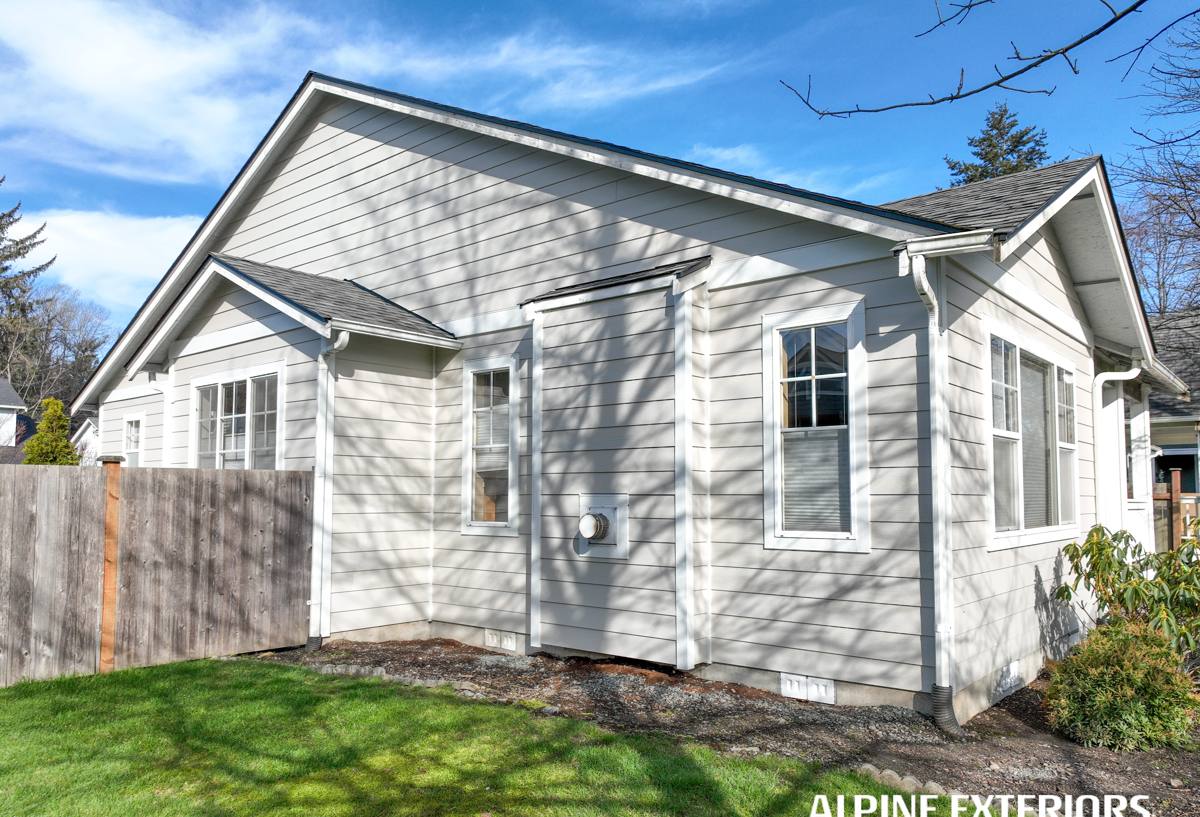
What Ship Harbor Homes Actually Need From Their Siding
Before talking about any specific product, it's worth being clear about the performance requirements this location actually demands:
- A cladding material that doesn't swell, rot, or delaminate when it stays damp for extended stretches
- A finish that resists moss and algae growth on north-facing and shaded walls, which never fully dry out between storms
- Fastener and joint detailing that shrugs off salt air instead of corroding or staining over time
- A factory finish, not a field-applied one, since repainting a full house on the water every few years gets expensive fast
- Enough rigidity and weight to resist wind-driven rain intrusion at laps and penetrations
That list rules out a lot of products before you even get to color and style preferences. It's also exactly why we standardized on James Hardie fiber cement and stopped installing vinyl, LP SmartSide, or bare wood siding on any home we work on — including here in Anacortes.
Why James Hardie Fits This Specific Climate
It's engineered for wet, not just weather-resistant
James Hardie makes climate-specific formulations, and the HZ10 product line is built for regions like ours — cooler, wetter, with real freeze-thaw cycling in winter. The fiber cement itself is dimensionally stable when wet, meaning it doesn't swell and buckle the way engineered wood products can when moisture gets past the surface finish.
ColorPlus finish resists the moss problem better than field paint
The factory-applied ColorPlus finish is baked on under controlled conditions, which gives it better adhesion and a harder, more consistent surface than a paint job applied on-site in variable weather. A tighter, more consistent finish gives algae and moss spores less to grab onto, which matters a lot on the shaded, north-facing walls that dominate a lot of Ship Harbor lots.
Non-combustible and stable long-term
Fiber cement is non-combustible, which isn't the primary concern on a waterfront lot the way it is in wildfire country, but it does mean the material isn't degrading from UV and moisture cycling the way vinyl can — vinyl siding gets brittle and can warp with repeated heat-cool and wet-dry cycling over the years, right when a home is closest to the water and getting the most reflected sun and salt exposure.
What a Correct Installation Actually Involves
Hardie siding performs the way it's supposed to only when it's installed to spec. In a location like Ship Harbor, a few details matter more than they would inland:
| Detail | Why it matters here specifically |
|---|---|
| Rainscreen gap behind the siding | Lets any wind-driven moisture that gets past the cladding drain and dry instead of sitting against the sheathing |
| Proper flashing at windows, doors, and penetrations | Driving rain off the water finds every unflashed gap eventually |
| Correct fastener type and spacing | Salt air accelerates corrosion on the wrong fastener material, leading to streaking and eventual fastener failure |
| Factory-cut edges sealed or back-primed | Field-cut edges are the one place ColorPlus protection isn't factory-applied |
| Correct clearance from grade, decks, and roof lines | Constant dampness at ground level accelerates moss growth and moisture wicking at the bottom course |
| Caulking only where Hardie's install guide calls for it | Over-caulking traps moisture; under-caulking lets it in — both fail faster in a wet marine climate |
Every one of these is a place where a crew unfamiliar with James Hardie's written installation requirements can cut a corner that won't show up as a problem for a year or two — and then shows up as a warranty dispute, because Hardie's product warranty is tied to installation per their published instructions.
Our Process for a Ship Harbor Job
- Walk-through and moisture check: We look at the existing siding, trim, and any visible moss or staining patterns to understand how water has been moving on the house, not just what the surface looks like.
- Tear-off and sheathing inspection: Once the old cladding is off, we check the sheathing and framing underneath for hidden rot before anything new goes on. This is where problems that started years ago actually get found.
- Weather-resistive barrier and rainscreen installation: This is the layer that does the real work of managing moisture behind the siding — it doesn't get skipped or shortcut.
- Hardie installation to manufacturer spec: Correct fastener placement, flashing detail, and clearances, following James Hardie's published installation guide rather than general carpentry habit.
- Final walk-through: We go over trim lines, caulk joints, and clearances with the homeowner before calling the job finished.
Material Comparison for a Marine, Moss-Prone Climate
| Factor | James Hardie Fiber Cement | Vinyl | LP SmartSide / Engineered Wood |
|---|---|---|---|
| Moisture/swelling behavior | Dimensionally stable when wet | Doesn't swell, but can warp with heat cycling | Can swell and delaminate at cut edges and joints if moisture gets in |
| Moss/algae resistance | Factory finish resists buildup better | Smooth surface but seams and laps still collect growth | Textured surface can hold moisture and organic growth |
| Salt air durability | Fiber cement substrate unaffected; use corrosion-resistant fasteners | Generally fine but can become brittle over time | Wood-based core is more vulnerable to long-term moisture exposure |
| Finish longevity | ColorPlus factory finish, 15-year finish warranty | Color is through-body but can fade/chalk over time | Factory-primed or pre-finished; still wood-based underneath |
| Field repainting needs | Rare if maintained | Not typically repainted | More prone to needing touch-up at seams and edges |
This isn't a claim that other products don't work anywhere — it's why, given the specific demands of a shaded, salt-air, high-moisture lot near the water, we install Hardie and Hardie only.
Living With Hardie Siding in a Moss-Prone Location
Even the right material still needs basic upkeep in this climate. A rinse-down once or twice a year knocks off the early stages of moss and algae before they get a grip, especially on north-facing walls and anywhere overhung by trees. Keeping gutters clear so water isn't sheeting down a wall repeatedly, and keeping plantings and mulch beds pulled back from the bottom course, both go a long way toward keeping the bottom few feet of siding — the part closest to constant dampness — looking and performing like the rest of the house.
None of this is high-maintenance compared to repainting wood siding or dealing with cracked, sun-brittled vinyl. It's just worth knowing going in, especially this close to the water.
Why a Crew That Already Works Ship Harbor Matters
Anacortes and the surrounding Skagit County shoreline aren't uniform — a lot facing the water gets different wind-driven rain exposure than one set back and shaded by mature trees, and the right rainscreen and flashing decisions can shift accordingly. A crew that has already worked jobs in this specific area has seen how these houses actually weather over time, not just how a spec sheet says they should perform. That matters more here than in a lot of places, because the cost of getting the moisture-management details wrong on a waterfront-adjacent home shows up as hidden rot, not just a cosmetic issue.
When you're vetting a contractor for a Hardie installation in this neighborhood, a few questions are worth asking directly:
- Do you install a rainscreen gap on every Hardie job, or only when asked?
- Are you a certified James Hardie installer, and can you show it?
- What fastener type do you use, and is it rated for coastal/salt-air exposure?
- Have you done other siding jobs in Anacortes or on Fidalgo Island specifically?
- Will the workmanship warranty be provided in writing, separate from the manufacturer's product warranty?
A contractor who installs Hardie exclusively — rather than switching between vinyl, LP, and fiber cement depending on the bid — has a reason to know these installation details cold. It's the only product we put on a wall, so getting the flashing, fastening, and rainscreen detail right isn't optional or occasional; it's the same process on every job.
If you're planning a siding replacement in Ship Harbor or anywhere else around Anacortes, we're happy to take a look at your home and walk you through what your specific exposure calls for. The estimate is free, there's no pressure, and you'll get a straight answer about what your house actually needs — just fill out the form below.