 Anacortes Siding
 Why Mount Vernon Homes Take a Beating on Siding
Homes in and around Mount Vernon sit in one of the tougher exterior environments in Western Washington. You've got salt-laden air drifting in off Skagit County's waterways and the nearby Sound, driving rain that comes in sideways for months at a stretch, and a moss season that can run nine or ten months out of the year on north- and west-facing walls. None of that is exotic — it's just relentless. Siding here doesn't fail because of one big event. It fails slowly, from years of moisture cycling into seams, fasteners corroding, and organic growth holding water against the wall longer than it should sit there.
That's the lens we use on every Mount Vernon-area job: not "what looks good going up" but "what still looks good and performs in year twelve." Some siding materials handle that test. Some don't, no matter how well they're installed. That's the whole reason we standardized on James Hardie fiber cement and don't install anything else.
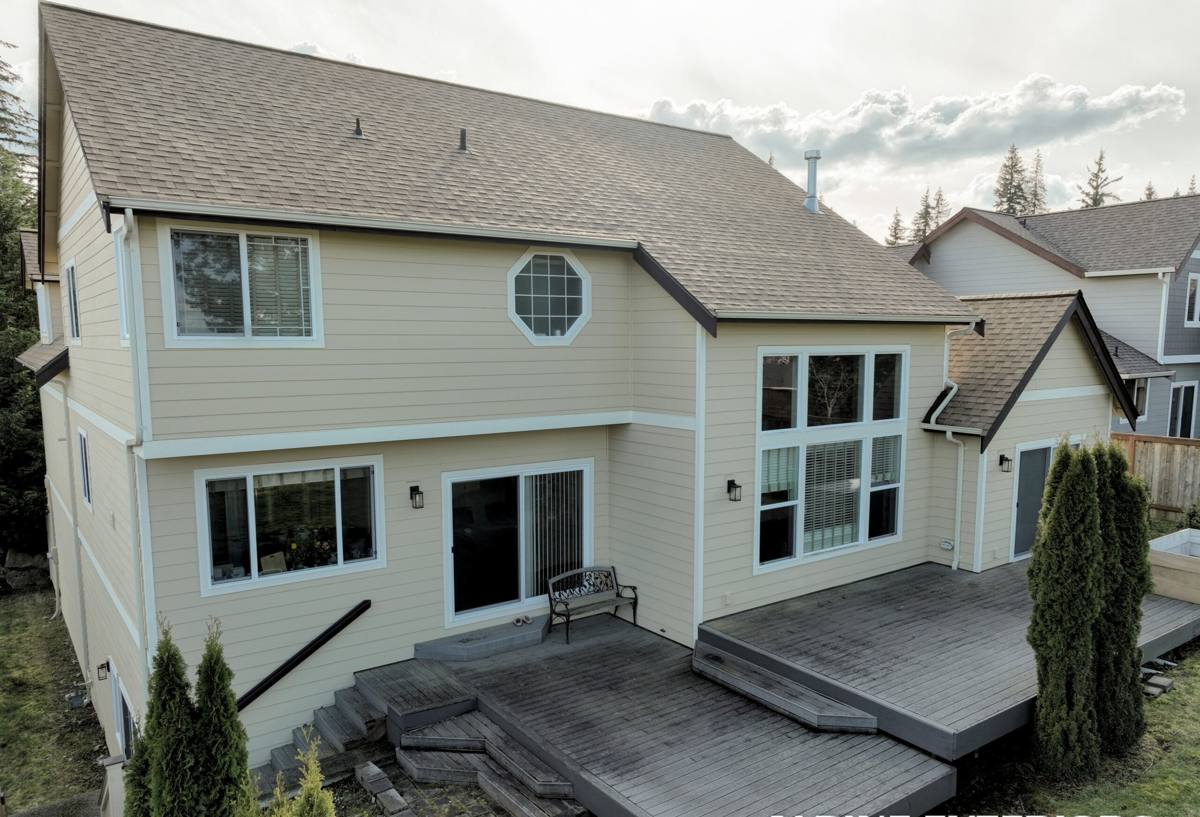
What James Hardie Actually Brings to This Climate
James Hardie siding is fiber cement — a mix of cement, sand, and cellulose fiber, engineered and baked, not just extruded plastic or painted wood. For a region like Skagit County, three things about it matter more than the marketing copy:
It Doesn't Rot or Feed Moss the Way Wood Does
Fiber cement is inorganic. Moss and algae can still grow on the surface in our damp, shaded conditions — nothing stops that entirely — but the moss isn't feeding on the board and rotting it out from underneath the way it will on cedar or untreated wood siding. That distinction matters a lot after a long Skagit Valley winter.
It's Dimensionally Stable in Wet-to-Dry Swings
Wood and some engineered wood products expand and contract with moisture. Over enough cycles, that movement opens up joints, stresses paint film, and works fasteners loose. Fiber cement moves far less, which means caulk lines and paint hold longer and seams stay tighter.
It's Non-Combustible
Not a climate point specifically, but it's part of why we install it — fiber cement doesn't contribute fuel to a fire the way wood-based sidings can.
James Hardie also builds climate-specific product lines — their HZ10 formulation is engineered for the wetter, milder Pacific Northwest climate zone specifically, as opposed to a one-size-fits-all national product. For a Mount Vernon home, that's not a marketing footnote; it's the correct spec for this region.
What a Correct Installation Involves
Fiber cement siding's reputation is only as good as the install underneath it. Most of the siding failures we get called out to inspect in Skagit County aren't material failures — they're installation shortcuts that let moisture get behind the cladding, where it does damage no siding material can fully resist. A correct Hardie install includes:
- A properly lapped, continuous weather-resistant barrier under the siding — not just wrapped and stapled, but flashed and sequenced correctly at every penetration
- Rain-screen or drainage gap detailing where the wall assembly calls for it, so incidental moisture can drain and dry instead of sitting against the back of the board
- Correct fastener type, length, and placement — stainless or hot-dip galvanized fasteners driven to Hardie's spec, not whatever nail gun was already loaded
- Proper flashing at windows, doors, and every roof-to-wall intersection, since these are where the vast majority of moisture intrusion actually starts
- Correct panel and joint spacing per Hardie's installation manual, including expansion gaps at trim and butt joints
- Factory-cut and factory-primed edges sealed per spec wherever field cuts are unavoidable
Skip any one of those and you can still end up with moisture problems behind the wall, even with the best siding material on the market. This is also why the installer matters as much as the product — a crew unfamiliar with Hardie's actual specifications, or unfamiliar with how wet this region really gets, will cut corners they don't even realize are corners.
Problem Areas We Watch For on Mount Vernon-Area Homes
A few things show up again and again on homes in this area, and they inform how we approach a job here:
North and West Wall Moisture Load
Walls that don't get much sun stay damp longer, hold moss growth longer, and are where we pay the closest attention to drainage detailing and flashing.
Roofline and Deck Intersections
Anywhere a roofline, porch roof, or deck ledger meets the wall is a higher-risk flashing point. Driving rain finds these spots first.
Older Fastener Corrosion
On re-sides over older siding, we regularly find corroded fasteners and softened sheathing behind the old material — a direct result of salt-influenced air combined with years of moisture cycling. That's addressed and repaired before new siding ever goes up, not covered over.
Our Process, Start to Finish
- Walk-through and assessment — we look at the whole exterior, not just the siding: trim condition, flashing, any signs of past moisture intrusion, and the shape of the walls that take the worst weather exposure.
- Written estimate — a clear scope, product line and color selection, and a price, with no vague allowances hiding decisions for later.
- Tear-off and inspection of what's underneath — this is where hidden rot or sheathing damage gets found and addressed, before it's sealed behind new siding.
- Weather barrier and flashing installation — done to spec, at every penetration, before a single piece of Hardie board goes up.
- Hardie installation — panels or lap siding installed per manufacturer spec, with correct fastening, spacing, and joint treatment.
- Trim, caulking, and final detailing — the finish work that determines how clean the job looks and how well it sheds water at every edge.
- Final walk-through — with you, before we consider the job done.
What It Costs: The Real Factors
We won't quote a number without seeing the house, but these are the variables that actually move the price on a Mount Vernon-area Hardie job:
| Factor | Why It Matters |
|---|---|
| Tear-off complexity | Removing old wood or vinyl siding is faster than removing multiple layers or siding installed directly over damaged sheathing that needs repair |
| Wall area and home shape | Cutouts, dormers, and multiple gables add labor beyond straight square footage |
| Number of stories | Second-story and taller walls require scaffolding or lift access, which adds time and cost |
| Siding profile chosen | Lap siding, board-and-batten, and shingle-style Hardie panels have different material and labor costs |
| Trim scope | Full trim replacement versus reusing sound existing trim changes both material cost and schedule |
| Hidden repairs found at tear-off | Rotted sheathing or framing found once old siding comes off is addressed as a change order, not guessed at up front |
ColorPlus and Style Options
James Hardie's ColorPlus finish is a factory-applied, baked-on finish rather than field-painted siding. For this climate, that's a real advantage — it holds color and resists fading and chipping better than a site-applied paint job, and touch-up product is available to match it when needed. Hardie offers lap siding, board-and-batten, and shingle-style panels, plus trim boards, so a Mount Vernon home can match a traditional Northwest look or a more modern profile without stepping outside a single, climate-engineered product system.
Why a Crew That Already Works This Area Matters
Skagit County's mix of coastal exposure, valley moisture, and moss pressure isn't identical to what a crew coming from a drier region is used to detailing for. A contractor who works Mount Vernon and Anacortes regularly knows which wall orientations need extra drainage attention, what the local permitting and inspection process looks like, and what actually goes wrong on homes here over time — because they've seen it, torn it open, and fixed it. That local pattern recognition is worth more than a lower bid from a crew installing to a generic national spec.
Warranty and Long-Term Value
James Hardie backs its siding with a strong manufacturer warranty, and it's transferable if you sell the home — a real selling point in a market where buyers are increasingly asking what the siding is and how old it is. But a manufacturer's warranty only protects the material; it doesn't cover water damage caused by a bad install. That's why we treat correct installation as the actual warranty that matters — the one built into how the job goes up, flashing by flashing, fastener by fastener.
If you're weighing a re-side in the Mount Vernon area, we're happy to take a look at your home and walk you through what it actually needs — no pressure, no hard sell. Request a free estimate below and we'll get you a straight answer.