 Anacortes Siding
 Why Flounder Bay Homes Wear Out Siding Faster Than Inland Anacortes
Flounder Bay sits right on the water on Fidalgo Island, and that location is exactly what makes it a beautiful place to live — and exactly what shortens the life of ordinary siding. Homes here take a steady diet of salt-laden air, wind-driven rain coming straight off the water, and a long stretch of gray, damp months where moss and algae get a real foothold on anything that stays wet. That combination is tougher on exterior materials than what a house a few miles inland in Skagit County deals with.
Salt air accelerates corrosion on fasteners, trim, and metal flashing. Driving rain doesn't just wet the surface of a wall — on an exposed waterfront lot, wind can push moisture up and under laps, seams, and trim joints that would stay dry on a more sheltered site. And once fall arrives, the long moss season means anything with a rough or absorbent surface starts collecting green growth that holds moisture against the wall even longer. None of this is unique to any one house in Flounder Bay — it's the baseline every home on this stretch of water is working against, and it's the reason siding choice and installation quality matter more here than they do a few miles away.
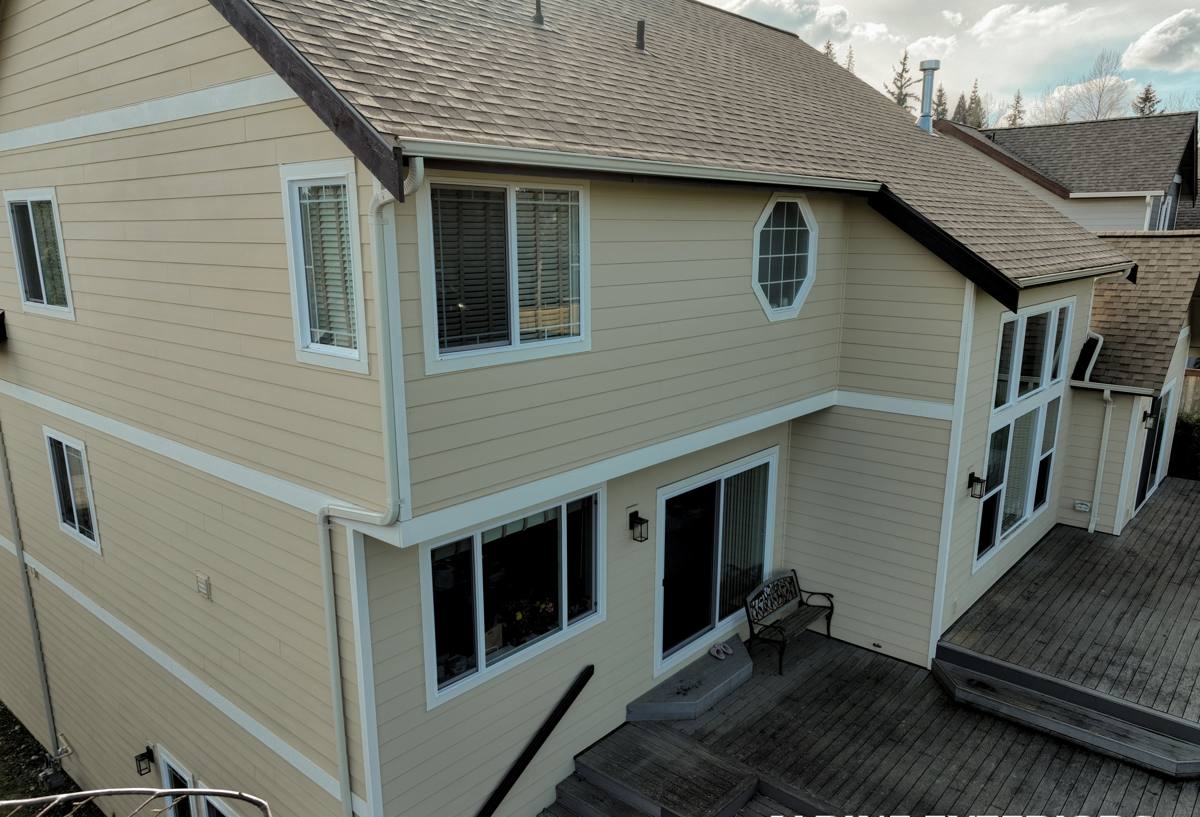
Signs a Flounder Bay Home Needs Replacement, Not Just Repair
Siding failure on the water doesn't always look dramatic. It's usually a slow accumulation of small problems that add up to a wall system that's no longer doing its job. Before assuming a patch will fix things, look for:
- Soft or spongy spots when you press on the siding, especially near the bottom courses or below windows
- Paint that keeps failing in the same spots within a year or two of repainting
- Persistent moss or algae staining that comes right back after cleaning
- Visible gaps, cupping, or warping in lap siding, especially on the sides that face the water or prevailing wind
- Rust streaks below nail heads or trim fasteners
- Musty smell or visible staining on interior walls that back up to exterior siding
One or two of these on their own might mean a repair. Several together, especially on the water-facing elevation, usually mean the underlying material or the original installation has reached the point where patching is just delaying a full replacement — and often at higher total cost than doing it right the first time.
What a Correct Siding Replacement Involves in a Marine Environment
It starts underneath the siding, not with the siding itself
The single biggest factor in how long a siding job lasts on waterfront property isn't the visible material — it's what's behind it. A correct replacement removes the old siding down to the sheathing, inspects for rot or hidden moisture damage, and installs a proper weather-resistive barrier with correctly lapped and taped seams. On a site exposed to driving rain, water management details — head flashing over windows and doors, kick-out flashing at roof-to-wall intersections, proper drainage gaps behind the siding — matter as much as the siding brand on the invoice.
Fasteners and hardware
In a salt-air environment, fastener choice isn't a minor detail. Standard fasteners can start showing corrosion within a few seasons this close to the water. Correct installation means corrosion-resistant fasteners rated for the exposure, installed at the manufacturer's specified pattern and depth — not just "close enough."
Ventilation and drying capacity
A wall assembly needs a way to dry out when it does get wet, which it will. Rainscreen gaps, proper attic and soffit ventilation, and avoiding trapping moisture behind non-breathable materials all factor into whether a wall system holds up in a damp coastal climate or slowly rots from the inside out.
Why We Install Only James Hardie Fiber Cement Siding
We made a decision as a company to install James Hardie fiber cement exclusively, and on a property like one in Flounder Bay, that decision is easy to explain. Fiber cement is non-combustible, dimensionally stable, and doesn't absorb and swell with moisture the way wood-based products do. That matters directly against the moss and driving rain this area sees every winter. Hardie's ColorPlus factory-applied finish is baked on under controlled conditions, which gives it better resistance to fading and moisture intrusion at the finish layer than field-applied paint — a real advantage when salt air is already working against any coating.
HardiePlank vs. HardiePanel
Most homes get HardiePlank lap siding, which gives the traditional horizontal-board look and sheds water course by course. Some modern or shed-style homes use HardiePanel vertical siding instead. Hardie also makes HZ10 and HZ5 product lines engineered for different climate zones — the HZ10 formulation is built for wetter, harsher climates, which fits the Anacortes and Skagit County coastline well.
What we won't install, and why
We don't install vinyl, LP SmartSide, primed spruce, cedar, or other fiber cement brands. Each has real strengths, but each also has a trade-off — vinyl can warp and doesn't stand up to wind-driven debris the way fiber cement does; wood-based and engineered-wood products are more sensitive to sustained moisture exposure; cedar needs ongoing maintenance to keep moisture out. On a waterfront lot where the climate is already working overtime against a wall system, we'd rather stand behind one product we trust completely than offer options we know will need more attention sooner.
How Siding Materials Hold Up in a Salt-Air, High-Moisture Setting
| Material | Salt air / moisture resistance | Maintenance burden | Typical lifespan here |
|---|---|---|---|
| Vinyl | Can warp or become brittle with temperature swings and wind exposure | Low, but cracks and gaps are hard to repair cleanly | 15–25 years, often less on exposed sites |
| Cedar | Attractive but absorbs moisture; prone to rot without diligent upkeep | High — regular sealing/staining required | Highly variable, heavily maintenance-dependent |
| LP SmartSide / engineered wood | Treated for moisture resistance but still wood-based at the core | Moderate — edge sealing and caulking critical | 20–30 years with consistent maintenance |
| James Hardie fiber cement | Doesn't absorb moisture or swell; resists salt-air degradation well | Low — occasional washing, factory finish holds up | 30+ years with correct installation |
Our Siding Replacement Process
- On-site assessment. We walk the whole exterior, check for hidden moisture or rot, and look specifically at how the house is oriented to wind and rain.
- Written scope and estimate. You get a clear breakdown of what's being removed, what's being replaced, and which Hardie products fit the home.
- Tear-off and sheathing inspection. Old siding comes off, and any damaged sheathing or framing is addressed before anything new goes back up.
- Weather barrier and flashing installation. This is the step that determines how the wall performs in driving rain — done correctly and inspected before siding goes on.
- Hardie siding installation to manufacturer spec. Correct fastener type, spacing, gapping, and caulking at every joint and penetration.
- Final walkthrough. We go over the finished work with you and make sure trim, caulking, and paint lines all meet the standard we hold ourselves to.
What Drives the Cost of a Flounder Bay Siding Replacement
Every home is different, so we won't quote a fake number here — but these are the factors that actually move the price up or down on a project like this:
| Factor | Why it matters |
|---|---|
| Amount of hidden damage found at tear-off | Rotted sheathing or framing found once old siding is off adds material and labor |
| Home size and wall complexity | Dormers, multiple gables, and cut-ins take more time and trim work than a simple rectangular footprint |
| Water/wind exposure of the site | Elevations facing open water may need extra flashing detail and fastener upgrades |
| Access and staging | Waterfront lots with limited driveway or yard space can affect scaffolding and material staging |
| Product line chosen | HardiePanel vs. HardiePlank, and standard vs. premium ColorPlus colors, affect material cost |
Why Hiring a Crew That Already Works Flounder Bay Matters
Anacortes has its own permitting process through the city, and waterfront lots sometimes carry extra considerations — setback rules, stormwater handling, or an HOA or waterfront association with its own architectural guidelines if your property is part of one. A crew that already does this work in Skagit County knows how to navigate that up front instead of discovering it mid-project. We also know how to sequence a job around this area's weather — you don't want a wall opened up to bare sheathing when a driving rain system is due in off the water, and local experience means planning around that instead of getting caught by it.
There's also a practical side: a crew that regularly works the Anacortes waterfront has already solved the access and staging challenges that come with narrower waterfront lots, seen how salt air actually behaves on real houses over years (not just in a manufacturer's brochure), and can tell you honestly what's worked and what hasn't on homes in conditions like yours.
Protecting Your Investment After Installation
Fiber cement siding installed correctly needs far less attention than most alternatives, but "less" doesn't mean "none" — especially this close to the water. A short annual routine keeps a Flounder Bay home's siding performing the way it should:
- Rinse the exterior once or twice a year to clear salt residue, especially on water-facing walls
- Check caulking at trim joints, windows, and doors annually and re-caulk any cracked or separated seams
- Keep gutters clear so water doesn't overflow and run down the face of the siding
- Trim back vegetation and clear debris that traps moisture against the wall
- Address any moss or algae growth promptly with a gentle wash rather than pressure that can force water behind laps
- Walk the exterior after major windstorms to check for loose trim or fastener issues
If you're weighing whether your Flounder Bay home needs siding replacement now or can wait, we're glad to take a look and give you a straight answer either way. Reach out for a free, no-pressure estimate using the form below.