 Anacortes Siding
 Fidalgo Island Puts Windows Through More Than Most Homes Ever See
Fidalgo Island sits right where the Salish Sea meets Skagit County, and that location is exactly what makes window replacement here a different job than it is twenty miles inland. Homes on and around the island take a steady diet of salt-laden air, wind-driven rain that hits windows sideways instead of straight down, and a wet season that runs long enough to grow moss on anything that holds moisture. None of that is dramatic on its own, but stacked up year after year, it's what pushes windows from "a little drafty" to "actively failing" faster than homeowners expect.
We're not talking about hurricane-force conditions. It's the slow, patient kind of wear — salt air corroding hardware and fasteners, repeated wetting and drying cycles stressing seals, and moss and algae holding dampness against wood trim and sills longer than it should sit there. A window that would last 25 years in a drier climate can start showing real problems here well before that if it wasn't installed with this exposure in mind.
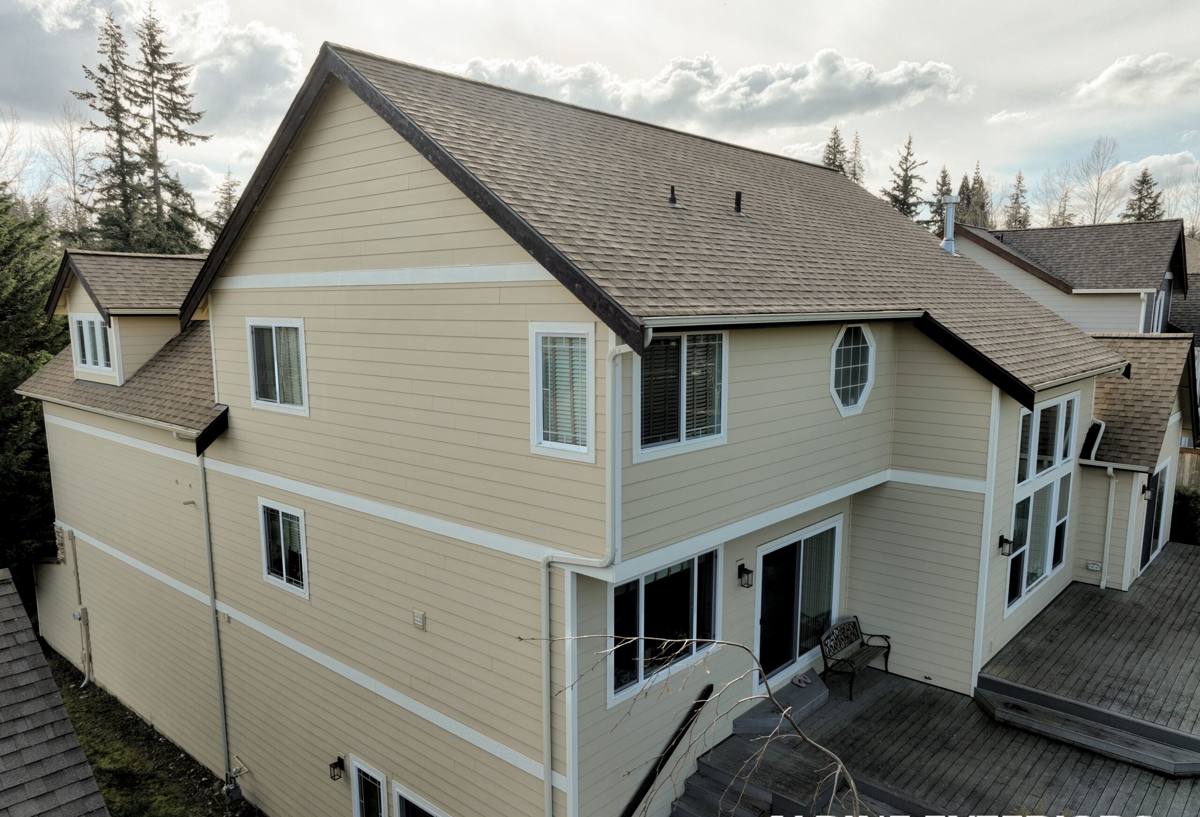
How to Tell a Fidalgo Island Window Is Actually Done
Most homeowners don't call about windows until something is obviously wrong, but by then the damage has often spread past the glass itself. Here's what we typically find during an inspection, roughly in order of how often it shows up:
- Fogging or moisture between panes — the seal on the insulated glass unit has failed and it can't be repaired, only replaced.
- Soft or discolored wood at the sill or bottom corners — usually a sign water has been getting behind the frame, not just landing on it.
- Windows that stick, won't latch, or have visibly warped frames — moisture cycling has swollen or shrunk the frame material unevenly.
- Visible gaps, drafts, or a cold spot near the window even when it's closed — the weatherstripping or flashing has given out.
- Chalky, pitted, or corroded hardware — salt air attacks metal locks, cranks, and screws faster than fresh air does.
- Green or black growth on the frame or sill — moss and mildew holding moisture against the material, which accelerates rot underneath.
Any one of these on its own might just mean a repair. Two or three together, especially on the same window, usually means the frame and flashing are compromised and replacement is the more honest answer than patching.
What a Correct Window Replacement Actually Involves
The window itself is maybe half the job. The other half — the part you can't see once it's finished — is what determines whether that window is still performing well in fifteen years or leaking behind the wall in five.
Removal Without Collateral Damage
Old windows have to come out without tearing up the surrounding siding, trim, or sheathing any more than necessary. On homes where the siding has its own age and wear, this is where a rushed crew causes damage that turns a window job into a siding repair job too.
Flashing and Water Management
This is the step that matters most in a driving-rain climate and the one that gets skipped most often on lower-quality installs. Proper flashing tape and a correctly lapped weather-resistive barrier direct any water that gets behind the exterior cladding back out, instead of letting it pool at the sill or track down into the wall cavity. On a house exposed to wind-driven rain off the water, this detail is the difference between a window that stays dry for decades and one that quietly rots the wall around it.
Air Sealing and Insulation
The gap between the new window frame and the rough opening needs to be sealed and insulated correctly — not stuffed with excess fiberglass or oversprayed with foam that can bow the frame. Done right, this is what actually stops the draft, not just caulk smeared around the trim afterward.
Fasteners and Hardware
In a salt-air environment, standard fasteners and hardware corrode noticeably faster than they would inland. We use fasteners and hardware rated for coastal exposure, because replacing a $2 screw later means pulling trim off a finished window.
Choosing a Frame Material for This Climate
There's no single "best" window material — there's a best fit for your house, budget, and exposure. Here's how the common options actually compare for a Fidalgo Island / Anacortes setting:
| Frame Material | Moisture & Salt Air Behavior | Maintenance | Typical Lifespan |
|---|---|---|---|
| Vinyl | Won't rot or corrode; good baseline performer in wet, salty air | Low — occasional cleaning | 20-30 years |
| Fiberglass | Very stable in temperature and moisture swings; strong resistance to warping | Low | 30-40+ years |
| Wood (unclad) | Handsome but needs consistent upkeep to resist rot in this much moisture | High — repainting/sealing on a schedule | Varies widely with maintenance |
| Wood-clad (exterior vinyl or aluminum shell) | Good protection for the exterior face; interior still needs normal wood care | Moderate | 25-35 years |
| Aluminum | Strong but conducts cold and can corrode faster near salt air without proper coating | Moderate | 20-30 years |
For most homes on Fidalgo Island, we steer people toward vinyl or fiberglass for the exterior-facing performance, and reserve wood or wood-clad for homeowners who specifically want that look and are prepared for the upkeep it requires this close to the water. That's a maintenance and moisture-behavior tradeoff, not a knock on wood windows themselves — some homeowners are happy to keep up with the repainting schedule, and that's a legitimate choice.
Glass and Weatherization Choices That Matter Here
Skagit County winters aren't brutally cold, but the combination of damp air and temperature swings makes glass performance matter more than people expect.
- Double-pane vs. triple-pane: double-pane with a good low-E coating and argon fill covers most homes here well; triple-pane adds cost and weight and is usually only worth it for rooms with unusual noise or cold exposure.
- Low-E coatings: reduce heat loss in winter and heat gain in summer, and they help cut down on the condensation that shows up on interior glass during cold, damp mornings.
- Argon gas fill: a low-cost upgrade that improves insulation between panes — worth including on nearly every project.
- Weatherstripping quality: matters as much as the glass itself for keeping wind-driven rain and drafts out; cheap weatherstripping is often the first thing to fail.
Our Process, Start to Finish
- On-site assessment — we look at each window individually, not just the ones you called about, because problems on a coastal-exposed home rarely show up in only one spot.
- Honest recommendation — repair where repair makes sense, replace where it doesn't. We'll tell you which is which and why.
- Measurement and product selection — matched to your home's exposure (which side takes the worst of the weather), style, and budget.
- Installation — proper removal, flashing, sealing, and insulation as described above, done in a sequence that doesn't leave your wall open to weather overnight.
- Cleanup and walkthrough — every window operated and checked with you before we consider the job finished.
- Warranty documentation — clear paperwork on what's covered by the manufacturer and what's covered by our workmanship.
Why Local Experience on Fidalgo Island Actually Matters
A window installer who mostly works dry, inland neighborhoods can still do competent work, but they haven't necessarily developed habits around the specific exposure that Anacortes and the surrounding island homes deal with — which walls typically take the worst wind-driven rain, how much extra attention marine-exposed hardware needs, or how a long moss season changes maintenance recommendations after the install is done. Crews that work this area regularly build those habits in from the start instead of learning them from a callback.
There's also a scheduling reality: this is a marine climate with a genuine wet season, and timing exterior work around weather windows is part of doing it right. Rushing a window install between rain systems, or forcing one during a soaking week, is how corners get cut on sealing and curing times. Local crews plan around that instead of fighting it.
Questions Worth Asking Before You Hire
- Will you inspect and flash the rough opening, or just set the new window in the old hole?
- What fasteners and hardware do you use, and are they rated for coastal/salt-air exposure?
- Can you walk me through your water-management detail at the sill and head flashing?
- What's covered under workmanship warranty versus the manufacturer's product warranty?
- Have you worked on homes in this specific area, and do you know its typical exposure issues?
- How do you handle scheduling around weather during Skagit County's wetter months?
What Windows Actually Cost, and Why the Range Is Wide
Pricing depends on frame material, glass package, window size and count, and how much of the surrounding trim or siding needs attention during the swap. Rather than quote a number that won't match your specific house, the honest answer is that the biggest cost drivers are usually: how many windows are being replaced at once, whether the openings are standard sizes or custom, the frame material chosen, and whether trim, siding, or sheathing repair is needed alongside the window itself. A single-window emergency replacement costs differently than a whole-house upgrade, and a full assessment is the only way to give you a number you can actually trust.
If your windows are fogging, drafting, sticking, or just showing their age after a few too many Skagit County winters, we're happy to come take a look. The estimate is free, there's no pressure attached to it, and you'll walk away knowing exactly what condition your windows are actually in — use the form below to get started.