 Anacortes Siding
 Deck Repair Built for Skyline's Conditions
Skyline sits close enough to the water and the tree line that its decks take a different kind of beating than decks a few miles inland. Salt-laden air off the Salish Sea corrodes fasteners and hardware faster than manufacturers' warranties usually account for. Driving rain off Fidalgo Bay drives moisture sideways under railings and ledger boards where it's never meant to sit. And the long, wet moss season here — often running from late fall through spring — coats every horizontal surface with a film that holds water against the wood and turns boards slick underfoot. None of this is unusual for a deck in Anacortes or anywhere else in Skagit County. It's just the baseline your deck has to survive, year after year.
A deck that looked fine two summers ago can quietly develop soft spots, rusted fasteners, or a ledger connection that's pulling away from the house — problems that don't always show themselves until someone steps in the wrong spot. Repairing a deck correctly in this neighborhood means understanding those failure patterns, not just patching whatever's visibly broken.
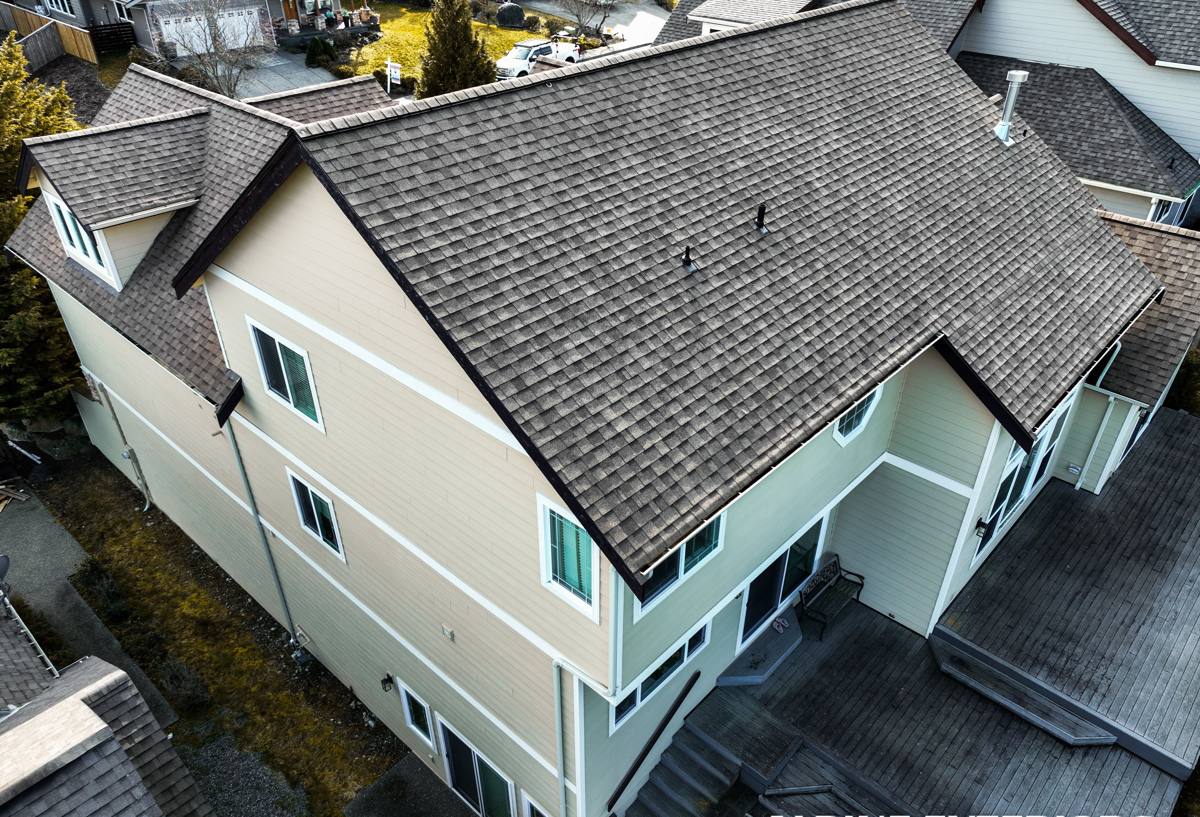
What Skyline's Climate Does to a Deck Over Time
Salt Air and Corrosion
Even homes set back from the immediate waterfront in Skyline get salt-bearing air moving through on a regular basis. Over years, that air attacks exposed metal — nails, screws, joist hangers, railing brackets — well before the wood itself gives out. A deck can look structurally sound on the surface while the fasteners holding it together have already lost most of their strength. This is one of the most common reasons we find a deck that "looks fine" but fails inspection or feels spongy in specific spots.
Driving Rain and Moisture Intrusion
Anacortes doesn't get the heaviest rainfall in the state, but what falls here often comes in sideways, pushed by wind off the water. That means moisture gets driven into places a straight-down rain would never reach: behind rim joists, under poorly flashed ledger boards, into end-grain cuts on railing posts, and around post bases where a builder didn't leave room for drainage. Repeated wetting and drying in these spots is what starts rot, and it usually starts from the inside out — which is why a deck can look good from a few feet away and still have real structural problems.
Moss, Algae, and the Long Wet Season
Skagit County's moss season is long, and a deck's horizontal surfaces are exactly the kind of shaded, damp environment moss and algae favor. Left alone, that growth holds moisture against the decking boards almost constantly, which accelerates rot in wood decking and can degrade the surface layer of composite products too. It also makes the deck genuinely dangerous to walk on — moss and algae on wood or composite decking get slick fast, and that's a liability most homeowners don't think about until someone slips.
Common Deck Repairs We See in This Neighborhood
- Soft or spongy decking boards, usually near the point where two boards meet or around a post
- Rusted, loose, or failed fasteners and joist hardware — often the first thing to go
- Ledger board separation or rot where the deck attaches to the house
- Railing posts loose at the base from water pooling around untreated end grain
- Stair stringers weakened by rot at ground contact points
- Moss and algae buildup creating a slip hazard and holding moisture against the surface
- Under-deck drainage issues that send water where it shouldn't go, including onto siding or foundation areas below
How We Approach a Deck Repair
Inspection First, Not Just a Patch Job
We start by getting under the deck where possible, checking joist hangers, the ledger connection, and post bases — the structural points that fail first but show the least from above. A soft board on the surface is often a symptom, not the whole problem. We'd rather tell a homeowner honestly that a repair needs to go deeper than expected than patch over something that's going to fail again in a year.
Matching the Repair to the Damage
Not every deck problem needs a full rebuild, and not every deck problem is safely solved with a surface patch either. Our approach depends on what we actually find:
- Isolated board replacement when rot or damage is limited to specific boards and the framing underneath is sound
- Fastener and hardware replacement when corrosion has weakened connections but the wood itself is still solid
- Ledger board repair or replacement when the connection to the house has been compromised by moisture — this one gets treated as a structural priority, not a cosmetic fix
- Framing and joist repair when rot has spread below the visible decking
- Railing and post repair where movement or rot at the base creates a safety issue
- Deep cleaning and moss treatment for decks where growth is a maintenance issue rather than a structural one
Rebuilding for Better Drainage, Not Just Replacing Like-for-Like
Where we find recurring moisture problems — a spot that keeps rotting even after a repair — we look at why water is getting trapped there in the first place. Sometimes that means adjusting flashing at the ledger, adding proper drainage gaps, or correcting a detail that was never quite right from the original build. Replacing rotted wood with new wood in the same conditions just buys a few more years before the same repair is needed again.
Repair vs. Replacement: How We Help You Decide
Not every deck with problems needs to be torn out. But a deck with widespread structural failure, especially at the ledger or main support posts, often costs more to keep patching than to rebuild properly. We walk homeowners through this honestly rather than defaulting to the more expensive option.
| Factor | Leans Toward Repair | Leans Toward Replacement |
|---|---|---|
| Extent of rot | Isolated to a few boards or one area | Spread across multiple structural members |
| Ledger board condition | Solid, properly flashed | Rotted or improperly attached |
| Age of the deck | Under 15 years, built to a reasonable standard | Original build already near end of service life |
| Fastener condition | Corrosion limited to a few connections | Widespread rust throughout the structure |
| Homeowner goals | Fix and maintain current layout | Wanting a different size, layout, or material |
Materials and Long-Term Maintenance
What we use for a repair depends on what's already there and what the homeowner wants going forward. Wood decking is common in this area and can be repaired cost-effectively when caught early, but it needs regular maintenance — cleaning, sealing, and moss control — to hold up against Anacortes's wet season year after year. Composite decking resists rot in the boards themselves, but the framing underneath is still typically wood, and that framing needs the same attention to drainage and fastener quality regardless of what's on top. We don't push one material as a fix-all; we explain the maintenance trade-offs honestly so the choice fits how much upkeep a homeowner actually wants to do.
A Simple Maintenance Checklist Between Repairs
- Clear leaves and debris from between boards and off the surface regularly, especially in fall
- Treat visible moss and algae promptly rather than letting it establish
- Check railing posts and stair stringers for movement once or twice a year
- Keep gutters and downspouts near the deck clear so runoff isn't draining onto it
- Reseal wood decking on the manufacturer's recommended schedule, not just when it looks faded
- Look underneath the deck occasionally for staining or soft wood, which shows up before surface symptoms do
Why Hiring a Crew That Already Works in Skyline Matters
A deck repair contractor who works regularly in this part of Skagit County already knows which failure points to check first because they've seen the same patterns on other decks nearby. That's not a marketing point — it changes how an inspection gets done. We know to check ledger flashing carefully because we've seen how often that detail gets missed in this climate. We know moss buildup isn't just cosmetic here because we've seen what it does to a deck surface over a few unaddressed seasons. That local pattern recognition means fewer surprises during the repair and a more accurate assessment up front.
We also understand what "built for this area" actually means in practice: proper fastener selection for a salt-air environment, flashing details that account for driving rain, and repair schedules that respect how long the wet season actually runs here. A repair done without that context might hold up fine somewhere drier — it doesn't always hold up in Anacortes.
What to Expect When You Call
We'll come look at the deck in person — photos and phone descriptions only tell part of the story, especially with hidden rot or fastener corrosion. We'll check the structure from below where we can access it, identify what's actually causing the problem rather than just what's visible, and give an honest recommendation on repair versus replacement. If it's a straightforward fix, we'll say so. If it's more involved, we'll explain why and what the options are, without pressure to choose the most expensive path.
If your deck in Skyline has soft spots, loose railings, rusted hardware, or just needs an honest once-over after another wet Skagit County winter, we're happy to take a look. Reach out for a free, no-pressure estimate using the form below.