 Anacortes Siding
 Why Cap Sante Is a Tougher Test for Siding Than Most Neighborhoods
Cap Sante sits above the water, and that view comes with a trade-off: the same exposure that makes the neighborhood desirable also makes it one of the harder places in Anacortes to keep exterior siding looking and performing well. Homes here take on salt-laden air off the marina and the surrounding waterways, driving rain that gets pushed sideways by wind off the strait, and long stretches of shade from mature trees on the more wooded lots that never let siding fully dry out between storms. Any one of those on its own is manageable. Together, over years, they wear through products that were never engineered for a marine climate.
This page is specifically about James Hardie fiber cement siding as it applies to Cap Sante homes — not a general overview of siding options. We install James Hardie exclusively, and the reasons for that are especially visible in a neighborhood like this one, where the climate does the arguing for us.
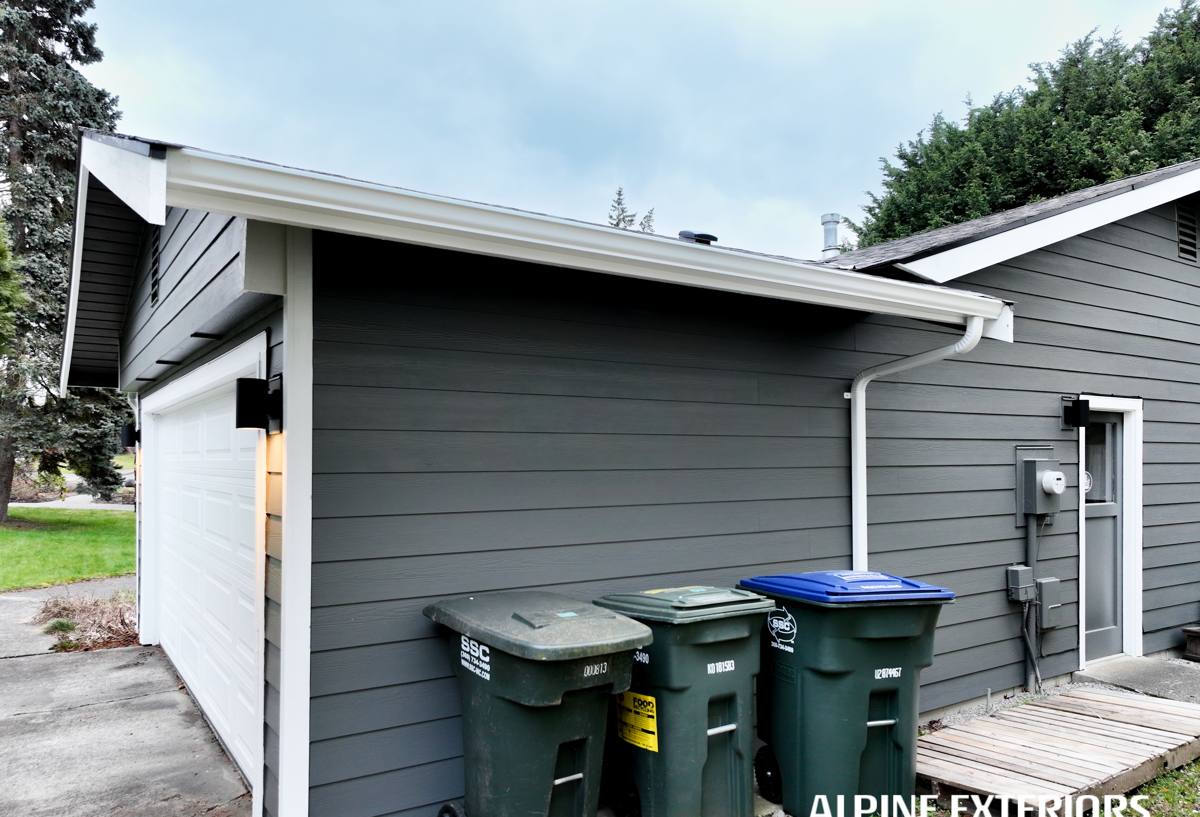
What Salt Air, Rain, and Moss Actually Do to a Wall System
It helps to understand the mechanics, not just the buzzwords.
Salt air is corrosive to metal fasteners, flashing, and trim hardware, and it accelerates the breakdown of paint films and coatings that aren't formulated to resist it. Siding that looks fine inland can chalk, fade, or degrade noticeably faster on a lot with direct water exposure.
Driving rain — rain pushed horizontally by wind rather than falling straight down — finds every gap in a wall assembly that vertical rain never would. It drives water up under laps, behind trim, and into seams that were caulked but not properly flashed. Skagit County's marine weather pattern produces this kind of wind-driven rain regularly through the fall and winter.
Moss and algae need three things to establish on siding: moisture, shade, and time. Cap Sante's tree cover and the region's long damp season supply all three. Once a biofilm gets a foothold on a siding surface, it holds moisture against that surface even longer, which speeds up whatever degradation is already happening underneath.
None of this is unique to Cap Sante — it's the Pacific Northwest coastal condition generally — but the waterfront exposure and tree canopy here put it on the more demanding end of what a wall system in Skagit County has to handle.
Why We Standardized on James Hardie for This Kind of Exposure
HZ5 Climate-Engineered Formulation
James Hardie makes region-specific formulations of its fiber cement siding, and the HZ5 line is engineered for climates with more moisture exposure and freeze-thaw cycling — which describes western Washington's coastal zone well. The fiber cement composition itself doesn't rot, doesn't feed mold or insects, and won't absorb water the way wood-based products can. That matters enormously on a lot where the siding rarely gets a long dry stretch to recover.
ColorPlus Factory Finish
James Hardie's ColorPlus finish is baked on at the factory under controlled conditions, which gives it better adhesion and UV resistance than a field-applied paint job can typically match — and it means the color coat isn't something our crew is trying to get right on a ladder in Anacortes drizzle. For a salt-air environment, a factory finish that resists fading and chalking is a real durability advantage, not a cosmetic one. It also means touch-up and repainting cycles stretch out much longer than with site-painted siding.
Fiber cement is also non-combustible, which isn't a Cap Sante-specific concern but is part of why we standardized on it across every property we work on, waterfront or not.
What a Correct Installation Actually Involves Here
The material only performs as designed if the installation respects a handful of details that matter more on an exposed, damp lot than they would somewhere drier and more sheltered.
- A properly installed weather-resistive barrier behind the siding, with all seams and penetrations sealed and lapped correctly to shed water downward
- A drainage gap (rainscreen) between the siding and the wall assembly so any moisture that does get behind the cladding can drain and the wall can dry
- Correct flashing at every window, door, and roof-to-wall intersection — the majority of siding failures we see trace back to flashing details, not the siding material itself
- Manufacturer-specified fastener spacing and type, using corrosion-resistant fasteners appropriate for a salt-air environment
- Minimum ground clearance (typically at least 6 inches) so splashback and standing moisture at grade don't sit against the bottom course
- Caulked and sealed joints only where James Hardie's install guide calls for sealant — over-caulking can trap moisture just as easily as under-caulking lets it in
Every one of those items is standard James Hardie installation guidance, but on an exposed waterfront lot there's less margin for skipping one. A gap in the weather barrier that would take years to cause a problem on a sheltered inland lot can show up in seasons on a Cap Sante property that takes wind-driven rain directly.
How James Hardie Compares to Other Siding in This Climate
We only install James Hardie, but homeowners deserve an honest comparison, not just a sales pitch. Here's how the common options actually behave under salt air, sustained moisture, and shade-driven moss pressure — the specific conditions Cap Sante presents.
| Siding Type | Moisture & Salt Air Behavior | Moss/Algae Resistance | Maintenance in This Climate |
|---|---|---|---|
| James Hardie (HZ5) | Fiber cement doesn't absorb water or rot; factory finish resists salt-driven fading | Smooth ColorPlus surface sheds moisture and resists biofilm buildup better than porous materials | Occasional rinse; repaint cycle is long due to factory finish |
| Vinyl | Won't rot, but can warp, fade, or become brittle with UV and temperature swings over time | Can still support moss/algae growth in shaded, damp areas; texture varies by product | Low, but panels can't be spot-repainted and discoloration is permanent |
| Engineered wood (e.g. LP SmartSide) | Wood-strand core is treated, but cut edges and unsealed seams are vulnerable if installation details are missed | More moisture retention than fiber cement means more moss/algae pressure over time | Requires diligent caulking/sealant upkeep and periodic repainting |
| Cedar | Natural wood; attractive but requires consistent sealing/staining to resist constant coastal moisture | Highest moss/algae susceptibility of the group without regular maintenance | Highest — regular staining, sealing, and moisture monitoring needed |
Every product on that list has a legitimate place somewhere. Our decision to install only James Hardie comes from years of seeing which materials hold up with the least ongoing intervention in exactly this kind of marine, shaded, wet climate — and Cap Sante is about as clear a case for it as Anacortes offers.
Our Process for a Cap Sante Siding Replacement
The steps don't change much from house to house, but the sequencing and attention shift based on exposure and lot conditions.
- Inspection and moisture check. Before quoting anything, we look at the existing siding, trim, and — where accessible — the sheathing underneath for signs of past water intrusion. Waterfront-adjacent homes are more likely to have hidden moisture issues than homes further inland.
- Tear-off. Old siding and damaged building paper or house wrap come off completely. We don't install new siding over compromised sheathing.
- Sheathing repair. Any rotted or water-damaged sheathing gets replaced before anything new goes on the wall — this is the step that's easiest to skip and most costly to skip.
- Weather barrier and rainscreen. A new weather-resistive barrier goes on with correct lapping and sealed penetrations, along with a drainage gap behind the siding.
- Flashing. Windows, doors, and roof intersections get flashed correctly before siding installation begins.
- James Hardie installation. Panels or lap siding go on to manufacturer spec — fastener pattern, clearance, and joint treatment included.
- Trim and finish detail. Corner boards, trim, and any transitions get finished and sealed only where called for.
- Walkthrough and cleanup. We walk the job with the homeowner and clear debris and old material from the site.
What Affects the Cost of a Hardie Install in Cap Sante
We don't quote exact numbers without seeing the house, but these are the real variables that move the price up or down on a project like this.
| Cost Factor | Why It Matters Here |
|---|---|
| Home size and wall square footage | The most straightforward driver of material and labor cost on any siding job |
| Tear-off and disposal of old siding | Removing and hauling away existing material adds labor time before new siding can start |
| Sheathing or water damage repair | Waterfront and shaded lots have a higher chance of hidden moisture damage that needs fixing before re-siding |
| Site access and lot slope | Some Cap Sante properties have steep grades or limited access that affect staging, scaffolding, and crew time |
| Trim and architectural detail | More corners, window trim, and roofline transitions mean more cutting, fitting, and flashing work |
| HZ5 vs. standard Hardie formulation | The climate-engineered line costs somewhat more but is the right call for this exposure level |
If your lot falls near the water, it's also worth knowing that shoreline-adjacent properties in Washington can carry additional permitting considerations depending on the scope of exterior work. We handle that conversation as part of the estimate rather than surprising a homeowner with it later.
Why a Crew That Already Works This Neighborhood Matters
A siding crew that mostly works inland, drier neighborhoods can install James Hardie correctly by the book and still miss the details that matter specifically on an exposed waterfront lot — which side of the house takes the worst wind-driven rain, where moss pressure builds fastest under tree cover, or how much margin to build into flashing details on a wall that almost never fully dries out. That judgment comes from doing the work in this exact kind of exposure repeatedly, not from a manufacturer's install manual alone. It's also why we standardized on one product system rather than juggling installation specs for several different materials — consistency in the crew's process is part of what keeps quality steady from house to house.
If you're planning a siding replacement on a Cap Sante home, we're glad to walk the exterior with you, point out what we're seeing, and put together a straightforward, no-pressure estimate for a James Hardie install built for this exposure. There's a form below to get that started.