 Anacortes Siding
 Burlington Roofs Carry a Different Kind of Wear
Burlington sits inland from the salt water of the Salish Sea, but Skagit County's weather doesn't care much about that distance. Roofs here still take on salt-laden air moving up the Sound, long stretches of driving rain off the water, and a moss season that can run eight or nine months out of the year once the shade and moisture line up. None of that is dramatic on its own. It's the accumulation — years of moisture cycling in and out of the same flashing joints, the same shingle courses, the same roof-to-wall transitions — that turns a small weak point into an active leak.
As a siding and exterior crew based in Anacortes, we spend a lot of our time at exactly the seam where roofs and walls meet, which is often where roof problems actually start. That vantage point shapes how we approach roof repair in Burlington: we're not just patching what's failing, we're looking at how water moves across the whole exterior and fixing the part of that path that's broken.
Where Leaks Actually Start (Not Where They Show Up)
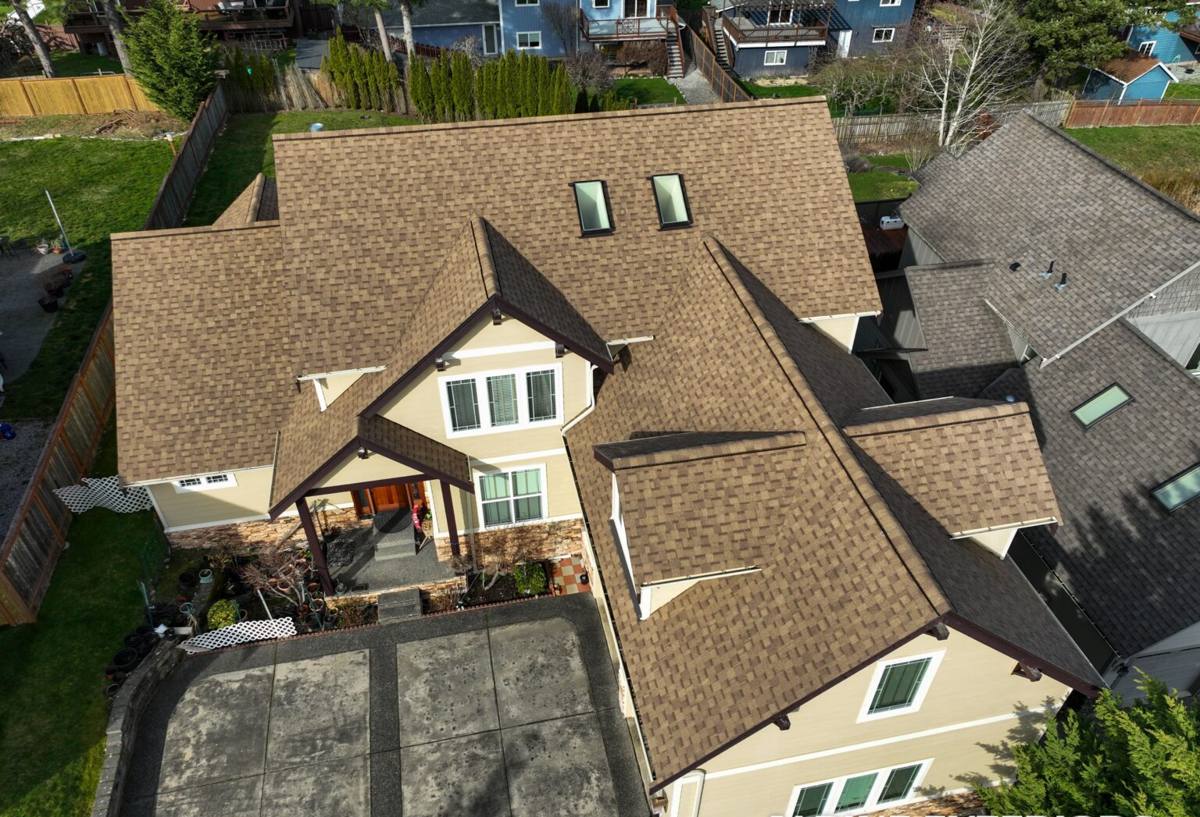
One of the most common mistakes in roof repair is treating the spot where water appears inside the house as the spot that needs fixing. Water travels. A stain on a ceiling in the middle of a room can trace back to a valley, a chimney flashing, or a wall intersection several feet away — sometimes upslope, sometimes to the side, depending on how the sheathing and rafters are laid out.
The usual suspects in this climate
- Valley flashing that's corroded, undersized, or was never properly woven with the shingle courses
- Pipe boots and vent flashings with cracked or UV-worn rubber collars
- Kickout flashing missing or misdirected at the base of a roof-to-wall intersection, sending runoff behind the siding instead of into the gutter
- Nail pops and lifted shingle tabs from wind-driven rain forcing water backward under the course above
- Underlayment that's been wet and dried repeatedly for years and has simply reached the end of its useful life
Driving rain matters here specifically because Skagit County storms often come with real wind behind them. Rain that falls straight down mostly runs off the way a roof is designed to shed it. Rain pushed sideways finds every gap in a lap, every under-driven nail, every place where flashing was cut a little short. That's why a repair that only addresses the visible hole in a shingle, without checking how wind-driven rain is hitting that section, tends not to hold.
What a Correct Repair Actually Involves
A repair that lasts starts with diagnosis, not with a tube of sealant. Sealant has its place, but it's a short-term fix when it's used to cover a flashing detail that was never built correctly. Our approach on a Burlington roof repair call generally looks like this:
- Trace the leak from the interior evidence back to its actual source, checking attic space or roof deck access where possible
- Inspect the surrounding flashing, underlayment, and shingle condition — not just the failure point, but the section around it
- Rebuild the flashing detail correctly if that's the root cause, rather than sealing over a bad detail
- Match replacement shingles or roofing material as closely as possible in type and, where feasible, in color and age
- Check attic ventilation in the affected area, since poor ventilation accelerates moisture damage to sheathing and shortens the life of any repair
That last step gets skipped more often than it should. A roof section can be repaired perfectly on the outside and still fail early if trapped moisture and heat underneath are cooking the underside of the deck. It's a five-minute check that we don't leave out.
Moss, Algae, and Skagic County's Long Wet Season
Moss is the slow-motion version of a roofing problem. It doesn't cause a leak the day it shows up, but it holds moisture directly against shingle surfaces and granules for months at a time, and given how long the wet season runs in this part of Washington, that's a lot of months. Over a few years, moss growth lifts shingle edges, traps organic debris in valleys, and clogs gutters right where a roof needs to drain fastest during a heavy storm.
We treat moss as a maintenance issue that prevents repair calls, not as a repair itself:
- Manual removal by hand or soft brushing — never a pressure washer, which strips protective granules and shortens shingle life
- Zinc or copper control strips installed near the ridge, which let rain carry trace metal ions down the roof and discourage regrowth over time
- Gutter and valley clearing timed around the fall leaf drop and again in late winter, before spring growth takes hold
- Trimming back overhanging branches where practical, since shade and moisture together are what let moss establish in the first place
If a roof already has a heavy moss mat, we'll usually recommend clearing and inspecting before doing any patch repair — there's no point fixing a flashing detail if moss-trapped water is going to keep working against the same spot.
Repair or Replace? How We Help You Decide
Not every call ends in a repair, and we'd rather tell a Burlington homeowner honestly that a full section — or the whole roof — is closer to the end of its life than talk them into patch after patch. Here's roughly how that decision plays out:
| Factor | Points Toward Repair | Points Toward Replacement |
|---|---|---|
| Age of roofing material | Well within expected lifespan for the material | At or past the typical service life for that shingle or roofing type |
| Extent of the problem | Isolated to one flashing detail, vent, or small section | Multiple leak points or widespread granule loss across several slopes |
| Underlying deck condition | Sheathing is sound where exposed | Soft spots, rot, or repeated water staining in the deck itself |
| Prior repair history | First repair call in years | Same area has needed patching more than once or twice |
| Overall condition context | Rest of the roof is in solid shape | Repairing one section would leave mismatched, unequal-aged roofing nearby |
We'll walk you through where your roof lands on that table before we recommend anything, and we're comfortable telling you a repair is the right call even when a replacement would be the bigger job for us.
Materials We Commonly Repair Around Burlington
Most homes in this area are roofed in asphalt composition shingle, with a smaller number of metal roofs and some older cedar shake still in service. Each repairs a little differently:
Asphalt composition shingle
The most common material we work on. Repairs are usually straightforward when replacement shingles of a similar type are available, though exact color matching gets harder as a roof ages and shingles weather and fade unevenly in the sun and salt air.
Metal roofing
Less common but not rare here. Metal repairs are almost always about fastener backout, sealant failure at penetrations, or panel seam issues rather than the panel material itself failing. Corrosion around fasteners can show up faster this close to the Sound, so we check those first.
Cedar shake
Found mostly on older homes. Cedar repair means replacing individual failed shakes and checking for split or curled pieces nearby, since one bad shake rarely fails in isolation once moss and moisture have been sitting on a section for years.
Our Roof Repair Process
We keep this simple and we keep you informed at each step:
- Inspection and diagnosis — we look at the roof, the attic access where available, and the exterior wall intersections nearby, not just the reported leak spot
- Written scope — you get a clear explanation of what's actually wrong and what fixing it involves, before any work starts
- The repair itself — proper flashing and underlayment work where needed, matched materials, and attention to the surrounding area, not just the failure point
- Cleanup and walk-through — debris and old material removed, and we show you what was done and why
Why a Crew Already Working Burlington Matters
Roof repair is one of those trades where local familiarity actually changes the outcome. A crew that's worked Skagit County roofs season after season has already seen how this region's combination of salt air, wind-driven rain, and moss behaves on real houses — not in a textbook, but on the specific mix of asphalt, metal, and cedar roofs that make up the local housing stock. That means faster, more accurate diagnosis and fewer surprises once a repair is underway.
It also means accountability. We're not a crew that flew in for one job and left town. If a repair doesn't hold the way it should, we're the same business you call back, and we stand behind the work accordingly.
Signs You Need a Roof Repair Now
Some roof problems can wait for a scheduled inspection. Others shouldn't. If you're seeing any of the following, it's worth a call sooner rather than later:
- A ceiling stain that's new, growing, or appears during or right after a heavy rain
- Visible daylight through the roof deck from inside the attic
- Shingle granules collecting in gutters or at downspout outlets in noticeable amounts
- Curling, cracked, or missing shingles visible from the ground
- Heavy moss buildup, especially in valleys or along the north-facing slope
- Soft or spongy spots when walking the roof, or sagging visible from the ground
- Water stains or peeling paint on exterior walls just below a roofline or wall intersection
If any of those sound familiar, it's better to have someone look at it before the next big storm off the Sound rather than after.
If you're dealing with a leak, moss buildup, or just want an honest read on where your roof stands, we're glad to take a look. Fill out the form below for a free, no-pressure estimate — we'll tell you straight what's going on and what it would take to fix it right.