 Anacortes Siding
 Asphalt Shingle Roofing Built for La Conner's Conditions
La Conner sits close enough to the water that every roof in town is doing double duty: shedding heavy winter rain and standing up to the salt-laden air that drifts in off the Swinomish Channel and the surrounding Skagit County shoreline. That combination is harder on a roof than most homeowners realize. Salt air accelerates corrosion on exposed metal fasteners and flashing. Long stretches of overcast, damp weather keep shingles wet longer than they'd stay in a drier climate, which is exactly the condition moss and algae need to take hold. None of this means asphalt shingle roofing is a bad choice here — it remains one of the most practical, cost-effective roofing systems available — but it does mean the installation details matter more in La Conner than they would in a drier inland town.
This page is about that one job, done right, for this one area: what a correctly installed asphalt shingle roof needs to survive a Skagit County marine climate, how we approach the work, and why it's worth hiring a crew that already knows this stretch of coastline.
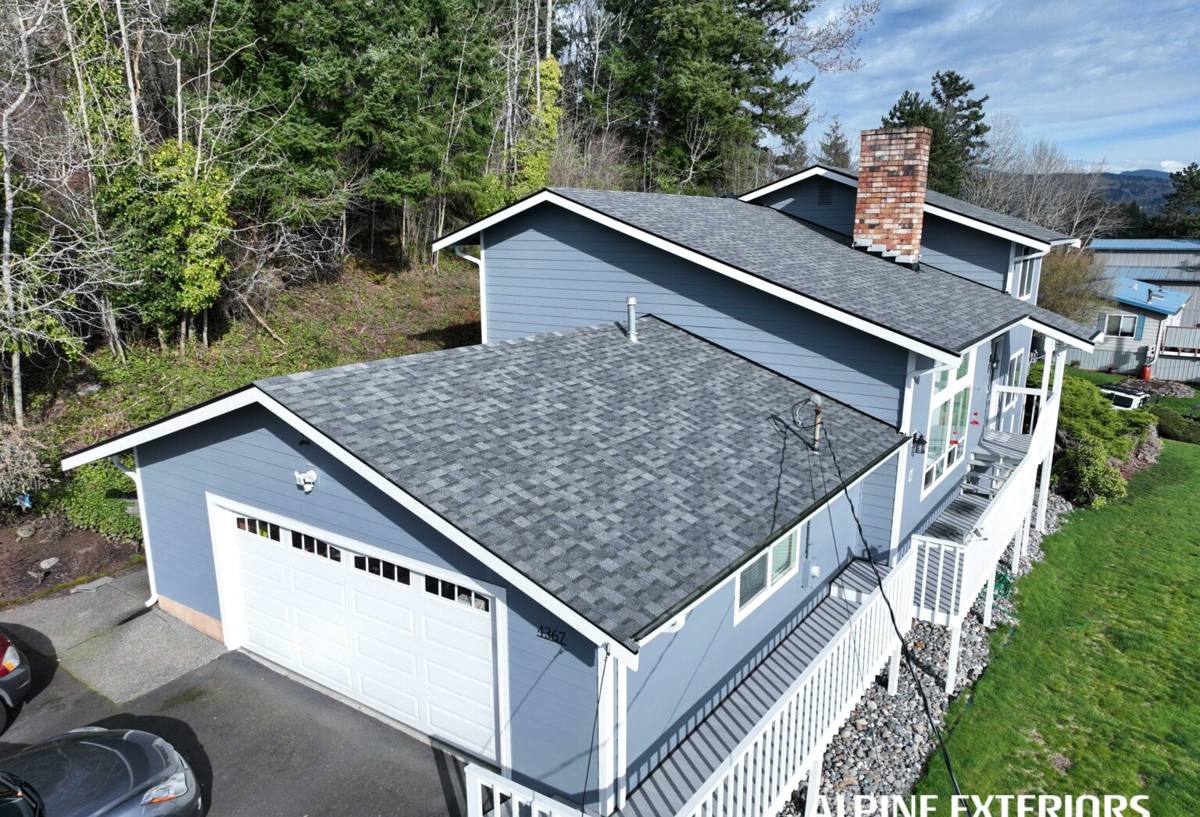
Why La Conner's Climate Is Tougher on a Roof Than It Looks
Salt Air and Metal Components
Every asphalt shingle roof depends on more than just the shingles themselves — drip edge, step flashing, valley metal, and nail fasteners all have to hold up over the life of the roof. In a salt-air environment, standard fasteners and lower-grade flashing corrode faster than they would even a few miles inland. Once a fastener starts to rust, it loses grip, and a loose fastener under a shingle is one of the more common causes of early wind or water damage.
Driving Rain and Wind-Driven Moisture
Storms coming off the water in this part of Washington often bring rain sideways rather than straight down. That changes how a roof needs to be detailed at every edge, valley, and penetration. A shingle roof that would perform fine in a calm, straight-down rain climate can still leak in La Conner if the underlayment, flashing laps, and starter courses weren't built with wind-driven moisture in mind.
Moss and Algae Season
Cool, shaded, damp conditions for much of the year make this region one of the more moss-prone climates in the country. Moss doesn't just look bad — its root structure works into the granule surface of a shingle and lifts tabs over time, and a moss mat holds moisture against the roof deck far longer than bare shingles would. Left unaddressed for a few seasons, moss growth measurably shortens the useful life of an otherwise sound roof.
What a Correct Asphalt Shingle Roof Requires Here
Given all of that, we build every La Conner asphalt shingle roof around a few non-negotiables:
- Corrosion-resistant fasteners and flashing metal rated for coastal exposure, not standard-grade hardware
- Ice-and-water shield or self-adhering membrane at eaves, valleys, and penetrations — the areas most exposed to wind-driven rain and standing moisture
- Full synthetic underlayment across the whole deck, not just the vulnerable spots, as a second line of defense
- Algae-resistant shingle granules on every job where moss and algae are a realistic long-term concern
- Proper ventilation at the ridge and soffit so moisture from inside the attic doesn't add to what's already coming from outside
- Attention to fastener placement and nailing pattern, since under- or over-driven nails are a bigger liability in a wet climate than a dry one
Our Installation Process
We run the same disciplined process on every asphalt shingle roof, adjusted for the specific house and its exposure:
- Inspection and scope. We walk the roof and the attic, not just the roof. Deck condition, existing ventilation, signs of past moisture intrusion, and moss buildup all factor into the plan before we quote anything.
- Tear-off and deck check. Old roofing comes off down to the deck. Any soft, delaminated, or water-damaged sheathing gets replaced — this is not an optional add-on, it's the difference between a roof that lasts and one that fails early from underneath.
- Underlayment and flashing. Self-adhering membrane goes in at eaves, valleys, and penetrations first, followed by synthetic underlayment across the full deck. New flashing goes in at every wall intersection, chimney, and vent — we don't reuse old flashing.
- Shingle installation. Shingles are installed to manufacturer specification for nailing pattern and exposure, with extra attention paid to starter strips and hip/ridge caps, which are common failure points in wind events.
- Ventilation check. Ridge and soffit ventilation are verified or corrected so the attic can actually breathe — critical in a climate where trapped moisture is already working against the roof from outside.
- Final walkthrough. We review the finished roof with the homeowner, including care and maintenance specific to this climate.
Choosing the Right Shingle for This Climate
Not every asphalt shingle product is built the same way, and the differences matter more here than in a mild, dry climate. This is a general comparison of the shingle categories most relevant to a La Conner home:
| Shingle Type | Moisture/Wind Behavior | Moss & Algae Resistance | Best Fit |
|---|---|---|---|
| Standard 3-tab | Adequate in calm conditions; lower wind rating | No special resistance | Budget-conscious jobs on well-ventilated, less shaded roofs |
| Architectural / laminate | Higher wind rating, better wind-driven rain performance due to thicker profile | Often available with algae-resistant granules | Most La Conner homes — our default recommendation |
| Algae-resistant (AR) laminate | Same strong wind/rain performance as standard laminate | Copper- or zinc-infused granules resist algae and slow moss colonization | Shaded lots, north-facing slopes, homes with a history of moss |
| High-wind / impact-rated | Reinforced for higher wind uplift and impact resistance | Varies by product; often paired with AR granules | Exposed sites near open water or with a history of storm damage |
For most homes in this area, we steer people toward algae-resistant architectural laminate shingles. They cost a bit more than 3-tab up front, but the combination of better wind performance and slower moss colonization tends to pay for itself over the life of the roof — fewer moss treatments, fewer early granule-loss issues, and a longer realistic service life before replacement.
Why We're Selective About Certain Products
Some lower-tier shingle lines skip algae-resistant granules entirely or use thinner laminate layers that don't hold up as well to repeated wetting and drying cycles. That's not a defect claim against any specific manufacturer — it's simply a maintenance and moisture-behavior trade-off, and in a climate like this one, it's a trade-off that shows up faster than it would somewhere drier. We'd rather spec a product correctly the first time than have a homeowner dealing with moss remediation every year or two.
Signs Your Roof Needs Attention
Homeowners in La Conner and the surrounding area should watch for:
- Dark streaking or green-black patches on north-facing or shaded slopes — early algae or moss growth
- Visible moss mats, especially along the ridge, valleys, or lower eaves where moisture sits longest
- Granules collecting in gutters or downspouts, a sign shingles are wearing past their protective layer
- Curling, cupping, or lifted shingle edges, often worse on the side of the house facing prevailing storms
- Rust staining around flashing, vents, or fasteners
- Soft spots, sagging, or visible daylight in the attic near the roof deck
- Water stains on interior ceilings, which usually mean a problem has already been active for a while
Maintenance in a Marine, Moss-Heavy Climate
An asphalt shingle roof in this part of Skagit County needs a bit more routine attention than the same roof would need in a drier region. Gutters should be checked more than once a year, since debris and needle litter combined with constant moisture speeds up moss establishment. Moss should be treated before it forms a thick mat, not after — light growth can often be managed gently, while an established mat usually means some granule loss has already happened underneath it. Pressure washing shingles is not something we recommend; it strips granules and shortens the roof's life faster than the moss itself would. Soft washing or manufacturer-approved treatments are the safer route. Ventilation should also be checked periodically, since a well-vented attic dries out faster after wet weather and gives moss less of a head start.
What Affects Cost on a La Conner Roofing Job
Every roof is priced on its own specifics, but these are the factors that most commonly move the number up or down:
| Factor | Why It Matters Here |
|---|---|
| Roof size and pitch | Steeper roofs take longer to work safely and use more material per square |
| Deck condition | Water-damaged sheathing found during tear-off adds material and labor to replace |
| Shingle grade selected | Algae-resistant and high-wind laminate products cost more per square than standard 3-tab |
| Flashing and detail work | Homes with multiple valleys, chimneys, or wall intersections need more flashing labor |
| Access and site conditions | Steep lots, limited driveway access, or tree cover near the roof affect setup time and disposal |
| Existing moss or moisture damage | Remediation and deck repair add cost beyond a straightforward tear-off and reroof |
As a very general reference point, many straightforward asphalt shingle reroofs in this part of Skagit County land somewhere in the range of $9,000 to $18,000, with steeper, larger, or more storm-exposed roofs running higher. The only way to get a number that actually applies to your house is a walk-through — we don't quote off square footage alone.
Why Hire a Crew That Already Works This Area
A roofing crew that spends most of its time inland doesn't necessarily think about salt-air corrosion, wind-driven rain at exposed eaves, or moss pressure the same way a crew that works this coastline every week does. Those aren't dramatic differences on paper, but they show up in which fasteners get used, how much underlayment goes down before the shingles, and whether algae-resistant granules get specified as the default rather than an upsell. We work in and around Anacortes and La Conner regularly, which means we're not guessing at how a roof here holds up over five or ten years — we're the ones who get the call back if it doesn't, so we build it right the first time.
Getting Started
If your La Conner home needs a new asphalt shingle roof, or you're not sure whether what you have needs repair, moss treatment, or full replacement, we're glad to take a look and give you a straight answer. There's no cost and no pressure to a walk-through and estimate — fill out the form below and we'll set up a time to come out.