 Anacortes Siding
 What March Point's Climate Actually Does to Siding
March Point sits out on the water, exposed to Fidalgo Bay and the open air moving off the Salish Sea. That location is part of what makes it a desirable place to live, and it's also exactly why siding here fails faster than it does a few miles inland. Salt-laden air, wind-driven rain, and long stretches of shade that never fully dry out are a specific combination of stresses, and a siding job that ignores any one of them will show problems within a few years instead of holding up for decades.
Salt Air and Metal Fasteners
Homes closer to the water take on airborne salt that settles on siding, trim, and especially fasteners. Standard fasteners and unprotected metal flashing corrode faster in this environment, which is why fastener choice and flashing material matter more here than they would on a home set back from the shoreline. It's a detail that's invisible once the wall is closed up, but it's the difference between trim that holds paint for fifteen years and trim that starts bleeding rust streaks in three.
Wind-Driven Rain and Wall Assemblies
Anacortes gets plenty of rain that falls straight down and does little damage. The rain that causes problems is the kind that comes sideways off the water during a wind event, driving moisture up under laps and around trim edges that were never designed to shed water from that angle. A wall assembly built for this exposure needs a real drainage plane behind the siding, not just a housewrap stapled up and covered over.
Moss, Algae, and Slow-Drying Exposures
North- and west-facing walls shaded by trees or neighboring structures can stay damp for days after a storm passes. That's the setup moss and algae need to take hold, and once organic growth is established on a wall it holds moisture against the surface even longer, accelerating whatever decay process is already underway underneath. Siding material and finish both play a role in how well a wall resists this cycle.
What a Correct Installation Requires Here
None of the climate factors above are exotic — they're just persistent. A correct installation deals with each of them as a matter of course, not as an upgrade.
Drainage Plane and Weather-Resistive Barrier
Every wall needs a continuous weather-resistive barrier with a true drainage gap behind the siding, so any water that gets past the cladding has somewhere to go besides the sheathing. On a home exposed to wind-driven rain off the water, this layer is doing real work, not just satisfying a code checkbox.
Flashing Every Penetration
Windows, doors, hose bibs, light fixtures, vents — every penetration through the siding is a potential entry point, and each one needs to be flashed so water is directed back out and down, never trapped behind the cladding. This is the part of a siding job that's easiest to rush and most expensive to fix later, because by the time a flashing failure shows up as a stain or soft spot, the damage is already inside the wall.
Fastener Schedule and Clearances
Fiber cement siding has a manufacturer-specified fastener pattern, nailing zone, and minimum clearance from grade, decks, and roof lines. Skipping or shortcutting these specs is one of the most common ways an otherwise good product ends up with problems that get blamed on the material instead of the installation.
Why This Crew Installs Only James Hardie Fiber Cement
We get asked fairly often why we don't offer vinyl, LP SmartSide, or cedar as options. Each of those products has real strengths — vinyl is inexpensive and low-maintenance in mild climates, engineered wood siding installs quickly, and cedar has a look plenty of homeowners want. But we've made installing only James Hardie fiber cement our standard, and in a marine climate like this one, the reasons hold up.
Vinyl siding expands and contracts significantly with temperature swings, and in wind-driven rain it relies on lap joints and J-channels that can let water track behind the panel if the installation isn't precise. Engineered wood products like LP SmartSide perform well when every cut edge is sealed and maintained, but that maintenance discipline has to continue for the life of the siding, and a missed edge in a wet climate can lead to swelling. Cedar is a genuinely attractive natural product, but it needs an ongoing finish schedule to hold up against constant moisture and won't resist rot or insects the way a fiber cement product does.
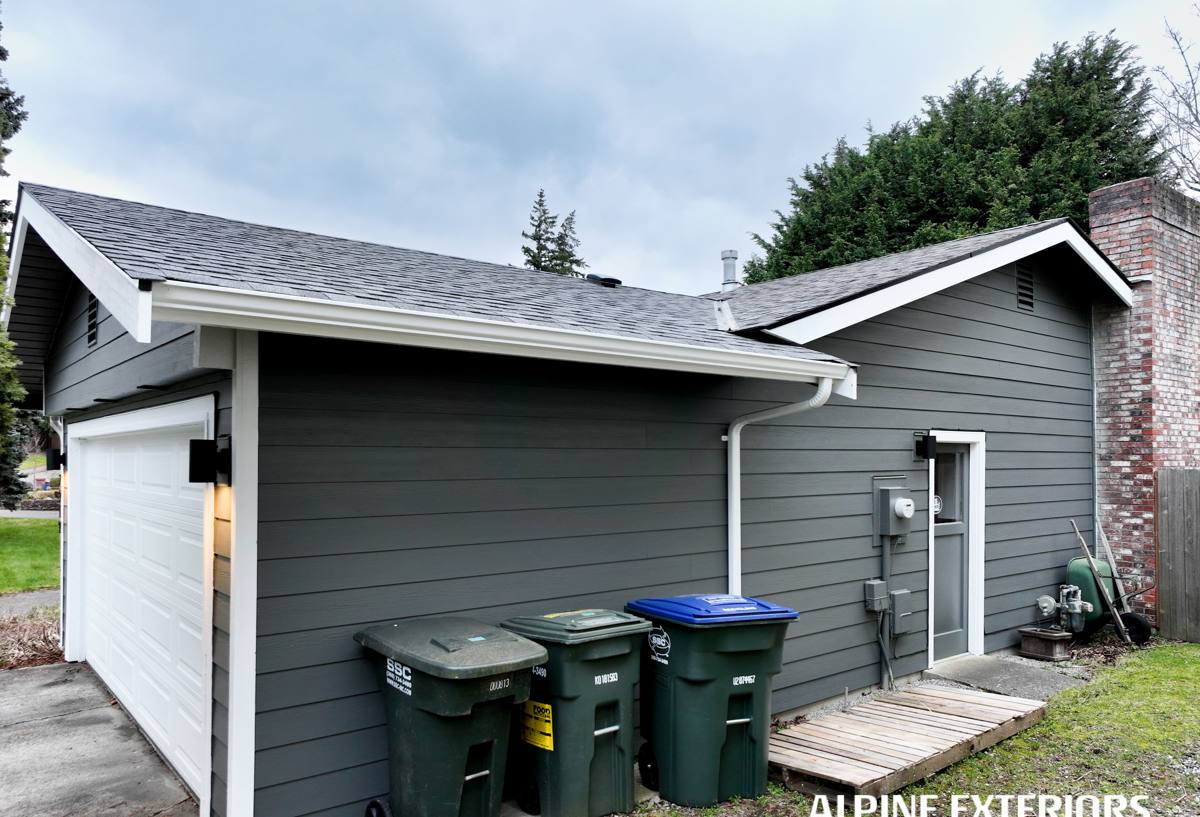
James Hardie's fiber cement is non-combustible, doesn't swell or rot when it gets wet, and comes with a factory-applied ColorPlus finish that's baked on rather than field-painted, which matters in an environment with this much salt spray and moisture cycling. It also carries a strong transferable warranty when installed to Hardie's specifications — which is precisely why installation quality is the part we control the most closely.
HZ5: Built for This Side of the State
James Hardie engineers its siding by climate zone rather than selling one product everywhere. The HZ5 product line is formulated for the wetter, more freeze-thaw-active climates found in Washington and the broader Pacific Northwest, as opposed to the HZ10 line built for hot, humid Southern exposures. That distinction isn't marketing — it affects how the product handles moisture cycling and how it holds paint and finish over time in a climate that goes from soaking wet to freezing and back multiple times a winter. Installing the right zone product is as much a part of "doing the job right" here as the flashing and fastening details are.
Our Process for a March Point Project
- On-site assessment — we look at wall orientation, existing moisture damage, sun and shade exposure, and how exposed the home is to wind off the water.
- Tear-off and sheathing check — old siding comes off and the sheathing underneath gets inspected before anything new goes up, so we're not covering up rot.
- Weather-resistive barrier and flashing — a continuous drainage plane and properly lapped flashing at every penetration and transition.
- James Hardie installation — HZ5 panels or lap siding installed to manufacturer fastening and clearance specifications.
- Trim, caulking, and finish detail — compatible trim and sealants chosen for long-term performance in salt air, not just appearance on install day.
- Final walkthrough and cleanup — a full walk of the exterior with the homeowner before we consider the job finished.
Cost Factors to Expect
Every home is different, and we won't quote a number without seeing the house, but these are the factors that actually move the price on a March Point siding job:
| Factor | Why It Matters Here | Effect on Cost |
|---|---|---|
| Home size and number of stories | More wall area and taller scaffolding/lift needs | Higher |
| Condition of existing sheathing | Water-exposed homes near the shoreline sometimes need repair before re-siding | Variable — found once old siding is off |
| Trim and architectural detail | More corners, penetrations, and trim lines mean more flashing and labor | Higher |
| Site access | Tight lots or limited equipment access slow the work | Moderate |
| Siding profile and ColorPlus selection | Panel vs. lap profile and finish choice affect material cost | Moderate |
Caring for New Siding After Installation
A correctly installed James Hardie exterior is low-maintenance, but "low-maintenance" isn't "no-maintenance," especially this close to the water. A little attention goes a long way:
- Rinse salt spray and general grime off the siding once or twice a year with a garden hose and soft brush.
- Keep gutters and downspouts clear so water isn't overflowing down the wall face.
- Trim back vegetation and tree limbs that keep a wall section shaded and slow to dry.
- Check caulking at trim joints and penetrations periodically and have gaps resealed before they open up.
- Have the exterior looked at after any major windstorm, since that's when flashing and trim take the most abuse.
Why Local Experience on This Job Matters
Siding installation isn't a one-size-fits-all process, and a crew that already works in and around Anacortes and Skagit County has a working sense of how wind, rain, and salt exposure actually behave on homes in this specific area — which walls take the worst weather, what kind of moisture damage shows up first, and how to sequence a job around the weather windows this part of Washington actually gives you. That's not something a crew coming in from outside the region picks up on their first job here. It's built from doing the work in this climate, on homes like the ones in March Point, over and over.
If you're weighing a siding replacement for a March Point home, we're glad to come take a look and talk through what your walls actually need — no pressure, no obligation. Use the form below to request a free estimate.