 Anacortes Siding
 Decks on the Cap Sante Hill Take a Different Kind of Beating
If you live on or near Cap Sante — up on the hill above the marina, or on one of the streets that catch the open view toward Fidalgo Bay and the San Juans — you already know your deck doesn't age like a deck in a subdivision fifteen miles inland. The elevation that gives you the view also gives you more direct wind, more salt-laden air off the water, and more sideways rain that gets up under railings and ledger boards instead of just falling straight down. Add Skagit County's long gray stretch from October through April, when moss and algae get a real foothold on any shaded or north-facing surface, and you've got a structure that's working harder than most homeowners realize.
None of that means a deck up here is doomed to fail early. It means the replacement has to be built with those specific conditions in mind — not built to a generic spec sheet and hoped for the best. That's the whole point of this page: what actually holds up on a Cap Sante deck, and what a correct replacement looks like from the ground up.
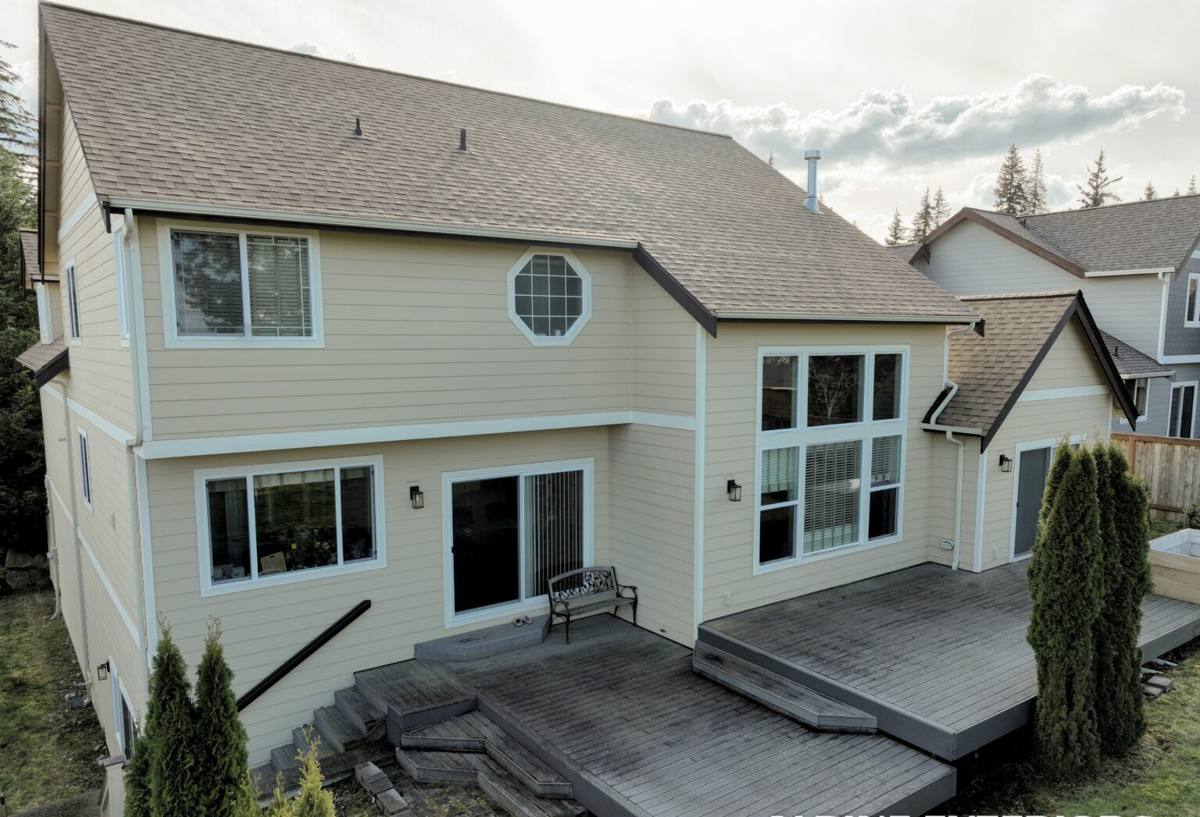
How to Tell It's Replacement Time, Not Repair Time
A lot of decks get patched for years past the point where patching still makes sense. The difference matters because a repair on a compromised substructure just moves the problem, it doesn't fix it.
Signs pointing to full replacement
- Soft, spongy, or visibly sagging spots when you walk the deck, especially near the house
- Ledger board attachment showing gaps, rust streaks, or water staining on the siding above it
- Joists or posts with soft wood when probed with a screwdriver — a sign of ongoing rot, not surface weathering
- Persistent moss or black-green algae film that comes back within weeks of cleaning
- Railings that flex or wobble under normal push, which usually means post rot, not just a loose bolt
- Fasteners that have corroded and bled rust stains into the decking
Signs a repair is still reasonable
- A handful of cupped or split boards on an otherwise sound frame
- Surface graying or moss on a structure that's still solid underfoot
- A single damaged post or rail section with no rot spreading into the connected framing
We'll tell you honestly which category your deck is in during the estimate — there's no reason to sell a full tear-out when a repair will genuinely hold, and no reason to patch something that's going to need redoing again in two years.
What Actually Goes Into a Correct Deck Replacement
A deck replacement is really three separate systems that all have to work together: the substructure, the surface, and the connection points. In a marine climate like Anacortes, the connection points are usually where cheap work fails first.
The substructure
Posts, beams, and joists need to be sized and spaced for the actual load and span — not just matched to what was there before, since older decks were sometimes under-built by today's standard. Post bases should sit on proper concrete footings set below frost depth, with a positive drainage path so water isn't sitting against the post base. Joist framing gets treated lumber rated for ground contact where it's within a few inches of grade or moisture, not just "treated" in name.
The ledger connection
This is the single most important — and most commonly botched — part of any deck attached to a house. It needs proper flashing that sheds water away from the house band board, correct structural fasteners (not just deck screws) rated for the load, and in most cases a code-required ledger connection using approved hardware rather than relying on the ledger bolts alone. Done wrong, this is exactly where you get the rot and water staining described above, usually invisible until the siding or band board is already compromised.
Hardware and fasteners
Salt air corrodes standard galvanized hardware faster than it will forty miles inland. We spec stainless steel or high-grade coated fasteners and structural connectors for anything exposed to the weather, and hot-dip galvanized or stainless for hidden structural hardware. This costs more up front than mill-standard hardware. It's also the difference between fasteners bleeding rust through your decking in three years and hardware that's still doing its job in twenty.
The decking surface
Board selection, gapping, and fastening pattern all affect how the deck sheds water and resists moss. Proper board spacing lets water drain instead of pooling in the joints, and end-grain sealing on cut boards keeps moisture from wicking in from the cut edges — a detail that's easy to skip and shows up as premature swelling within a couple of seasons.
Decking Material: What Actually Makes Sense in This Climate
There's no single "best" decking material — there's a best fit for your budget, your maintenance appetite, and how exposed your deck is to wind-driven rain and shade-driven moss. Here's how the common options actually compare for a Cap Sante property.
| Material | Moisture & Moss Behavior | Maintenance | Typical Lifespan | Relative Cost |
|---|---|---|---|---|
| Pressure-treated wood | Absorbs water, prone to moss/algae in shaded spots without regular cleaning | Annual cleaning, periodic staining/sealing | 10–15 years with upkeep | Lowest |
| Cedar | Naturally rot-resistant but still needs sealing to hold up to driving rain and salt air | Sealing every 1–2 years | 15–20 years with upkeep | Moderate |
| Capped composite | Shell resists moisture absorption; moss can still grow on the surface film without periodic cleaning | Occasional washing, no sealing/staining | 25–30 years | Higher |
| PVC decking | No wood fiber to absorb moisture; most resistant to moss and rot in shaded, damp spots | Occasional washing | 25–30+ years | Highest |
Our general standard for shaded, wind-exposed, or view-side decks up on Cap Sante is capped composite or PVC, simply because the maintenance burden of a wood deck in that kind of exposure is real — moss and algae come back fast in a shaded corner that stays damp most of the winter. That's a maintenance and moisture-behavior tradeoff, not a knock on wood as a material; a sunny, well-drained deck with an owner willing to seal it on schedule can do fine in cedar or treated lumber for years. We'll talk through what your specific site and sun exposure actually calls for rather than pushing one product line by default.
Our Process, Start to Finish
- On-site estimate. We walk the existing deck, check the substructure where we can access it, and talk through what you actually want out of the space.
- Written scope and price. You get a clear breakdown of what's being torn out, what's being rebuilt, material options, and a firm number — not a vague range.
- Permit handling. For anything requiring a permit through the City of Anacortes, we pull it and coordinate inspections so you're not chasing paperwork.
- Tear-out and disposal. Old decking, framing, and hardware removed and hauled off.
- Substructure rebuild. Posts, footings, beams, joists, and ledger connection built to current code, not just matched to what was there.
- Decking and railing install. Surface material and railing system installed per manufacturer spec, with attention to drainage and fastening pattern.
- Final walkthrough. We go over the finished deck with you before calling the job done.
Permits and Code — What to Expect
Most full deck replacements in Anacortes require a building permit, particularly when the ledger connection, footings, or framing are being rebuilt rather than just the surface boards. Requirements can also touch on railing height, guard spacing, and setback from property lines depending on your lot. We handle the permit application and inspection scheduling as part of the job — you shouldn't have to be the one figuring out what Skagit County or the city requires. If you're not sure whether your project needs a permit, that's a normal question to ask during the estimate, not something to guess at.
Keeping a New Deck Looking Right Through the Wet Season
A properly built deck still needs some seasonal attention in this climate — the goal of a good build is to make that attention minimal, not eliminate it entirely.
- Sweep debris off the deck regularly in fall so wet leaves don't sit on the surface
- Rinse off salt spray and grime a few times a year, more often if the deck faces open water or wind
- Check that gaps between boards stay clear so water keeps draining rather than pooling
- Inspect railing posts and stair stringers once a year for movement or soft spots
- Re-seal wood decking on the schedule your material calls for — don't wait for it to look gray
- Keep gutters and downspouts near the deck clear so runoff isn't dumping directly onto it
Why It Matters That We Already Work This Neighborhood
A deck built by a crew that's never dealt with the exposure up on Cap Sante will often use the same specs they'd use on a sheltered lot across town — standard galvanized hardware, standard board spacing, standard ledger flashing. On a hillside catching direct wind off the bay, those shortcuts show up faster than they would somewhere calmer. Knowing which corners of a property face the worst of the weather, which fastener grade actually holds up here, and how the local permit process works isn't something you get from a generic spec sheet — it comes from having built and repaired decks in this specific setting before. That's the difference between a deck that needs attention again in five years and one that's still solid in twenty.
If your deck is showing signs of wear, or you're just ready to replace an aging structure before it becomes a bigger problem, we're glad to come take a look. The estimate is free, there's no pressure to sign anything on the spot, and you'll get a straight answer about whether you need a full replacement or something less. Fill out the form below to get started.