 Anacortes Siding
 Siding Replacement in Burlington: What Local Homes Are Up Against
Burlington sits in the Skagit Valley, close enough to the water and the river delta that its homes deal with a specific combination of weather: salt-tinged marine air drifting in off Padilla Bay and the Sound, long stretches of driving rain from fall through spring, and a moss season that can run most of the year in shaded, north-facing spots. None of that is dramatic on its own. The problem is how it adds up on a house that sits through decades of it without the siding ever getting a real break to dry out.
Older siding in this area tends to fail in predictable ways: paint that won't hold past a few years no matter how often it's redone, soft or delaminating panels near the ground and under gutters, and moss or algae staining that keeps coming back on the shady sides of the house. If any of that sounds familiar, it's not bad luck — it's what happens when a siding material that was never built for the Pacific Northwest gets asked to perform like one that was.
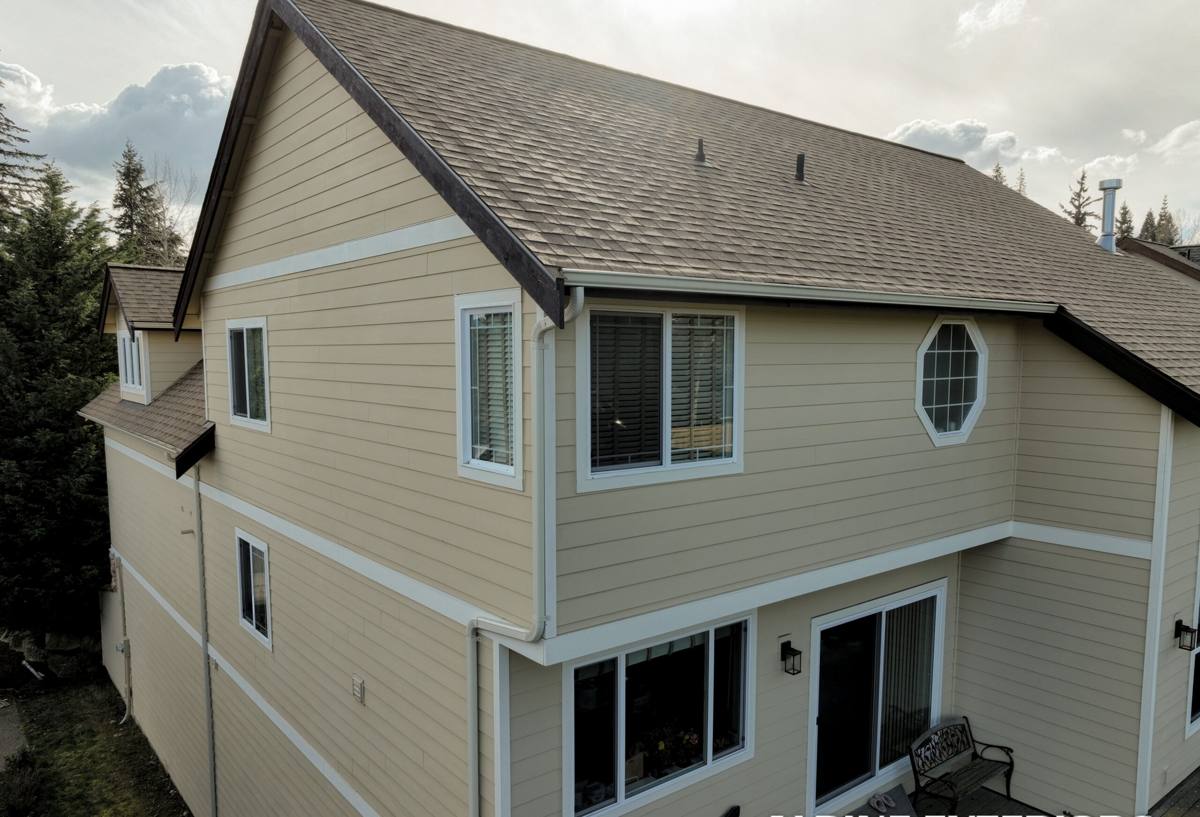
Why Siding Replacement Is a Different Job in Burlington Than It Is Elsewhere
Siding replacement isn't a one-size-fits-all service. A crew that mostly works drier inland climates will make different assumptions than one that works Skagit County year-round. Three things matter more here than in most parts of the country:
Moisture management behind the siding
Skagit County's rain isn't just frequent — it's often wind-driven, which pushes water sideways against walls instead of straight down. That means the water-resistive barrier, flashing details, and drainage plane behind the siding matter as much as the siding itself. Replacement is the one time all of that is fully exposed and correctable, and it's the step that gets rushed on cheaper jobs.
Moss and algae exposure
Shaded elevations, mature tree cover, and the valley's damp air give moss and algae plenty of opportunity to take hold on siding that holds surface moisture. The material and finish you choose has a direct effect on how much of that growth you'll be scrubbing or pressure-washing off every year.
Salt-influenced air
Burlington isn't beachfront, but it's close enough to tidal water that fasteners, trim metal, and paint systems all see some benefit from being rated for a marine-influenced environment rather than a purely inland one.
What a Correct Siding Replacement Actually Involves
A siding replacement that's done right is really several trades working in sequence, not just new panels going up over the old wall. Skipping steps is how a house ends up with the same problems again in ten years, just hidden behind new-looking siding.
- Tear-off and inspection. Old siding comes off and the sheathing underneath gets inspected for rot, soft spots, or prior water damage — especially around windows, doors, and anywhere trim meets a horizontal surface.
- Sheathing repair. Any compromised sheathing is cut out and replaced before anything else happens. Covering damaged sheathing with new siding just delays the problem.
- Water-resistive barrier. A new weather-resistant barrier goes on correctly lapped, shingle-style, so water sheds down and out rather than finding a way in.
- Flashing. Windows, doors, and any roof-to-wall or deck-to-wall transitions get properly flashed. This is the single most common place inspectors find shortcuts on older installs.
- Furring or rainscreen gap where appropriate. A small air gap behind the siding lets moisture that does get in dry out instead of sitting against the wall.
- Siding installation to manufacturer spec. Correct fastener type and spacing, proper clearances at grade and roofline, and factory-specified gaps at butt joints.
- Trim, caulking, and paint touch-up. Finished with manufacturer-approved sealants at the joints that need them — not everywhere, since over-caulking can trap moisture rather than keep it out.
Why We Only Install James Hardie Fiber Cement
We made a decision a while back to stop installing several products that are common elsewhere — vinyl, LP SmartSide, primed spruce, cedar, and other fiber cement brands like Cemplank or Allura — and install James Hardie exclusively. That's not a marketing position; it's a maintenance and durability call based on what we see when we replace failed siding in this climate.
What that decision comes down to
- Non-combustible material. Fiber cement doesn't feed a fire the way wood-based products can, which matters for insurance conversations as much as safety.
- Built for wet, coastal-influenced climates. Hardie's HZ5 product line is engineered for regions like ours with sustained moisture exposure, rather than a general-purpose product used everywhere in the country.
- A factory finish that actually holds up. ColorPlus finish is baked on in a controlled factory environment, not brushed or sprayed on site, and it's formulated to resist the fading and cracking that field-applied paint struggles with under constant rain and UV cycling.
- Dimensional stability. Fiber cement doesn't swell, warp, or rot the way wood-based composite siding can when it stays damp for extended periods — a real factor in a place where "dry season" is relative.
- A warranty backed by decades of field performance in exactly this kind of climate, transferable if the home sells.
We're not going to tell you other products are worthless — vinyl is inexpensive and easy to source, wood has a look some homeowners want, and other fiber cement brands are, on paper, similar to Hardie. But once you factor in how each one actually behaves after ten or fifteen years of Skagit County weather, the maintenance burden and replacement cycle stop looking like a bargain. Hardie is what we're willing to warranty our labor against, which is why it's the only product we put on a wall.
Comparing Siding Options for a Burlington Home
| Factor | Vinyl | Wood / LP-Style Composite | James Hardie Fiber Cement |
|---|---|---|---|
| Moisture resistance | Good on the face, but seams and fasteners can let water behind it | Vulnerable if the factory seal is compromised or maintenance lapses | Engineered specifically for high-moisture climates (HZ5) |
| Moss/algae resistance | Surface growth still common in shaded, damp spots | Similar surface growth risk, plus underlying rot risk if it stays wet | Factory finish resists staining better; still needs occasional cleaning |
| Fire resistance | Can soften or melt under high heat | Combustible | Non-combustible |
| Finish longevity | Color molded in but can chalk and fade | Field-applied paint typically needs attention within a few years | ColorPlus factory finish, longer repaint intervals |
| Typical lifespan when installed correctly | 20-30 years | Varies widely with maintenance | 30-50+ years |
Signs a Burlington Home Needs Siding Replacement Now
- Paint that won't hold for more than a couple of years between coats
- Soft, spongy, or visibly warped panels, especially near the bottom of walls
- Persistent moss or algae staining that returns quickly after cleaning
- Visible gaps, cracking, or separation at seams and corners
- Rising energy bills that point to a wall assembly no longer doing its job
- Water stains or musty smells on interior walls that share an exterior wall with visible siding wear
Our Process for a Burlington Siding Replacement
Every project starts with an on-site inspection, not a phone estimate — you can't accurately price tear-off or spot hidden sheathing damage without walking the house. From there we walk you through what we find, what it will take to fix it properly, and what the finished product will look like using James Hardie's color and board options. Once the scope is set, we handle the tear-off, any sheathing repair, correct weather barrier and flashing work, and the final install and trim work in sequence — with the underlying work inspected before anything gets covered up.
We also don't treat every Burlington property the same. A home a block off the water gets different fastener and flashing attention than one further inland, and a heavily shaded lot with a moss problem gets a different color and finish conversation than one in full sun. Local, ongoing work in Skagit County is what lets us make those calls without guessing.
Why Hiring a Crew That Already Works Burlington Matters
Siding installation instructions look the same on paper everywhere in the country, but the judgment calls — how tight to run clearances at grade, where a rainscreen gap earns its keep, which elevations need the most attention to moss and staining — come from having actually worked houses in this specific climate. A crew that installs mostly in drier regions and treats a Skagit County job the same way is more likely to skip details that don't matter much elsewhere but matter a great deal here.
There's also a practical side: a local crew can respond quickly if something needs a follow-up look after a hard winter storm, and is already familiar with how local building departments handle permitting and inspection for exterior work in the area.
What to Ask Before Hiring Anyone for Siding Replacement
- Will you inspect and repair sheathing before installing new siding, and is that itemized separately?
- What water-resistive barrier and flashing details do you use, and can you explain why?
- Are you a certified installer for the siding brand you're proposing?
- What's covered under labor warranty versus manufacturer warranty, and for how long?
- Can you show examples of siding replacement work you've done in this specific climate?
If your Burlington home's siding is holding moisture, losing paint faster than it should, or just due for an honest look, we're glad to walk the property with you and give you a straight assessment. Fill out the form below for a free, no-pressure estimate.